Sisilia Frederika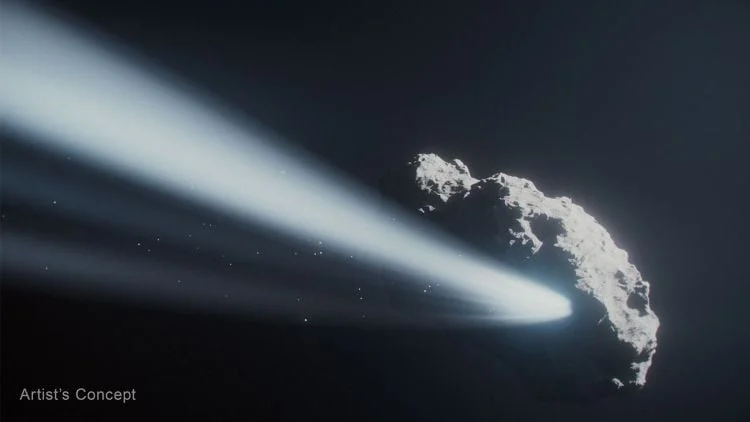
In a landmark study that challenges long-held assumptions regarding the rotational stability of celestial bodies, a lone researcher from the University of California, Los Angeles (UCLA), has documented the first-ever instance of a comet reversing its spin direction. The discovery, centered on the short-period comet 41P/Tuttle-Giacobini-Kresák (hereafter referred to as 41P), was made possible through an exhaustive analysis of data captured by NASA’s Hubble Space Telescope during the comet’s 2017 approach to the Sun. This unprecedented finding, published in the March 2026 issue of The Astronomical Journal, suggests that the volatile nature of cometary surfaces can exert enough physical force to fundamentally alter, halt, and reverse the rotation of a kilometric-scale object in a remarkably short period.
Comets have long been a subject of fascination for both the public and the scientific community. To the casual observer, they are "dirty snowballs" that produce spectacular tails of gas and dust as they venture into the inner solar system. For planetary scientists, however, these objects are invaluable time capsules, preserving chemical and physical signatures from the formation of the solar system approximately 4.6 billion years ago. The discovery of a reverse-spinning comet adds a complex new layer to our understanding of how these ancient remnants evolve and eventually disintegrate under the influence of solar radiation.
The Discovery of Rotational Reversal
The study’s sole author, Dr. David Jewitt, a Distinguished Professor in the Department of Earth, Planetary, and Space Sciences at UCLA, identified the phenomenon while examining high-resolution imagery and photometric data from the Hubble Space Telescope. The data focused on 41P during its perihelion—its closest approach to the Sun—in 2017. During this window, the comet exhibited a dramatic shift in its rotational dynamics that had never been documented in any other cometary body.
According to the research, 41P did not merely slow down; it underwent a complete cycle of deceleration, a momentary halt, and a subsequent reversal of its spin. This "braking" effect is attributed to the uneven distribution of outgassing jets on the comet’s nucleus. As a comet approaches the Sun, its frozen volatiles—primarily water ice, carbon monoxide, and carbon dioxide—sublimate, transitioning directly from solid to gas. This gas escapes through vents or fissures in the crust, creating powerful jets that act as natural thrusters.
Dr. Jewitt likened the process to a playground merry-go-round. "Jets of gas streaming off the surface can act like small thrusters," Jewitt explained in a statement released via NASA. "If those jets are unevenly distributed, they can dramatically change how a comet, especially a small one, rotates. It’s like pushing a merry-go-round. If it’s turning in one direction, and then you push against that, you can slow it and reverse it."
Historical Context and Chronology of 41P
Comet 41P/Tuttle-Giacobini-Kresák has a storied history of discovery and re-discovery, reflecting the challenges of tracking small, periodically active objects. It was first sighted by Horace Parnell Tuttle in 1858, but its orbit was not well-established, and it was lost for decades. It was later rediscovered independently by Michel Giacobini in 1907 and Lubor Kresák in 1951. This triple discovery is why the comet bears its hyphenated name, a rarity in astronomical nomenclature.
A member of the "Jupiter-family" comets, 41P originates from the Kuiper Belt, a vast region of icy bodies beyond the orbit of Neptune. It follows a short-period orbit, returning to the inner solar system every 5.4 years. While it has been observed for over a century, the 2017 perihelion offered a unique opportunity for high-fidelity observation due to its proximity to Earth and the advanced capabilities of the Hubble Space Telescope.
Historically, 41P was known for its "outbursts"—sudden, massive increases in brightness caused by the rapid release of dust and gas. However, the 2017 observations revealed a surprising contrast to previous cycles. The comet’s surface was found to be significantly less active in 2017 than it was during its 2001 perihelion. This rapid change in activity levels over a mere 25-year period is an anomaly in cometary science, as surface evolution is typically expected to occur over centuries or millennia.
Supporting Data and Physical Analysis
The nucleus of 41P is relatively small, with Hubble estimates placing its diameter at approximately 1 kilometer (0.6 miles). This small size is a critical factor in the comet’s susceptibility to rotational changes. Because the nucleus has low mass and, consequently, low gravitational binding energy and rotational inertia, the torque produced by outgassing jets can have a disproportionately large impact on its spin rate.
The study utilized computer modeling to simulate the forces required to reverse the spin of a 1-kilometer body. The findings suggest two primary possibilities for 41P’s unique behavior:
- Extreme Outgassing: The comet may be emitting an unusually high volume of gas relative to its size, creating the necessary thrust to overcome its existing angular momentum.
- Fragmentation History: 41P might be a secondary fragment of a much larger parent comet that broke apart in the distant past. As a "shard," its internal structure might be more fragile and its shape more irregular, leading to the unbalanced jet distribution observed today.
Furthermore, the data indicates that 41P is currently in a state of extreme rotational instability. If the current rate of spin acceleration continues, the centrifugal forces acting on the nucleus could eventually exceed its internal strength. This would lead to "rotational fission," a process where the comet literally rips itself apart, scattering its remnants into space.
Implications for Cometary Lifespans
The discovery of the reverse spin and the resulting structural instability has led to a grim forecast for the future of 41P. While the average lifetime of a short-period comet is estimated to be around 1,000 years once it enters the inner solar system, Dr. Jewitt’s study suggests that 41P’s remaining lifespan may be measured in decades rather than centuries.
The rapid evolution observed between 2001 and 2017 serves as a warning that comets can reach their "end-of-life" phase much faster than previously thought. As the nucleus spins and shifts, new layers of ice are exposed to solar radiation, leading to further outgassing and further rotational changes. This feedback loop accelerates the depletion of the comet’s volatile reserves and increases the likelihood of a catastrophic structural failure.
The scientific community views these findings as a rare opportunity to study the "death throes" of a comet. Understanding the mechanics of how 41P disintegrates will provide vital data for models of solar system evolution and the distribution of water and organic molecules—the building blocks of life—which comets are thought to have delivered to the early Earth.
Broader Astronomical Impact
The discovery of a reverse-spinning comet has implications that extend far beyond the study of 41P. It highlights the dynamic and often violent nature of the "small bodies" in our solar system. Currently, astronomers have cataloged between 4,000 and 5,000 comets traveling from the outer reaches of the solar system to the inner planetary region. However, this is a small fraction of the trillions of objects estimated to reside in the Kuiper Belt (30 to 50 AU from the Sun) and the even more distant Oort Cloud.
The Oort Cloud, which extends up to 100,000 AU—nearly halfway to the nearest star, Proxima Centauri—is the reservoir for long-period comets. These objects can take thousands or even millions of years to complete a single orbit. By studying the behavior of short-period comets like 41P, researchers can better predict the behavior of these long-period visitors when they eventually enter the inner solar system.
Moreover, the study underscores the continued importance of the Hubble Space Telescope. Despite the launch of newer observatories like the James Webb Space Telescope (JWST), Hubble’s ability to provide consistent, long-term monitoring in visible and ultraviolet light remains essential for tracking changes in celestial objects over decades.
Future Research and Observations
The findings regarding 41P/Tuttle-Giacobini-Kresák open a new chapter in planetary science, prompting researchers to re-examine archival data of other small comets for signs of rotational instability. If spin reversal is more common than previously realized, it could explain why some comets disappear unexpectedly or undergo sudden fragmentation without an obvious external cause.
In the coming years, ground-based observatories and future space missions will likely keep a close watch on 41P during its next few perihelion passes. Scientists are particularly interested in whether the comet will stabilize its new spin direction or if the "merry-go-round" effect will continue to shift its rotation erratically.
The study of 41P serves as a reminder that the solar system is not a static environment but a constantly changing laboratory of physics. As Dr. Jewitt’s research demonstrates, even a "lone researcher" utilizing the right data can uncover phenomena that shift our fundamental understanding of the cosmos. The mystery of 41P’s reverse spin is a testament to the unpredictable nature of space and the ongoing quest to decode the history of our celestial neighborhood. As long as these icy travelers continue their trek toward the Sun, they will continue to provide the data necessary to solve the puzzles of our origins.