Sisilia Frederika
The mechanisms governing the birth of stars represent one of the most fundamental inquiries in modern astrophysics, as stars serve as the primary engines of cosmic evolution. Beyond their role as luminous beacons, stars are the crucibles of nucleosynthesis, responsible for forging the heavy elements—carbon, oxygen, and iron—that comprise planets and the building blocks of life. On a macroscopic scale, the feedback from stellar winds and supernovae regulates the physical state of entire galaxies, while their predictable luminosities allow astronomers to use them as standard candles to measure the expansion of the universe. Consequently, understanding the precise dynamics of how gas collapses to form these celestial bodies is essential for a comprehensive model of the cosmos.
New research published in The Astrophysical Journal Letters has provided a significant breakthrough in this field by mapping the intricate gas flows within a stellar nursery known as Monoceros R2. Led by Jihye Hwang, an Assistant Professor at Kyushu University’s Institute for Advanced Study, the study titled "From Interfilamentary Gas to Filaments and Hubs: Gas Flows in the Monoceros R2 Hub–Filament System" challenges long-held assumptions about how matter is delivered to star-forming regions. By utilizing high-resolution radio observations, the research team has demonstrated that the formation of massive stars and star clusters is fueled not only by dense, visible filaments of gas but also by a previously under-analyzed reservoir of low-density "interfilamentary" gas.
The Architecture of Stellar Nurseries: Hubs and Filaments
To understand the significance of Hwang’s findings, one must first consider the structural hierarchy of molecular clouds. Modern astronomy views these clouds as complex networks of "Hub-Filament Systems" (HFS). In this framework, filaments are elongated, thread-like structures of dense molecular hydrogen that act as cosmic pipelines. These filaments intersect at dense junctions known as hubs. These hubs, characterized by high column densities and low aspect ratios, are the primary sites for the formation of high-mass stars and dense star clusters.
Traditionally, the scientific community has focused on the gas moving along these dense filaments. It was understood that gravity pulls gas along the length of these "pipelines" into the central hubs, where the pressure and density eventually trigger the collapse of protostellar cores. However, the regions surrounding these filaments—the interfilamentary spaces—were often regarded as relatively empty or static. The research by Hwang and her colleagues suggests that these "empty" spaces are, in fact, active participants in the star-formation process, contributing a substantial amount of mass to the growing stellar embryos.
The Monoceros R2 Laboratory
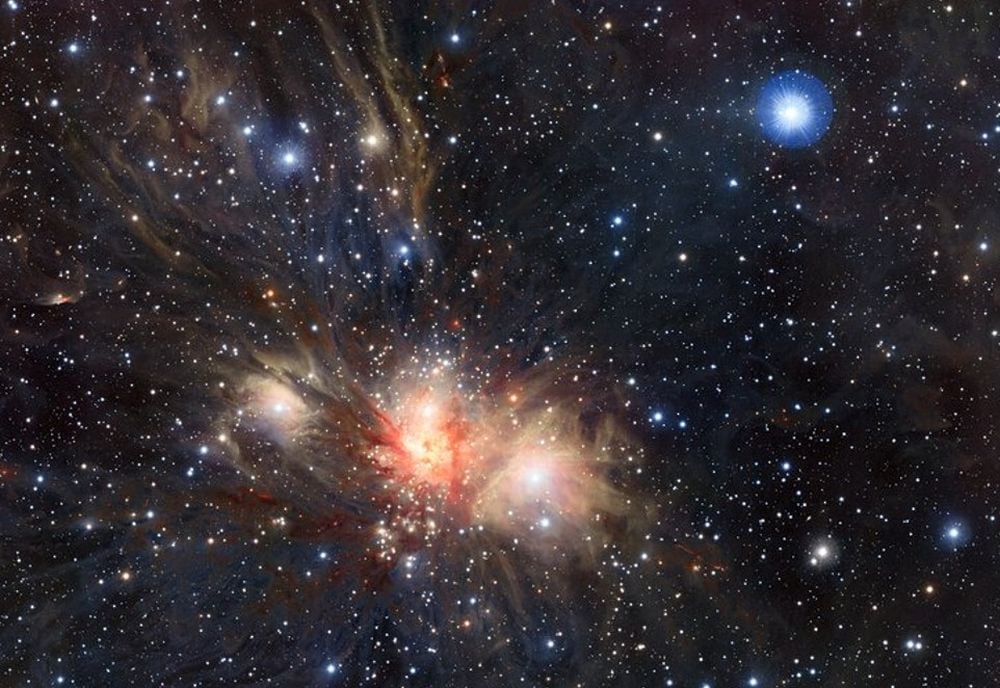
The focus of this study, Monoceros R2, is a giant molecular cloud located approximately 2,700 light-years (830 parsecs) from Earth. It is a well-known site of active star formation, particularly high-mass stars, making it an ideal laboratory for studying HFS dynamics. Previous observations by the European Southern Observatory’s (ESO) VISTA telescope provided a stunning infrared view of the region, revealing a vast, illuminated cloud of molecular hydrogen. While these infrared images show where the gas is, they do not show how it moves.
To track the movement of the gas, the researchers turned to the Nobeyama 45-meter radio telescope in Japan. Unlike optical telescopes, which see the light reflected or emitted by stars and dust, radio telescopes can detect the spectral signatures of specific molecules. By analyzing the Doppler shift of these signals—the slight change in frequency caused by the motion of the gas toward or away from the observer—the team was able to create a three-dimensional map of the gas kinematics in Monoceros R2.
Methodology: Tracking Carbon Monoxide Isotopes
The researchers specifically looked for two rare isotopes of carbon monoxide: $^13$CO (Carbon-13 monoxide) and C$^18$O (Carbon monoxide with Oxygen-18). Carbon monoxide is the second most abundant molecule in the universe after molecular hydrogen (H$_2$), but H$_2$ is difficult to detect directly in cold clouds. Astronomers use CO as a "proxy" or tracer.
The choice of specific isotopes was critical for the study’s success. The most common form of carbon monoxide ($^12$CO) is so abundant that it becomes "optically thick," meaning the telescope cannot see through the outer layers of the cloud. In contrast, $^13$CO and C$^18$O are much rarer and thus "optically thin," allowing astronomers to peer deep into the heart of the star-forming region.
- $^13$CO was used to trace the low-density gas found in the interfilamentary regions.
- C$^18$O was used to trace the high-density gas within the filaments themselves.
By comparing the velocity and distribution of these two tracers, the team identified three distinct dense filaments and three adjacent interfilamentary regions. This allowed them to measure the rate of mass accretion—the speed at which gas is added—to both the filaments and the central hub.
Key Findings: The Role of Interfilamentary Gas
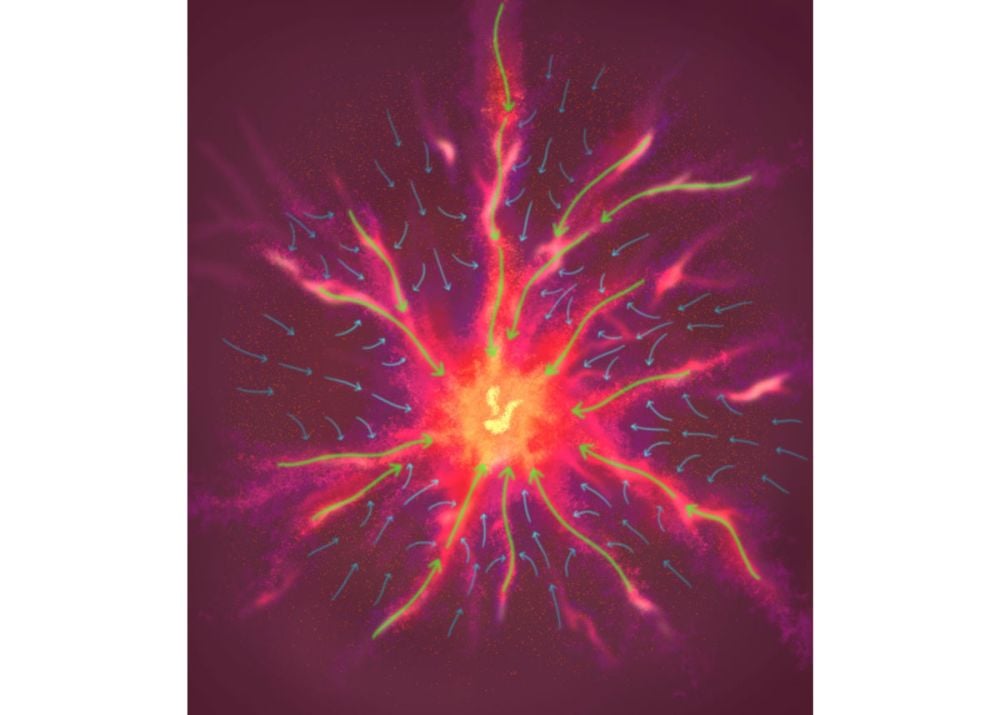
The data revealed a complex, multi-directional flow of matter. As expected, gas was moving along the dense filaments toward the central hub. However, the study also found that the low-density interfilamentary gas was not static. Instead, it was flowing in two directions: toward the central hub and laterally into the filaments themselves.
According to the study, at least 30% of the gas mass in the interfilamentary regions is currently flowing into the filaments. This process effectively "replenishes" the filaments, providing them with a constant supply of new matter even as they drain their own gas into the hub. This suggests that the filaments are not just static pipes but are growing and evolving structures that "sweep up" gas from their surroundings.
Furthermore, the researchers found that while the gas in the dense filaments moves faster, the sheer volume of the interfilamentary regions means their contribution to the total mass of the hub is significant. The flow of gas toward the hub was found to be the dominant motion across the entire system, reinforcing the idea that star formation is a large-scale gravitational collapse that involves the entire molecular cloud, not just its densest parts.
Implications for Galactic Evolution and Star Formation Models
The findings from Monoceros R2 have profound implications for theoretical models of star formation. Current simulations often struggle to account for the speed at which high-mass stars form. High-mass stars require an immense amount of gas to be delivered to a small area in a relatively short period. If filaments were the only source of this gas, the formation process might be slower than what is observed in the universe.
By identifying the interfilamentary regions as a major source of mass, Hwang’s research provides a solution to this "mass delivery" problem. It suggests that the "reservoir" for star formation is much larger than previously estimated. This could lead to a revision of the Initial Mass Function (IMF)—the empirical function that describes the initial distribution of masses for a population of stars—by providing a more accurate picture of how much gas is available to form stars of different sizes.
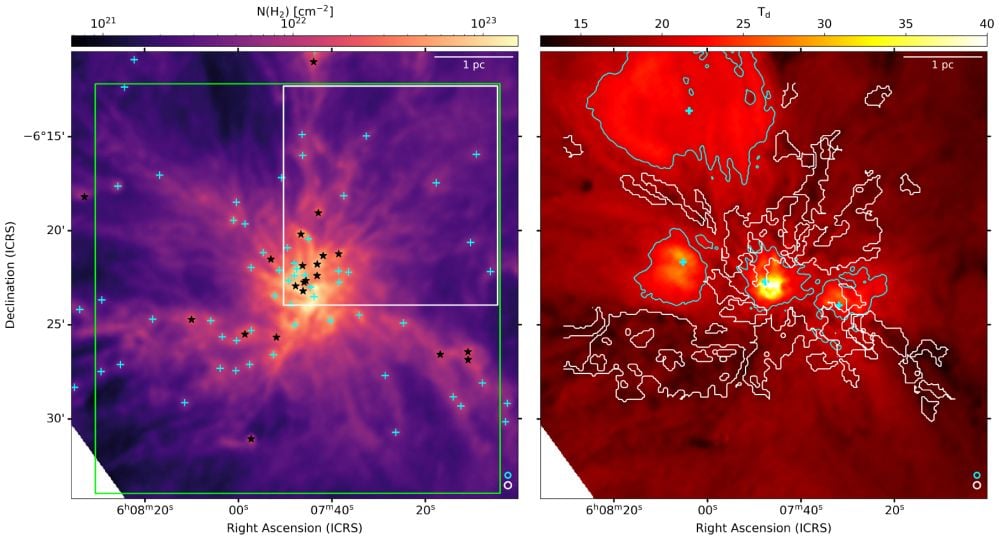
"Our results indicate that understanding star formation requires accounting for the entire gas reservoir, not only that of the dense filaments," Hwang explained in a statement. This shift in perspective moves the field toward a more holistic "global collapse" model, where the entire environment of a molecular cloud is seen as an integrated system.
Future Research and Global Context
The study of Monoceros R2 is part of a broader international effort to map the "skeleton" of the Milky Way. As telescopes become more sensitive, astronomers are discovering that the filamentary structure seen in Monoceros R2 is ubiquitous throughout our galaxy and others. The next step for Hwang and her team will be to extend this analysis to other Hub-Filament Systems to determine if the 30% replenishment rate is a universal standard or if it varies based on the environment.
Future studies will likely involve comparing these observational results with sophisticated numerical simulations. By plugging the observed velocity and density data into supercomputer models, scientists can test whether current laws of gravity and fluid dynamics can accurately replicate the complex flows seen in Monoceros R2.
The work also highlights the continued importance of single-dish radio telescopes like the Nobeyama 45m. While giant interferometers like ALMA (the Atacama Large Millimeter/submillimeter Array) offer higher resolution for looking at individual protostars, single-dish telescopes are essential for mapping the large-scale, diffuse gas structures that provide the context for those stars’ birth.
Conclusion
The research led by Jihye Hwang provides a vital new piece of the puzzle in the story of stellar origins. By proving that low-density interfilamentary gas plays a dynamic role in feeding star-forming hubs, the study forces a re-evaluation of how mass is accumulated in the cosmos. It reminds us that in the vastness of space, even the "thinner" regions of gas are not merely empty voids, but are essential components of the machinery that creates the stars, the planets, and ultimately, the chemical foundations of life itself. As astronomers continue to probe the depths of regions like Monoceros R2, they move closer to a unified theory of how the gaseous chaos of the early universe organized itself into the structured, star-filled cosmos we inhabit today.