Sisilia Frederika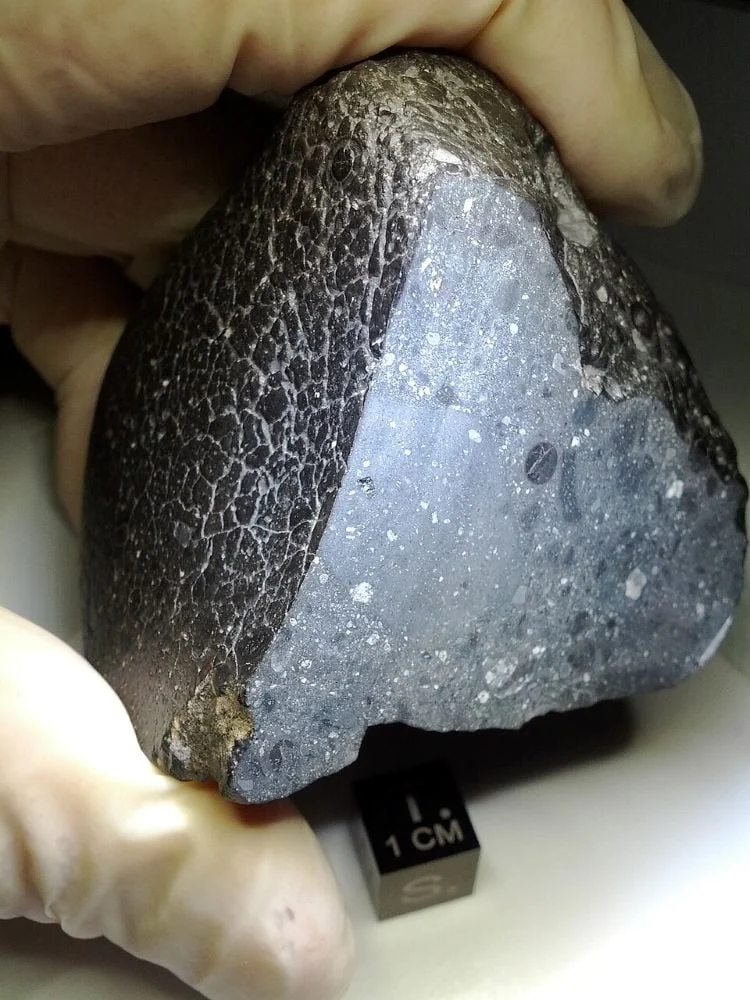
The narrative of Mars as a barren, frozen desert has been fundamentally challenged by a new analysis of one of the rarest objects on Earth: a 4.5-billion-year-old piece of the Martian crust known as "Black Beauty." An international research initiative, led by the Technical University of Denmark (DTU) and the Paul Scherrer Institute (PSI), has utilized advanced imaging techniques to identify macroscopic hydrogen deposits within the meteorite, providing the most direct evidence to date of a vast water reservoir on early Mars. This discovery, recently published in the journal Geophysical Research Letters, suggests that the Red Planet’s crust was once saturated with enough liquid water to interact significantly with the lithosphere, creating a potentially habitable environment far earlier than previously confirmed.
The Significance of Northwest Africa 7034
Technically designated as Northwest Africa (NWA) 7034, the meteorite colloquially known as Black Beauty was discovered in the Sahara Desert in 2011. While thousands of meteorites have been recovered on Earth, only a small fraction—approximately 300—are confirmed to be of Martian origin. Among these, Black Beauty occupies a unique scientific niche. Most Martian meteorites belong to the SNC group (Shergottites, Nakhlites, and Chassignites), which are typically younger volcanic rocks. Black Beauty, however, is a polymict breccia—a "mush" of different rock fragments fused together—and is the only meteorite known to originate from the ancient Martian crust.
Radiometric dating places the age of Black Beauty at roughly 4.4 to 4.5 billion years. This timeline corresponds to the Pre-Noachian period, the earliest era of Martian history. Because the meteorite contains a diverse array of crustal lithologies, it serves as a geological time capsule, preserving the chemical signatures of a period when the solar system was in its infancy.
Advanced Imaging: X-Rays and Neutrons
To look inside the meteorite without destroying its precious structure, the research team employed a dual-imaging strategy. The integration of X-ray and neutron tomography allowed the scientists to distinguish between different chemical elements with unprecedented precision.
X-ray tomography is a standard tool in geological analysis, highly effective at mapping the distribution of dense elements like iron, silicon, and calcium. However, X-rays are less effective at detecting light elements, particularly hydrogen. This is where neutron tomography, conducted at the Paul Scherrer Institute’s SINQ neutron source, became essential.
"Neutrons are particularly sensitive to hydrogen," explained Dr. David Mannes, a scientist at PSI and a co-author of the study. While X-rays pass through light elements relatively easily, neutrons are scattered by them. By overlaying the two sets of data, the team could identify that "voids" or "holes" seen in previous X-ray scans were not empty spaces, but were actually filled with hydrous minerals and macroscopic hydrogen deposits. This allowed the team to visualize, for the first time, the spatial distribution of water-altered minerals within a sample of the primary Martian crust.
A Chronology of Water on Mars
The findings from Black Beauty provide a critical anchor for the timeline of Martian volatiles. To understand the significance of this discovery, it is necessary to view it within the context of Mars’ geological evolution:
- The Pre-Noachian Era (4.5 – 4.1 Billion Years Ago): Black Beauty forms. The presence of hydrated minerals in this sample indicates that water was already interacting with the crust within the first 100 million years of the planet’s formation.
- The Noachian Era (4.1 – 3.7 Billion Years Ago): This period is traditionally associated with high rates of meteorite impacts and the formation of large valley networks. The new data suggests the "wet" phase of Mars likely preceded this era.
- The Hesperian Era (3.7 – 3.0 Billion Years Ago): Mars began to transition from a wet world to a cold, arid one, characterized by large-scale volcanic activity and occasional catastrophic flooding.
- The Amazonian Era (3.0 Billion Years Ago – Present): The current era, where Mars is a hyper-arid desert with water existing primarily as ice at the poles or trapped in the subsurface.
The identification of water in a 4.5-billion-year-old crustal rock suggests that the Martian "water cycle" was established almost immediately after the planet’s accretion, providing a much longer window for the potential emergence of life than previously hypothesized.
Comparative Planetary Science: From Meteorites to Jezero Crater
The implications of the Black Beauty study extend beyond the laboratory, offering vital "ground truth" for ongoing robotic missions. The researchers noted that the hydrated materials found within NWA 7034 bear a striking resemblance to the mineralogical data being gathered by NASA’s Perseverance rover in Jezero Crater.
Perseverance is currently exploring an ancient river delta, searching for signs of past microbial life. The rover has identified carbonates and clays—minerals that form in the presence of liquid water. By finding these same materials in a meteorite that can be physically handled and analyzed with Earth-bound technology, scientists can calibrate the remote sensing instruments on Perseverance and the Curiosity rover. This synergy between "fieldwork" on Mars and "lab work" on Earth is essential for confirming that the minerals seen from orbit are indeed the result of long-term aqueous alteration.
The Legacy of Martian Meteorites and the ALH84001 Controversy
The study of Martian meteorites has always been a field of high stakes and high drama. The most famous predecessor to Black Beauty is Allan Hills 84001 (ALH84001), discovered in Antarctica in 1984. In 1996, a team led by David McKay of NASA published a paper in Science claiming that ALH84001 contained microscopic structures resembling fossilized bacteria.
The announcement was so significant that President Bill Clinton delivered a televised address on the discovery. However, the scientific community eventually reached a consensus that the "fossils" could have been created by non-biological, hydrothermal processes. Despite the controversy, ALH84001 revolutionized the field of astrobiology by proving that Mars had a complex chemical history. Black Beauty continues this legacy but with more robust, verifiable data regarding the planet’s hydrologic cycle, shifting the focus from the search for "fossils" to the characterization of the "habitability" of the environment itself.
The Future of Sample Return and Geopolitical Shifts
While Black Beauty provides a wealth of information, meteorites remain "accidental" samples. They are often contaminated by Earth’s atmosphere and soil, and their exact point of origin on the Martian surface is usually unknown. To solve the mysteries of Mars, scientists require pristine samples collected from specific geological contexts.
For years, the Mars Sample Return (MSR) mission—a joint venture between NASA and the European Space Agency (ESA)—was considered the "Holy Grail" of planetary science. The Perseverance rover has already filled dozens of titanium tubes with Martian soil and rock, intended for retrieval by a future mission. However, the MSR program is currently facing an existential crisis. In 2024, budgetary pressures and "ballooning costs" led the U.S. Congress to cut funding, forcing NASA to reconsider the mission’s architecture and timeline.
This delay has opened a window for other spacefaring nations. The China National Space Administration (CNSA) has announced its own ambitious Mars sample return mission, Tianwen-3, which aims to return samples to Earth by 2031. If successful, China could become the first nation to bring back a piece of the Red Planet, potentially shifting the center of gravity for planetary science from the West to the East.
Conclusion: The Implications for Planetary Habitability
The analysis of Black Beauty serves as a reminder that the history of our solar system is written in its rocks. By proving that the Martian crust was rich in water nearly 4.5 billion years ago, the DTU and PSI researchers have reinforced the theory that Mars was once a "Blue Marble" in its own right.
This research does more than just fill a gap in the geological record; it informs our understanding of planetary habitability across the universe. If a planet as small as Mars could maintain a significant water reservoir so early in its life, it increases the statistical likelihood that exoplanets in other star systems may also undergo similar "wet" phases.
As scientists wait for the next generation of samples—whether delivered by NASA, ESA, or CNSA—the "Black Beauty" meteorite remains the most significant link to the Martian past. It is a testament to the power of modern imaging technology and a beacon for the future of astrobiology. The hunt for water on Mars has moved from a question of "if" to a detailed investigation of "how much" and "for how long," bringing us closer to answering the ultimate question: were we ever truly alone in the solar system?