Clarissa Hana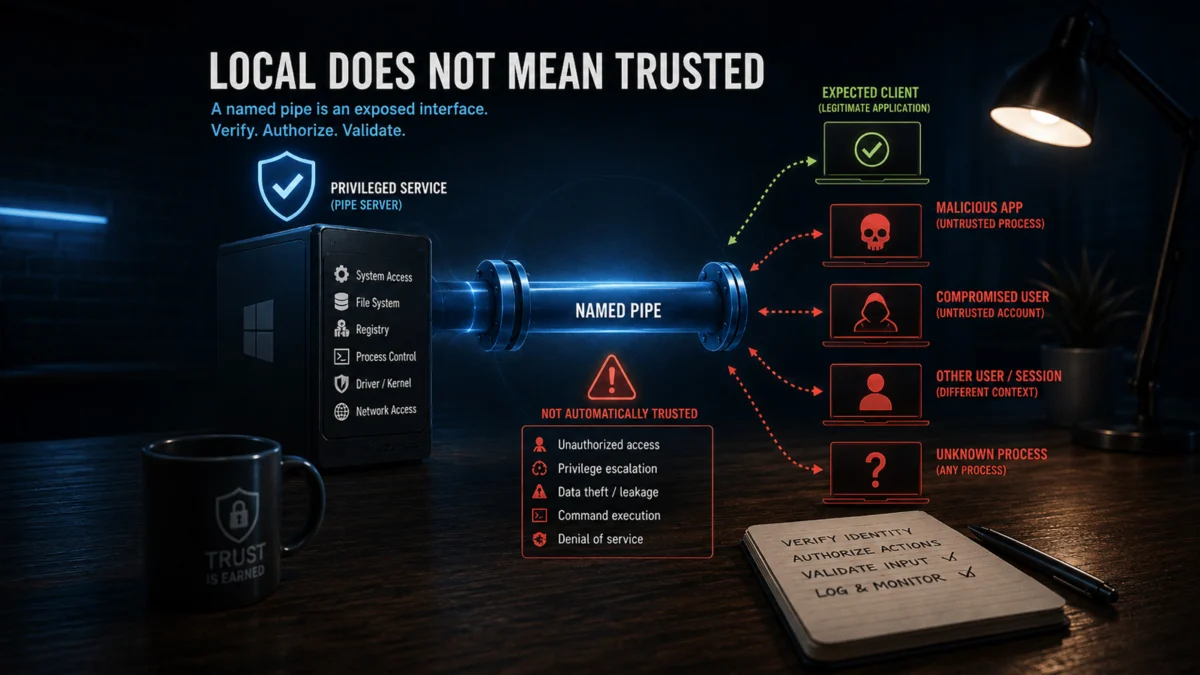
Named pipes, a fundamental inter-process communication (IPC) mechanism in Windows, are frequently employed for seamless data exchange between applications on the same system. Their efficiency and direct operating system support make them a popular choice for diverse software components, from background services and desktop applications to command-line utilities. However, a pervasive misconception that "local does not mean trusted" when it comes to named pipes presents a significant security vulnerability, potentially opening doors for attackers to exploit privileged functionalities.
Written by Farid Mustafayev, Cybersecurity Expert at ThreatLocker, this comprehensive analysis delves into the inherent risks associated with named pipe communication and outlines robust strategies for their secure implementation. The core issue lies in the assumption that because two processes reside on the same machine, their communication can be implicitly trusted. This assumption is fundamentally flawed, as a Windows environment can host a multitude of processes operating under vastly different security contexts, including high-privilege accounts like LocalSystem, standard user accounts, service accounts, and even compromised entities.
Local Does Not Equate to Trusted: Unpacking the Vulnerability
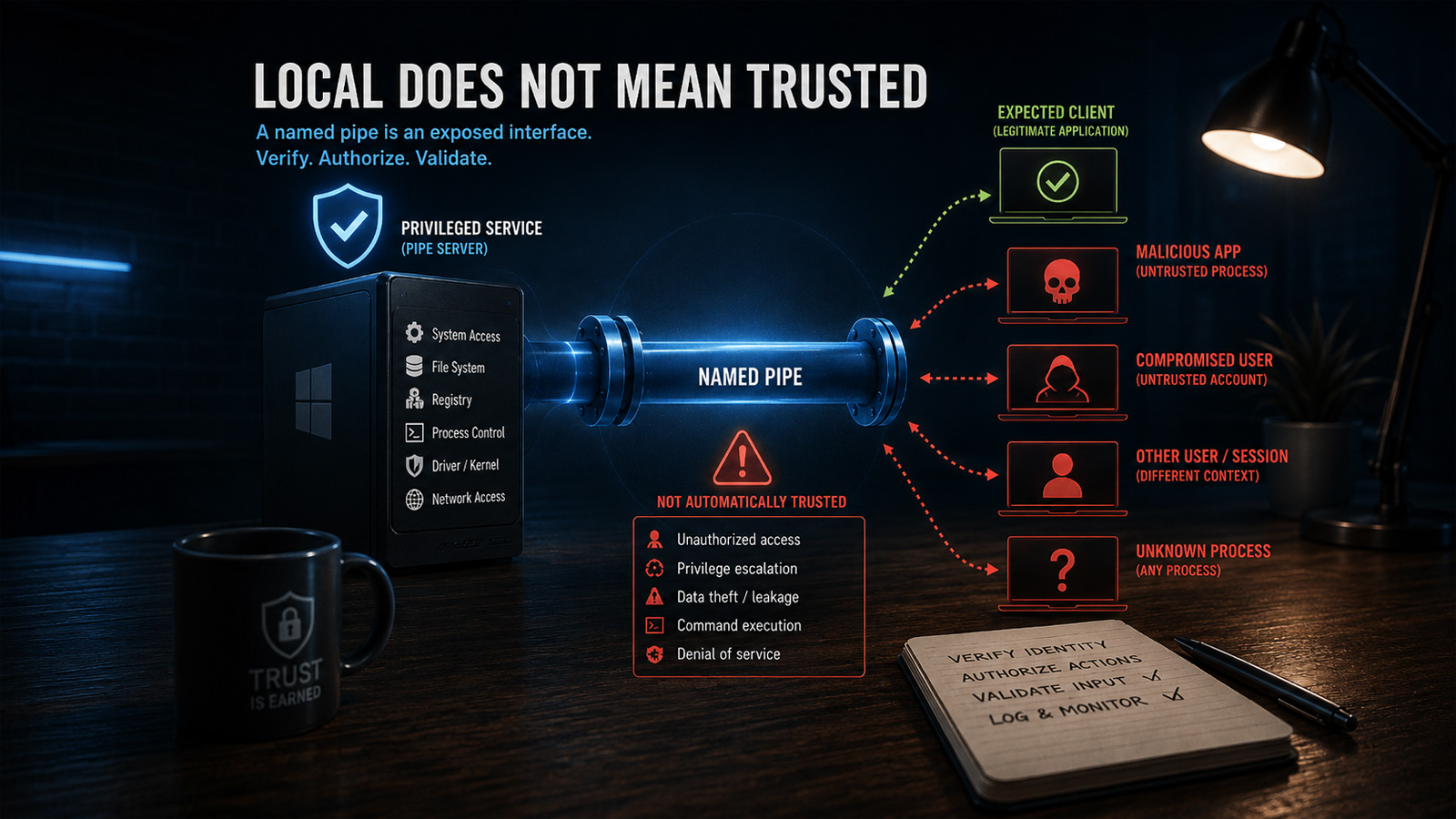
The inherent design of named pipes, while efficient, does not inherently distinguish between intended legitimate communication channels and potentially malicious ones. Any process that can ascertain the pipe’s name and possesses the requisite access permissions can attempt to establish a connection. Crucially, the Windows operating system itself cannot definitively determine which specific executable the pipe’s developer intended to communicate with. This lack of inherent process identity verification transforms named pipes into exposed local interfaces, demanding rigorous scrutiny before any data is processed.
The greatest risks materialize when a highly privileged Windows service, often running under the LocalSystem account with extensive system modification capabilities, communicates with a less privileged user-facing application. When such privileged operations are exposed through a named pipe, the pipe effectively becomes an API for accessing elevated system functions. A successful connection, in this scenario, merely signifies that the client had permission to open the pipe; it does not authenticate the client’s identity, verify its authorization for specific actions, or guarantee the integrity of the data being transmitted.
Identity, Access Control, and the Erosion of Privilege Boundaries
The foundation of secure named pipe communication rests on robust identity verification, stringent access control, and the clear delineation of privilege boundaries. Developers often err by assigning overly broad permissions to named pipes, such as granting access to Everyone, Authenticated Users, or all interactive users. This expansive access can inadvertently permit unrelated processes, including malware, to interact with sensitive pipe endpoints.
A critical distinction must be made between authentication and authorization. While a user might be authenticated to query service status, this should not automatically grant them permission to stop the service, alter protected settings, launch arbitrary processes, or access unauthorized files. Each sensitive command must be individually authorized. Impersonation, a technique where the server temporarily assumes the client’s security context, can be a valuable tool but requires meticulous handling. The server must confirm successful impersonation, limit operations performed under the client’s identity, and ensure a reliable reversion to its original security context.
Untrusted Servers, Commands, and Data: A Multi-faceted Threat
The security of named pipe communication is not a one-way street. Just as the server must verify the client, the client must also authenticate the server. Predictable pipe names, while identifying a communication channel, offer no inherent proof of the server’s legitimacy. An attacker could preemptively create a pipe with the expected name before the legitimate server initializes, effectively hijacking client connections. While the first-pipe-instance option can help detect name contention, it is not a substitute for proper access controls and server identity verification.
Furthermore, all messages received through a named pipe must be treated as untrusted input. Even an authenticated client, if compromised or containing a vulnerability, could transmit malicious data. This could include crafted file paths leading to sensitive system files, malformed commands designed to crash the service, or payloads designed to exploit deserialization vulnerabilities. A privileged service that directly translates such input into file operations, registry modifications, process launches, or command-line executions risks becoming a "confused deputy"—an attacker dictates the action, while the service provides the necessary privileges. To mitigate this, requests should adhere to strict message framing, bounded sizes, command allowlists, schema validation, path normalization, operation-specific authorization, and robust error handling.
Availability and the Shadow of Remote Exposure
The security considerations for named pipes extend beyond privilege escalation and unauthorized commands to encompass denial-of-service (DoS) risks. Malicious or malfunctioning processes can repeatedly attempt to connect, hold connections open indefinitely, submit incomplete messages, or bombard the server with resource-intensive requests. This can lead to scenarios where all available pipe instances are occupied, preventing legitimate clients from establishing connections.
The potential for remote access to named pipes further complicates the security landscape. While often assumed to be local, Windows named pipes can, under certain configurations, be accessible over a network. Pipes intended exclusively for local inter-process communication (IPC) must explicitly block network identities or employ mechanisms that guarantee local-only communication. The overarching threat model should be straightforward: every named pipe connection must be considered potentially hostile until the identity of both the client and server, their respective permissions, the requested operation, and the message content have been thoroughly verified.
When a Named Pipe Becomes a Security Boundary
A named pipe fundamentally transforms into a security boundary when the processes on either end operate with different privilege levels or trust models. This is most acutely observed in scenarios involving a Windows service running with elevated privileges (e.g., LocalSystem) and a desktop application operating under a standard user account. The service might possess the ability to modify protected files, alter system configurations, access other users’ data, or interact with kernel drivers—capabilities far beyond the standard user’s reach.
When such a service exposes its functionalities via a named pipe, any weakness in the pipe’s permissions, identity verification, command validation, or authorization logic can be exploited by an untrusted local process. A successful connection only proves that the client had the necessary permissions to open the pipe, not that it is the intended application. Another process under the same user account could possess identical access. Therefore, the server must meticulously validate the actual security identity behind the connection, rather than relying on superficial indicators like process names or executable paths.
Each operation must be authorized independently. A client permitted to query service status should not automatically gain the ability to stop the service, modify protected configurations, or launch processes. This distinction between authentication (who connected) and authorization (what they can do) is paramount, especially when the server processes client-controlled paths, command-line arguments, registry locations, executable names, or serialized commands. Without stringent validation, the service can become a tool for attackers, executing their chosen actions with the service’s elevated privileges. For instance, a request to "read file: C:ProgramDataProductstatus.json" could be subverted by an attacker replacing the path with "C:WindowsSystem32configSAM," leading to unauthorized access of sensitive system data.
A secure named-pipe server must implement a multi-layered approach before executing any privileged request. This includes verifying the connecting client’s identity, ensuring the client is authorized for the specific operation, validating all input parameters to prevent injection or manipulation, and strictly scoping the operation to prevent unintended side effects. The principle is that the pipe server must never perform an operation solely because a client requested it; it must confirm the requester’s identity, authorization, and ensure the request adheres to tightly defined security boundaries.
Access Control and Client Authorization: The Gatekeepers of Information
A critical first step in securing named pipes is establishing explicit access control lists (ACLs) for the pipe. This involves defining a security descriptor that grants access only to the necessary Windows identities, such as a specific user SID, a service account, an administrator group, or a particular logon session. Relying on default ACLs is perilous, as they often grant broader permissions than an application requires.
However, access to the pipe itself does not equate to permission to execute every available command. A client might be authorized to retrieve status information but denied permission to modify configuration or access protected files. Therefore, authorization must be performed for each sensitive operation individually, not solely at the time of connection establishment.
For local application-to-application communication, developers can leverage Windows APIs to inspect the process associated with the opposite end of the pipe. Functions like GetNamedPipeClientProcessId and GetNamedPipeServerProcessId retrieve the process identifier, which can then be used in conjunction with QueryFullProcessImageName to obtain the executable path. This path can be compared against an expected, secure location. It is imperative that the expected executable resides in a directory that standard users cannot modify to prevent attackers from replacing legitimate executables with malicious ones while maintaining the expected path.
For enhanced security, applications can also validate the Authenticode signature or compare cryptographic hashes of the executable. However, PID and executable path checks should be considered secondary controls. Security research has demonstrated methods to spoof PIDs and transfer pipe handles between processes, meaning these checks alone cannot definitively prove the identity of the process sending every message. A truly secure implementation integrates multiple controls, including restrictive pipe permissions, client identity verification, operation-specific authorization, and input validation. The connection must be rejected if identity verification fails or cannot be completed, and a privileged service must never fall back to accepting a request simply because the pipe connection itself succeeded.
Impersonation and Privileged Operations: A Double-Edged Sword
When a named pipe server operates with higher privileges than its client, impersonation can be employed to execute code under the client’s security context. This means that resource access checks are performed using the client’s token, not the server’s elevated token. In .NET, NamedPipeServerStream.RunAsClient provides a controlled mechanism for this. This is particularly useful when a client should only perform an operation if its own Windows account possesses the necessary permissions, such as reading a user-owned file or accessing a user-specific registry key.
However, impersonation is not a panacea for authorization. The server must still verify that the client is authorized for the requested operation. Impersonation merely shifts the security context for access checks; it does not dictate the appropriateness of the command itself. Furthermore, privileged services should avoid unnecessary switching between client and service identities. A request might involve reading a file under impersonation and then installing its contents as configuration under the service’s elevated identity. This could still allow the client to influence a privileged operation even if part of it was processed under impersonation.
The safer design separates operations into distinct stages: first, the client provides necessary information; second, the server validates this information and determines authorization; third, if authorized, the server performs the operation, potentially using impersonation for specific, client-scoped actions. The scope of impersonation should be as minimal as possible, excluding long-running tasks, callbacks, or unrelated service logic.
When using native Windows APIs, the pattern remains consistent: ImpersonateNamedPipeClient should be called to assume the client’s identity, and RevertToSelf must be reliably invoked in a finally block to restore the server’s original security context. Crucially, if impersonation fails, the request must be rejected. Continuing processing under the service’s original privileged identity after a failed impersonation attempt can lead to unintended privilege escalation. Similarly, reliably restoring the original identity is vital to prevent subsequent operations from accidentally executing under a previous client’s context.
Privileged pipe commands should also be narrow and purpose-specific. A command like "Write any value to any registry key" presents a significantly larger attack surface than "Update the application’s approved policy setting." The service should avoid exposing general-purpose file access, registry modification, process creation, or command execution capabilities. Each privileged command must precisely define the resources that can be accessed, the acceptable values, and the client identities permitted to invoke it. Impersonation is most effective as one layer within a comprehensive security design, complementing restrictive pipe permissions, client verification, command authorization, and input validation.
Treating Pipe Messages as Untrusted Input: The Core Tenet
Even after successfully verifying the process connected to a named pipe, its messages must be treated as untrusted input. A legitimate application might be compromised, contain exploitable vulnerabilities, or pass user-controlled data to the pipe. A malicious process could also obtain or inherit a valid pipe handle. Consequently, every message received through a named pipe requires rigorous validation of both its structure and the requested operation before any privileged action is performed.
A dangerous implementation might directly deserialize a request and execute it, for example: File.WriteAllText(request.Path, request.Content);. Even if request has an expected structure, the Path and Content values remain under client control. This could allow a privileged service to overwrite files outside its designated directory, modify protected configurations, or consume excessive disk space.
A safer approach involves exposing narrowly defined commands and validating every field. For instance, instead of a generic WriteFile command, prefer application-specific requests like UpdateConfiguration or GetStatus. The protocol should avoid general-purpose operations that allow clients to dictate both the action and its target.
Validate Message Structure and Size: A named pipe connection is fundamentally a byte stream unless explicitly configured for message transmission. A single Read call might not retrieve an entire application message, so servers should not assume read boundaries align with request boundaries. The protocol must define explicit message framing, such as a fixed-size header followed by a length-prefixed payload. The declared payload length must be validated before allocating memory or reading the payload to prevent excessive memory allocation or buffer overflows. Applications should also limit collection sizes, string lengths, nesting depth, and the number of objects accepted by deserializers.
Validate Values, Not Only Types: Successful deserialization only confirms that a payload can be converted into an expected object type; it does not guarantee the acceptability of the values within. For example, a file path must be normalized and checked against an approved directory to prevent directory traversal attacks. The same principle applies to registry paths, process arguments, URLs, and configuration values. Servers should validate each value against an allowlist or a narrowly defined range. Path validation also requires careful consideration of symbolic links, junctions, reparse points, and time-of-check/time-of-use (TOCTOU) race conditions.
Reject Invalid Requests Safely: Malformed or unauthorized messages should be rejected without partial processing. Servers must avoid returning sensitive information such as stack traces, internal paths, security tokens, or detailed exception information to the client. Errors communicated through the pipe should use a limited, controlled set of response codes, such as Success, InvalidRequest, Unauthorized, UnsupportedCommand, or InternalError. Detailed diagnostic information can be logged in protected service logs, while the client receives only the necessary information to handle the failure. Each request should pass through a predictable sequence: connection establishment, authentication, authorization, request validation, and finally, privileged execution. The named pipe is merely a transport mechanism; the receiving application bears the responsibility for enforcing the protocol and protecting exposed operations.
Denial-of-Service and Remote-Access Risks: Maintaining Availability
Even with robust command authorization, named pipe endpoints remain susceptible to denial-of-service (DoS) attacks. The goal here is not necessarily to execute privileged operations but to prevent legitimate applications from communicating with the service, thereby disrupting its functionality. A malicious or malfunctioning process can repeatedly connect, occupy all available pipe instances, hold connections open without sending complete messages, or continuously reconnect after being disconnected. This can leave legitimate clients unable to establish a connection.
Similar risks exist after a connection is accepted. A client might send data extremely slowly, declare an oversized payload, stop mid-message, or flood the server with valid but resource-intensive requests. Without proper limitations, these actions can exhaust threads, tasks, memory, CPU time, handles, and internal request queues. Named pipe buffers also consume kernel nonpaged pool memory, and the number of pipe instances and buffered data are limited by system resources. Creating an unrestricted number of instances or selecting unnecessarily large buffers can contribute to resource exhaustion.
A defensive server should implement clear limits for connection attempts, concurrently open connections, message size, and request processing time. Blocking operations should support cancellation and avoid indefinite waits for client data. When a client exceeds time, size, or request limits, the server should terminate the connection and release its resources promptly. Limits should be enforced before expensive operations commence. For instance, an excessive declared payload size should be rejected before buffer allocation. Similarly, authorization and basic request validation should precede disk access, process creation, cryptographic operations, or database queries.
The application should avoid creating one unrestricted worker thread per connection. A bounded concurrency model prevents a large number of connected clients from exhausting the process’s thread pool or creating an uncontrolled backlog. Rate limits can be applied per connection, process, user identity, or logon session, depending on the application architecture. However, availability controls should not solely rely on the client PID, as processes can restart or use multiple processes under the same user account. Multiple signals should be considered, and the server must maintain global limits even with per-client controls.
Another often-overlooked risk is remote accessibility. Windows named pipes are not inherently confined to local communication. They can support network communication, and Microsoft has indicated that named pipes may be remotely accessible when the Windows Server service is running. Therefore, using a local pipe name does not guarantee local-only communication. Pipes intended for local IPC must explicitly enforce this requirement. Native pipe servers can specify PIPE_REJECT_REMOTE_CLIENTS to automatically reject remote connections. Without this option, remote clients may connect and be evaluated against the pipe’s security descriptor. The pipe’s ACL can also deny access to the NT AUTHORITYNETWORK identity. For communication restricted to a single interactive session, the server can grant access to the appropriate logon SID rather than broad groups shared by local and remote users. These protections should be combined for maximum efficacy. DoS protection and remote-access restrictions are integral to the pipe’s security model, ensuring availability and enforcing locality.
Designing a Secure Named-Pipe Architecture: A Layered Defense
A secure named-pipe design prioritizes minimizing the number of exposed operations and the amount of privileged code directly processing client-controlled data. The pipe should function as a narrow communication boundary, not a general-purpose interface to the operating system. A practical architecture separates connection handling, validation, authorization, and privileged execution.
Keep the Pipe Protocol Narrow: The pipe protocol should expose business operations rather than operating-system primitives. For example, an application might legitimately need to request a policy refresh or obtain service status, but it typically does not require unrestricted commands for writing arbitrary files or launching executables. Narrow operations facilitate practical authorization and validation, enabling the server to precisely control resource access, expected fields, and invoking client identities. A robust protocol should include versioning, command enumeration, field validation, and state management, rejecting unknown versions, commands, fields, and states.
Separate Connection Access From Command Permission: The permission to connect to a pipe should not imply permission to use all its features. The pipe’s security descriptor should restrict which Windows identities can establish a connection. Post-connection, the server must identify the client and authorize each command independently. This allows for different trust levels within the same service; ordinary users might query status, while administrators or trusted management processes handle sensitive settings. For highly sensitive operations, separate named pipes (e.g., Product.Status, Product.UserActions, Product.Admin) with distinct access control rules and message limits can offer enhanced security. However, each new endpoint increases the attack surface and must be independently protected.
Use Multiple Layers of Identity Verification: No single identity check should be considered conclusive. A robust architecture can combine several layers: restrictive pipe permissions, client identity verification (e.g., through Windows security tokens), command-level authorization, and input validation. Process ID and executable-path checks serve as defense-in-depth controls but should not be the primary authorization mechanism, as PIDs can be spoofed and handles transferred. Strongest decisions should be based on Windows security identities and narrowly defined permissions.
Isolate Privileged Execution: The component responsible for reading pipe messages should perform minimal privileged work. Connection handling, deserialization, framing, and basic validation are exposed to attacker-controlled input. Separating this logic from privileged operations reduces the impact of parser or protocol vulnerabilities. The privileged operation layer should receive only validated, strongly typed instructions, not raw message buffers or arbitrary paths. For highly sensitive applications, separating the pipe gateway and privileged worker into different processes further enhances security by creating an additional process boundary.
Control the Lifetime of Every Connection: Each accepted connection should have a clear and bounded lifecycle, including connection establishment, authentication and authorization, request processing, and connection termination. Servers should not allow unauthenticated clients to hold connections indefinitely. Idle timeouts, request deadlines, connection limits, cancellation, and bounded queues are essential. Long-running operations should not block the pipe’s reader; instead, the service can accept the request, assign an operation identifier, and allow the client to query progress through a separate status request.
Make the Server Authoritative: The client should request an outcome, and the server should determine how that outcome is achieved. For instance, the client requests an update by identifier, and the server resolves the package, verifies its signature, and determines the installation command. The client should not supply the executable path or download URL. This centralizes security-sensitive decisions within the trusted component. The server must also independently verify security claims made by the client, such as user administrator status or file signature validity.
Audit Security-Relevant Activity: A secure architecture should record sufficient information for security investigations without exposing sensitive data. Useful audit events include connection attempts (successful and failed), unauthorized command requests, authorization failures, and explicit rejections of invalid messages. Logs should identify the Windows user, session, peer PID, command type, and result. Raw secrets and sensitive payloads should not be logged. Audit data should support both security investigation and operational troubleshooting.
Recommended Architecture: For most privileged Windows service scenarios, a defensible design includes a pipe gateway component that handles connections, performs initial validation, and forwards requests to an authorization layer. A separate privileged worker component then executes validated, authorized operations. The central principle is that the named pipe should expose the smallest possible interface between trust levels, avoiding the exposure of arbitrary privileged operations.
Practical Named-Pipe Security Checklist
Before exposing application functionality through a named pipe, developers should verify that their design addresses the following critical areas:
- Restrictive Pipe Permissions: Define explicit security descriptors that grant access only to necessary Windows identities. Avoid broad permissions like
EveryoneorAuthenticated Users. - Endpoint Verification: Implement mechanisms to verify the identity of both the client and server. This can include checking process IDs, executable paths, digital signatures, and cryptographic hashes.
- Operation-Level Authorization: Authorize each sensitive command independently. Do not grant blanket permissions based on connection establishment alone.
- Strict Input Validation: Treat all messages as untrusted input. Validate message framing, size, structure, and individual field values. Use allowlists and narrowly defined ranges.
- Bounded Resource Usage: Implement limits for connection duration, message size, concurrent connections, and resource consumption to prevent denial-of-service attacks.
- Narrowly Scoped Privileged Functionality: Expose only essential business operations, not general-purpose operating system primitives. Keep privileged code separate from client-facing input processing.
- Secure Impersonation Handling: If impersonation is used, ensure it is handled carefully, with proper verification, limited scope, and reliable reversion to the server’s original identity.
- Local-Only Enforcement: For pipes intended for local communication, explicitly block remote connections and deny network identities.
- Auditing and Logging: Record security-relevant events for investigation and troubleshooting without exposing sensitive data.
- Defense-in-Depth: Combine multiple security controls, as no single protection is foolproof.
A secure named-pipe implementation relies on a layered defense, integrating restrictive access control, robust endpoint verification, granular operation authorization, meticulous input validation, controlled resource usage, and narrowly scoped privileged functionality. By adhering to these principles, organizations can significantly mitigate the risks associated with named pipe exploitation and safeguard their systems against potential breaches.
Author Bio:
Farid Mustafayev is a software developer at ThreatLocker specializing in Microsoft Windows Service development and cybersecurity. With over 15 years of industry experience, he possesses deep expertise in .NET technologies, including ASP.NET WebAPI, Windows Services, Windows Forms, WPF, RESTful APIs, and low-level Windows internals. He has led the development and hardening of Windows Services designed to protect systems against malware and ransomware, including work with kernel-level integrations and custom driver enhancements. Previously, Mustafayev served as a Technical Lead, guiding architecture decisions, mentoring developers, and building scalable, maintainable systems. His experience also includes microservices-based architectures and cloud-native solutions on AWS, with a focus on availability, performance, and security across distributed environments.
Sponsored and written by ThreatLocker.