Clarissa Hana
A significant cybersecurity threat has emerged within the automotive sector, with researchers uncovering a sophisticated supply-chain attack that infects Android-based car head units with malware. This malicious software enlists compromised vehicles into a proxy botnet or exploits them for fraudulent advertising activities. The operation, meticulously analyzed by Kaspersky researchers, has been attributed to the notorious MoYu group, a threat actor previously identified as the orchestrator behind the widespread BadBox malware botnet, which itself has impacted millions of devices. This marks a concerning first for the automotive cybersecurity landscape, representing the initial documented instance of a malware infection chain specifically engineered to target the unique architecture of in-car infotainment systems.
The Anatomy of the Attack: A Multi-Stage Infiltration
The MoYu group’s operation specifically targets the systems provided by DoFun, a prominent Chinese company specializing in automotive software, cloud services, and hardware. DoFun supplies generic Android-based head units that serve as the central command and control hub for a vehicle’s diverse functionalities, including its infotainment system, navigation capabilities, and various settings. These units are ubiquitous in modern vehicles, integrating seamlessly to provide a connected and feature-rich driving experience.
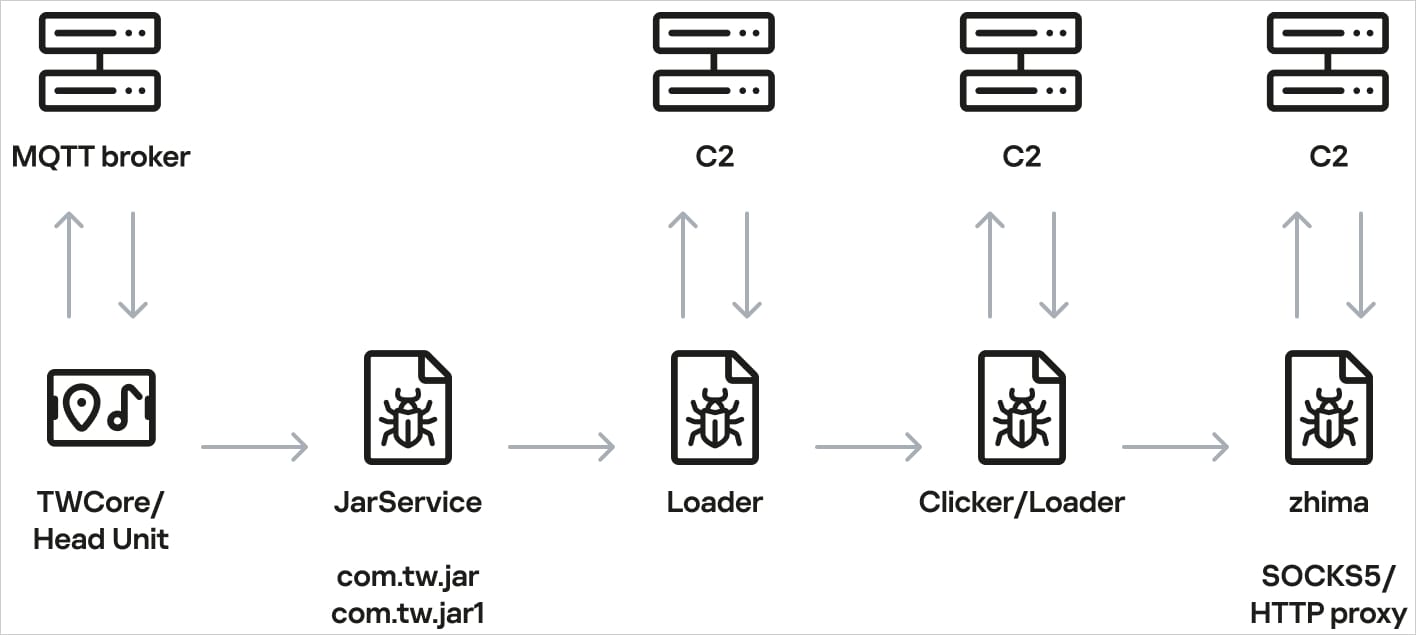
The infiltration vector was identified in June of this year when Kaspersky’s diligent researchers detected a malicious APK (Android Package Kit) file being surreptitiously downloaded from a seemingly legitimate DoFun system app. This app, known as TWCore, is designed to receive operational instructions through an MQTT (Message Queuing Telemetry Transport) server, which in this compromised instance was hosted at the domain cardoor[.]cn. The rogue APK, which operates without any discernible user interface, was christened "JarService" by the researchers. Upon execution, JarService performs a critical function: it decrypts and launches a second-stage loader. This loader is instrumental in establishing clandestine communication with a command-and-control (C2) server, a critical infrastructure component for any botnet operation, from which it then downloads another encrypted payload.
The ultimate payload delivered to the compromised head unit is designed for stealth and persistent data exfiltration. It periodically transmits vital device information to the attackers. This data includes specifics such as the model of the head unit, its display resolution, the connected Wi-Fi network’s SSID (Service Set Identifier), and the device’s MAC (Media Access Control) address. In return, the malware retrieves a set of commands from the attackers, enabling them to dictate the compromised device’s subsequent actions.

Malicious Intent: Proxy Botnets and Ad Fraud
While the thought of a compromised car system might conjure images of direct interference with driving mechanics, Kaspersky’s analysis indicates that the MoYu group’s malware is not designed to disrupt critical vehicle control systems or compromise driving safety. Instead, the primary objectives appear to be financial gain through advertising fraud and the repurposing of internet-connected car head units into residential proxy nodes for monetization.
The researchers observed that the attackers predominantly deployed a reverse-proxy module within the malware, codenamed "zhima." This module is the key component that transforms the victimized head unit into a node within a proxy botnet. In essence, the compromised car acts as an intermediary, routing the internet traffic of other users or malicious actors through its own connection. This obfuscates the true origin of illicit online activities, making them significantly harder to trace. Furthermore, the malware was observed initiating web requests specifically designed to engage in click-fraud activities. This involves generating fake clicks on online advertisements, thereby defrauding advertisers and generating illegitimate revenue for the attackers.
The malware supports a suite of nine distinct commands, which provide the MoYu group with a versatile toolkit for managing their compromised fleet. While the specific details of these commands are not fully enumerated in the initial report, their existence underscores the modular and adaptable nature of the threat. This allows the attackers to pivot their strategy, engage in different types of malicious activities, or extract various forms of data as needed.
Timeline of Discovery and Response
The timeline of this sophisticated attack began to unfold in June 2026, when Kaspersky researchers initiated their deep dive into the compromised DoFun systems. Their meticulous analysis led to the identification of the rogue APK and the subsequent unraveling of the multi-stage infection chain.
- June 2026: Kaspersky researchers detect a rogue APK file being downloaded from a legitimate DoFun system app (TWCore).
- Analysis: Researchers dissect the malware, identifying its multi-stage infection process and its capabilities, including the "zhima" reverse-proxy module.
- Attribution: The operation is linked to the MoYu threat actor group, known for previous botnet activities.
- Notification: Kaspersky informs DoFun of their findings regarding the vulnerability in their systems.
- Response: DoFun provides a statement to Kaspersky, asserting that the issue has been resolved.
- Further Inquiry: BleepingComputer, reporting on the incident, contacts both DoFun and Kaspersky for further details on the initial compromise vector and the specifics of the resolution. The article indicates that updates will be provided as more information becomes available.
Broader Implications for Automotive Cybersecurity
The implications of this attack extend far beyond the immediate financial losses incurred through ad fraud and proxy services. The successful infiltration of a supply chain for automotive head units raises critical questions about the security posture of the broader automotive technology ecosystem.

Supply Chain Vulnerabilities: This incident highlights the inherent risks associated with complex supply chains in the automotive industry. A compromise at any point in the chain, whether it be a software provider, hardware manufacturer, or even a third-party service, can have cascading effects on a vast number of vehicles. The reliance on generic Android-based systems, while offering cost and development advantages, also introduces a wider attack surface if not secured rigorously.
Data Privacy and Security: The data collected by the malware, including device models and network information, while seemingly innocuous in isolation, could be aggregated and used for more targeted attacks or to build detailed profiles of vehicle owners. Furthermore, the use of compromised vehicles as proxy nodes raises concerns about the potential for illegal activities to be traced back to innocent vehicle owners, leading to unwarranted scrutiny or legal complications.
The Rise of Connected Vehicle Threats: As vehicles become increasingly connected, evolving from mere modes of transportation into sophisticated, data-generating, and internet-enabled devices, the threat landscape shifts dramatically. Cybersecurity must evolve in parallel to address the unique vulnerabilities presented by these complex systems. The MoYu attack serves as a stark reminder that the potential attack vectors are expanding, and the consequences of breaches are becoming more significant.
The Evolving Tactics of Threat Actors: The MoYu group’s demonstrated ability to adapt and target new environments, such as the automotive sector, underscores the persistent innovation of cybercriminals. Their shift from traditional botnet operations to more nuanced monetization strategies like proxy services and ad fraud indicates a growing sophistication and a focus on less detectable, yet highly profitable, illicit activities.
Industry-Wide Security Imperatives: This incident should serve as a wake-up call for the automotive industry. A concerted effort is needed to enhance security protocols across the entire vehicle lifecycle, from design and manufacturing to software updates and ongoing maintenance. This includes:
- Robust Security Audits: Implementing stringent security audits for all third-party software and hardware components integrated into vehicles.
- Secure Development Practices: Encouraging and enforcing secure coding practices for all automotive software.
- Regular Vulnerability Patching: Establishing a reliable and rapid mechanism for deploying security patches and updates to in-car systems, similar to how mobile operating systems are updated.
- Threat Intelligence Sharing: Fostering collaboration and intelligence sharing among automotive manufacturers, cybersecurity firms, and regulatory bodies to proactively identify and mitigate emerging threats.
- Consumer Awareness: Educating consumers about the importance of keeping their vehicle’s software updated and being aware of potential cybersecurity risks associated with connected car features.
Official Responses and Future Outlook
DoFun’s swift response, stating that the problem has been resolved, is a positive step. However, the specifics of the initial compromise vector and the exact nature of the resolution remain areas requiring further clarification. The continued investigation by BleepingComputer and ongoing dialogue with both DoFun and Kaspersky are crucial for a comprehensive understanding of the incident and for preventing similar attacks in the future.
The automotive industry is at a critical juncture. As the integration of technology deepens, the imperative for robust cybersecurity measures becomes paramount. The MoYu group’s exploitation of Android car head units is not merely an isolated incident; it is a harbinger of the evolving threats that connected vehicles will face. Proactive, collaborative, and comprehensive security strategies are essential to ensure that the advancements in automotive technology do not come at the expense of safety, privacy, and security for drivers worldwide. The industry must move beyond reactive measures and embrace a future where cybersecurity is as integral to vehicle design as the engine itself.