Clarissa Hana
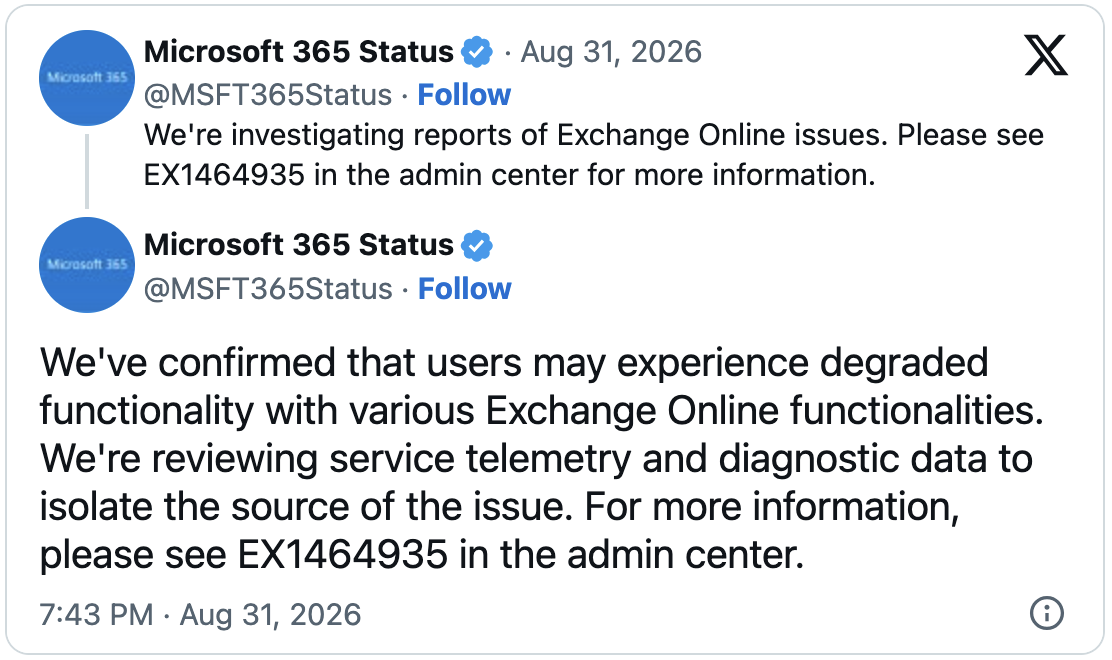
Microsoft is currently investigating a significant and pervasive service disruption impacting its Exchange Online customers, leading to widespread authentication issues, delayed or failed email deliveries, and a cascade of other operational problems. The incident, officially logged as EX1464935 in the Microsoft 365 admin center, was first acknowledged by the tech giant at approximately 5:30 PM UTC on August 30, 2024. This acknowledgment followed a surge in user reports and observations across various online platforms, including professional IT forums and social media channels.
The scope of the outage became evident as tens of thousands of users reported experiencing difficulties. Downdetector, a leading service for tracking online outages, registered a sharp spike in user-submitted reports, indicating that a substantial portion of the Exchange Online user base was affected. These reports primarily detailed problems with receiving emails via Outlook and general inaccessibility to the Exchange Online platform. The widespread nature of these issues has raised concerns among businesses and organizations that rely heavily on Microsoft’s cloud-based email and collaboration services for their daily operations.
Unraveling the Technical Difficulties: Authentication and Connectivity at the Core
Microsoft’s initial assessment, as communicated through its admin center updates and official status channels, pointed towards a specific failure pattern. The company stated that it had "isolated a common failure pattern across affected Exchange Online requests that is associated with authentication and protocol connectivity." This suggests that the core mechanisms responsible for verifying user identities and establishing connections to the email service are faltering. The complexity of modern authentication protocols, such as OAuth and multi-factor authentication (MFA), means that even minor misconfigurations or underlying infrastructure issues can have far-reaching consequences.
Further analysis by Microsoft’s engineering teams focused on dissecting service telemetry data. The goal was to pinpoint the precise origin of the disruption and to validate potential solutions. The company emphasized its ongoing efforts to assess the full extent of the impact and to remain vigilant for any emerging affected scenarios. The classification of the event as an "incident" by Microsoft typically signifies a critical service issue with demonstrable user impact, underscoring the severity of the situation.

A Timeline of Disruption: From Initial Reports to Emerging Causes
The initial reports of Exchange Online issues began to surface on August 30, 2024, around mid-afternoon UTC. Users on platforms like Reddit and X (formerly Twitter) started sharing their experiences of being unable to send or receive emails, or encountering persistent authentication errors when attempting to access their mailboxes.
- August 30, 2024, ~5:30 PM UTC: Microsoft officially acknowledges the widespread service issue impacting Exchange Online and initiates an investigation. The incident is logged as EX1464935 in the Microsoft 365 admin center.
- August 30, 2024, Afternoon/Evening UTC: Reports flood social media and IT forums detailing authentication problems, email delivery failures, and general service unavailability for Exchange Online users. Downdetector begins to show a significant increase in reported outages.
- August 30, 2024, Late Evening UTC: Microsoft provides an update, identifying a "common failure pattern associated with authentication and protocol connectivity" as the likely cause. The company states it is analyzing telemetry to identify the root source and validate remediation options.
- August 31, 2024, 14:29 EDT (August 31, 2024, 18:29 UTC): Microsoft releases a crucial update, attributing the outage to issues with "core authentication configuration." The company announces that it is performing manual tests to reset configurations at the server level.
This timeline highlights the iterative process of incident response, where initial observations are refined into more specific diagnoses as engineering teams gather and analyze data. The progression from general connectivity issues to a specific focus on authentication configuration underscores the complexity of diagnosing and resolving large-scale cloud service disruptions.
Historical Context: A Pattern of Exchange Online Challenges
This latest widespread outage is not an isolated event for Microsoft Exchange Online. The service has experienced several notable disruptions in recent months, raising questions about the robustness and reliability of the platform.
In June 2024, Microsoft mitigated a significant service issue that similarly impacted mail flow for customers across North America, Asia-Pacific (APAC), and Europe. This incident also led to delays and failures in email delivery, disrupting business communications for a global user base.
Earlier in April 2024, the company was still working to resolve persistent mailbox access issues that had intermittently affected Outlook mobile and macOS users for several weeks. Concurrently, another outage in April prevented users from accessing their mailboxes through various Exchange Online connection protocols, including Outlook on the web, Outlook desktop, and Exchange ActiveSync.

These recurring incidents, while potentially unrelated in their root causes, collectively paint a picture of ongoing challenges in maintaining the stability and consistent performance of a critical enterprise service. The frequency of these disruptions can erode user confidence and necessitate robust business continuity plans for organizations heavily reliant on Microsoft 365.
The Underlying Cause: A Core Authentication Configuration Flaw
The most recent update from Microsoft on August 31, 2024, at 14:29 EDT, provided a more definitive explanation for the ongoing problems. The company revealed that the outage stemmed from "issues related to a core authentication configuration used by multiple internal services within the Exchange Online infrastructure." This suggests a fundamental flaw in how authentication credentials and access permissions are managed and applied across various components of the Exchange Online service.
The remediation efforts outlined by Microsoft involve a manual, server-level reset of these configurations. This approach indicates that the issue is not easily resolved through automated processes and requires direct intervention by engineers. The methodical testing of individual server configurations aims to validate whether this reset effectively restores normal authentication and connectivity. The reliance on manual intervention for such a widespread issue underscores the intricate nature of the problem and the potential for cascading failures when core infrastructure elements are compromised.
Broader Implications for Businesses and Users
The persistent and widespread nature of this Exchange Online outage has significant implications for businesses and their employees. Email remains a primary communication channel for most organizations, and disruptions to this service can lead to:
- Lost Productivity: Employees unable to access their email or send/receive messages experience direct productivity losses. This can halt projects, delay critical decision-making, and impact customer service.
- Missed Opportunities: In sales and business development, timely communication is paramount. Email delays can result in missed sales opportunities, delayed responses to inquiries, and damage to client relationships.
- Operational Stoppages: For businesses that rely on automated email workflows, such as order confirmations, notification systems, or customer support ticketing, an outage can bring essential operational processes to a standstill.
- Reputational Damage: For service providers or companies with customer-facing roles, prolonged email disruptions can lead to negative customer experiences and damage their reputation for reliability.
- Increased IT Support Load: IT departments are often inundated with support requests during such outages, diverting their resources from other critical tasks.
The fact that the issue is rooted in "core authentication configuration" is particularly concerning. Authentication is the gateway to accessing services, and any compromise in this area can have wide-ranging security and operational ramifications. While Microsoft is actively working to resolve the issue, the duration and impact of such outages highlight the critical need for businesses to have robust backup communication strategies and contingency plans in place. This includes exploring alternative communication tools and ensuring that essential business functions can continue even in the event of a primary service failure.
The Path to Resolution: Technical Challenges and Ongoing Monitoring
Microsoft’s commitment to resolving the issue is evident in its continuous updates and the detailed technical explanations provided. The company’s engineering teams are engaged in a complex diagnostic and remediation process. The manual testing of server-level configurations suggests a cautious approach, aiming to ensure that any fix deployed does not inadvertently introduce new problems.
The analysis of service telemetry is crucial in understanding the behavior of the affected systems and identifying the precise sequence of events that led to the authentication and connectivity failures. This data-driven approach is standard practice in managing large-scale cloud infrastructure, where subtle anomalies can often be the key to uncovering root causes.
The ongoing monitoring for additional affected scenarios is also vital. Given the interconnected nature of cloud services, a problem in one area can sometimes manifest in unexpected ways across other parts of the platform. Microsoft’s proactive stance in assessing the full scope of impact demonstrates a commitment to a comprehensive resolution.
As the investigation continues, businesses worldwide remain on alert, hoping for a swift return to normalcy. The recurring nature of these disruptions serves as a stark reminder of the inherent complexities of managing global cloud infrastructure and the continuous need for vigilance, robust engineering, and transparent communication from service providers like Microsoft. The ultimate resolution of this incident will likely involve not only a fix for the current configuration issue but also a review of processes to prevent similar occurrences in the future.