Sisilia Frederika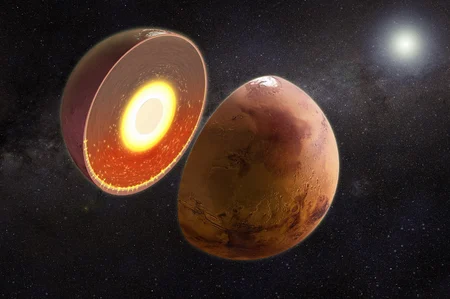
The planet Mars is currently characterized as a cold, desiccated wasteland, a far cry from the geologically active and potentially habitable world it was billions of years ago. However, a groundbreaking study published in the journal Nature has revealed that the interior of the Red Planet is far from a uniform, cooling cinder. An international team of researchers, led by Dr. Alexander Berne of the University of Arizona and formerly of Caltech, has discovered a significant thermal anomaly deep beneath the Martian surface. The study indicates that the southern hemisphere’s interior is approximately 200 to 400 degrees Celsius (392 to 752 degrees Fahrenheit) hotter than that of the northern hemisphere. This discovery suggests that the internal heat of Mars is not evenly distributed, a finding that carries profound implications for our understanding of planetary evolution, volcanic history, and the potential for subsurface liquid water.
The Evolution of the Martian Interior
To understand the significance of this thermal disparity, one must look back at the early history of the solar system. Approximately four billion years ago, Mars was a world of extremes. It possessed a much warmer interior, which fueled widespread volcanism. This volcanic activity was crucial for the planet’s early habitability, as it released gases that built a thick atmosphere. During this era, Mars also boasted a robust magnetic field generated by a geodynamo in its molten core. This magnetic shield protected the planet from the erosive power of solar winds and high-energy cosmic radiation. Under these protected conditions, liquid water flowed across the surface, carving the valleys and basins that are still visible today.
However, the fate of Mars was dictated by its size. With a radius roughly half that of Earth, Mars has a much higher surface-area-to-volume ratio. This physical reality caused the planet’s interior to lose heat much faster than Earth’s. As the core cooled, the geodynamo shut down, and the magnetic field withered away. Without its protective shield, the atmosphere was stripped away by solar winds, causing surface water to evaporate or freeze. For decades, the prevailing scientific consensus was that Mars had reached a state of near-total geological senescence. The new data regarding the North-South thermal dichotomy suggests that this cooling process was far more complex and asymmetrical than previously hypothesized.
Methodology: The Science of Tidal Tomography
The research team arrived at these conclusions by analyzing decades of archival data from three of NASA’s most prolific Mars missions: the Mars Global Surveyor (MGS), which operated from 1997 to 2006; Mars Odyssey, which has been orbiting the planet since 2001; and the Mars Reconnaissance Orbiter (MRO), active since 2006. By synthesizing data from these three platforms, researchers were able to track infinitesimal changes in spacecraft velocity as they orbited the planet. These fluctuations are caused by variations in Mars’s gravitational pull, which in turn reflect the density and structure of the material deep beneath the surface.
The team employed a sophisticated technique known as tidal tomography. This method relies on the fact that Mars, like Earth, experiences "tides" caused by the gravitational pull of the Sun. While Earth’s tides are most visible in its oceans, the entire body of a planet—including its solid crust and mantle—flexes and deforms slightly in response to external gravity. The degree to which a planet deforms depends on the temperature and "squishiness" of its interior. Warmer rock is more ductile and deforms more easily than cold, rigid rock.
By combining the orbital data with known factors such as Mars’s orbital eccentricity (0.093, significantly more elliptical than Earth’s 0.017) and its axial tilt (25.19 degrees), the researchers constructed a high-resolution gravitational model. This model allowed them to peer into the mantle and identify the temperature differences that exist between the two hemispheres.
The Martian Dichotomy and Crustal Insulation
One of the most striking features of Mars is its "crustal dichotomy." The northern hemisphere is dominated by the northern lowlands—vast, relatively smooth plains with an elevation significantly lower than the rest of the planet. In contrast, the southern hemisphere consists of the southern highlands—rugged, ancient, and heavily cratered terrain with a much thicker crust.
The research suggests that this physical difference is the primary driver of the thermal anomaly. The southern hemisphere’s crust is estimated to be significantly thicker than the northern crust. This extra layer of rock acts as a thermal blanket, insulating the mantle below and preventing heat from escaping into space. This insulation has likely preserved the elevated temperatures in the southern interior for billions of years, even as the northern interior cooled more rapidly due to its thinner crustal covering.
The only major exception to this southern heat retention is the Hellas Planitia, a massive impact basin in the south. Because the impact that created Hellas stripped away a massive portion of the crust, the elevation there is thousands of meters lower than the northern plains, potentially allowing for localized cooling in an otherwise hot hemisphere.
Corroborating Evidence from NASA’s InSight Mission
The findings from the tidal tomography study align remarkably well with data obtained by NASA’s InSight (Interior Exploration using Seismic Investigations, Geodesy and Heat Transport) lander. Before its mission ended in late 2022, InSight provided the first comprehensive look at the "pulse" of Mars by recording "marsquakes."
Seismologists noticed a peculiar pattern: seismic waves traveling through the southern hemisphere’s interior tended to dissipate and lose energy much faster than waves traveling through the northern interior. In geophysics, warmer, more attenuated rock absorbs seismic energy more readily than cold, solid rock. At the time, this was a puzzling observation, but the new research provides a definitive explanation. The seismic waves were being dampened by the higher temperatures and more ductile material residing deep beneath the southern highlands.
Official Perspectives and Scientific Impact
Dr. Alexander Berne, the lead author of the study, emphasized that these findings challenge the traditional "spherical symmetry" models used in planetary science. "Scientists usually assume that the interiors of planetary bodies are generally spherically symmetric, but this is not necessarily true," Dr. Berne stated. He noted that as gravity data becomes more precise, scientists are beginning to see the three-dimensional complexities that define a planet’s life story.
The study’s results have been met with significant interest from the broader scientific community. Geologists suggest that if the southern interior remains 400 degrees Celsius hotter than the north, it could mean that Mars is not as "dead" as once thought. While active surface volcanism has not been observed in modern times, the presence of such a significant heat reservoir suggests that pockets of magma could still exist deep underground. This raises the possibility of hydrothermal activity, which has long been a focal point for astrobiologists searching for signs of microbial life.
Implications for Future Exploration
The discovery of this thermal imbalance has practical implications for future Mars exploration, including both robotic and human missions. Understanding the interior heat distribution is vital for selecting landing sites where geothermal energy might be accessible or where subsurface ice might be melted into liquid water by internal heat.
Furthermore, the study provides a "blueprint" for how we study other planetary bodies. If Mars exhibits such extreme internal asymmetry, it is highly probable that other worlds—such as the Moon, Venus, or the icy moons of Jupiter and Saturn—also possess non-uniform interior temperatures. This will require a shift in how orbital missions are designed, placing a higher premium on long-term gravitational mapping.
Chronology of Mars Interior Research
To contextualize this discovery, it is helpful to look at the timeline of Martian geophysical study:
- 1970s (Viking Era): First attempts to detect marsquakes; results were inconclusive due to wind interference.
- 1996 (Mars Global Surveyor): Launch of the mission that provided the first high-resolution gravity and topographic maps, identifying the crustal dichotomy.
- 2001-Present (Mars Odyssey & MRO): Continuous monitoring of the planet, providing the long-term orbital data necessary for tidal tomography.
- 2018-2022 (InSight Mission): Successful deployment of a seismometer on the Martian surface, revealing the dampened seismic waves in the south.
- 2024 (Nature Publication): Synthesis of orbital and seismic data confirms the 200-400°C temperature difference between the hemispheres.
Conclusion: A New Chapter in Martian Science
The revelation that Mars possesses a "hot" side and a "cold" side deep beneath its surface marks a turning point in planetary geophysics. It proves that the history of a planet is written not just on its surface, but in the slow, uneven cooling of its heart. As researchers continue to refine their gravitational models and prepare for future missions—such as the Mars Sample Return—this new understanding of the planet’s internal heat will be foundational. Mars may be a desert today, but its interior remains a dynamic environment, holding the secrets of a world that refused to cool down quietly. The study serves as a reminder that the more we look at our celestial neighbors, the more we realize that "dead" planets are often far more alive than they appear.