Galang Taruna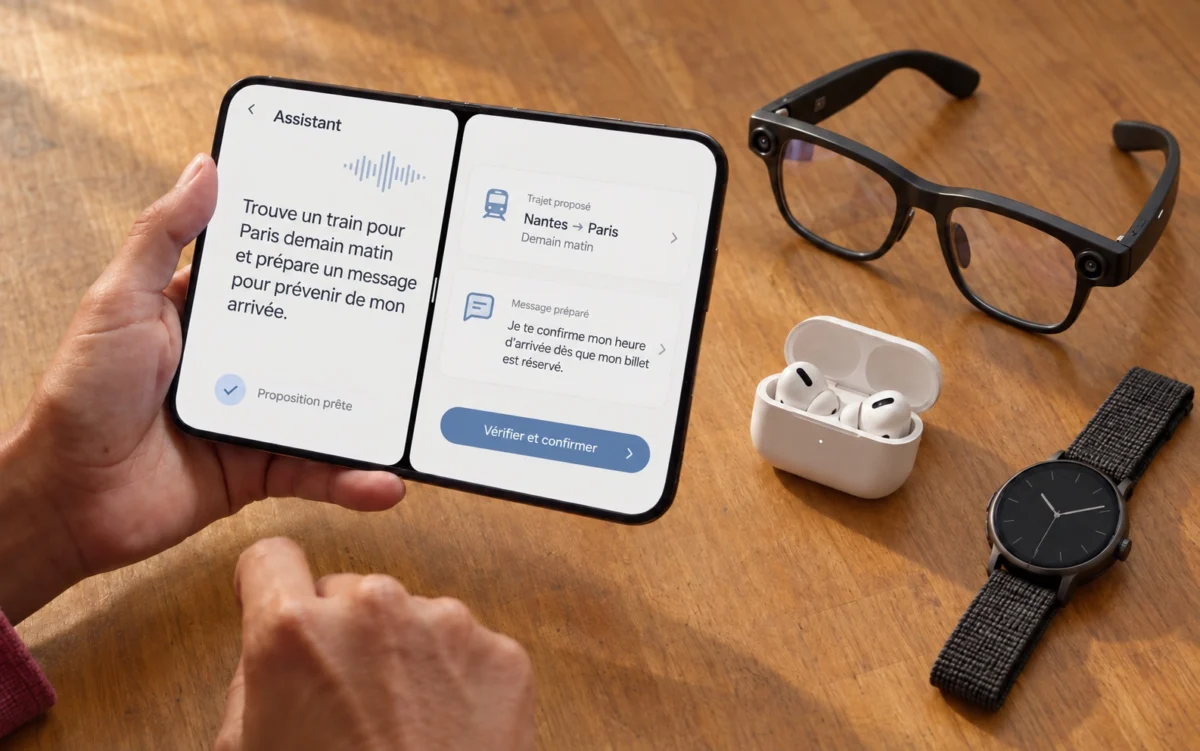
The notion that the ubiquitous smartphone screen could recede from its central role, often misconstrued as the device’s impending demise, is not a radical prediction but a long-standing thesis within the technology industry, now gaining unprecedented traction due to advancements in generative AI and connected wearables. This perspective, which initially sparked debate following a recent Frandroid article discussing Apple’s entry into the foldable phone market with the iPhone Duo, posits a fundamental re-evaluation of our primary digital interface, drawing parallels to the personal computer’s evolution rather than its extinction.
The discussion gained prominence in the wake of Apple’s latest keynote, where the introduction of the iPhone Duo, seven years after the Samsung Galaxy Fold pioneered the foldable segment, coincided with growing industry chatter about a post-smartphone era. While the foldable market has historically remained a niche, never exceeding 2% of total smartphone sales, Apple’s move into this segment appears counter-intuitive to some, given the simultaneous rise of technologies hinting at a future where the screen, and indeed the smartphone itself, might no longer be the undisputed nexus of our digital lives.
The Inefficiency of Current Digital Interaction
At the heart of this evolving thesis lies the inherent inefficiency of our current interaction model with digital devices. To accomplish almost any digital task today – from booking a train ticket to replying to a message or checking an arrival time – users typically follow a multi-step process: retrieve the smartphone, unlock it, locate the app icon, open the application, find the specific function, input data, and finally, interpret the result. This sequence, often involving five to seven distinct actions, has become so ingrained that its cumbersome nature is rarely perceived, primarily because it represents a significant improvement over pre-smartphone methods.
However, this reliance on an icon-driven, menu-navigated, thumb-operated interface is a direct consequence of machines’ historical inability to comprehend natural human intent. Users have been forced to "speak the machine’s language" through structured commands and visual menus displayed on a six-inch screen. The core theory suggests that if a machine can eventually understand a natural language request – such as "Book me a train to Paris tomorrow morning," "Tell them I’ll be late," or "Remind me what Lola said about the quote" – then the need to navigate applications, find functions, or manipulate complex on-screen forms significantly diminishes. When the interface transforms into a conversational exchange, the traditional screen, particularly as a primary input and navigation tool, loses a substantial part of its rationale. It’s not the end of all screens, but a reduction in the necessity for a single, central screen for every digital interaction.
A Decades-Old Vision Reinvigorated by AI
The concept of moving beyond the smartphone as the primary interface is not new. Its roots can be traced back over a decade, with several attempts preceding the current AI revolution:

- Google Glass (2013): This pioneering wearable attempted to integrate digital information into daily life via a prism display and voice commands. Its failure was multi-faceted, stemming from high cost, poor battery life, an awkward aesthetic, and privacy concerns related to its integrated camera. It represented an early, albeit premature, vision of ambient computing.
- Voice Assistants (Siri 2011, Alexa 2014): Early iterations of voice assistants aimed to allow hands-free interaction, primarily within the home environment. However, they largely failed to grasp complex user intentions, often executing simple commands rather than understanding nuanced requests. Their limited contextual awareness and fragmented capabilities prevented them from displacing the smartphone.
- Smartwatches: While successful in carving out a niche for notifications, mobile payments, and health monitoring, smartwatches never truly threatened the smartphone’s dominance. They augmented, rather than replaced, the primary device, serving as convenient extensions.
The broader idea of "ambient computing," where technology seamlessly integrates into the environment, was articulated as early as the 1990s by researchers at Xerox PARC. What differentiates the current moment from these earlier attempts is the advent of generative AI and Large Language Models (LLMs). This technology provides the missing piece: a computational engine capable of understanding natural language, processing complex intentions, and orchestrating multiple actions across various services without explicit application-level navigation.
The Distributed Computing Paradigm: Wearables as the New Frontier
No serious proponent of this thesis suggests a single device will replace the smartphone. Instead, the vision is one of a distributed computing environment, where various wearables collaboratively fulfill the functions currently consolidated within a single smartphone. This multi-device ecosystem might include:
- Smart Glasses: Offering contextual visual information, augmented reality overlays, and a discreet display for text. They see what the user sees, integrating digital and physical realities.
- Smart Earbuds: Facilitating two-way voice communication, audio experiences, and discreet AI assistant interactions.
- Smartwatches and Rings: Providing glanceable information like time, notifications, and crucial health data (heart rate, sleep patterns, activity tracking).
- Other Sensors: Embedded in clothing or worn as discreet accessories, measuring environmental data or specific biometrics.
In this paradigm, generative AI acts as the intelligent orchestrator, seamlessly connecting data from these disparate devices and executing user intentions, whether locally on a chip or via cloud processing. Each wearable addresses a specific set of needs, collectively offloading tasks from the smartphone without any single device attempting a direct, frontal assault on its comprehensive capabilities. This modular approach makes the thesis both credible and challenging to visualize, as it moves away from the singular "iPhone successor" model to a more integrated, ambient experience.
Lessons from Recent Failures: AI Pin and Rabbit R1
The recent market performance of devices like the Humane AI Pin and the Rabbit R1 offers critical insights into the viability of this distributed computing model.
- Humane AI Pin: Launched in 2024 at $699 plus a subscription, the AI Pin aimed to be a screen-less, standalone device using a laser projector on the palm for display and voice commands for interaction. Its ambitious attempt to replace the smartphone entirely without a traditional screen ultimately failed. Issues included significant latency (several seconds for responses), overheating, and an inability to deliver on its promise of seamless, comprehensive functionality. By February 2025, Humane was reportedly seeking an acquisition, eventually selling its patents to HP, demonstrating the immense difficulty of replicating the smartphone’s versatility in a screen-less, nascent form factor.
- Rabbit R1: This device also stumbled, failing to offer significant advantages over a free app on an existing smartphone. It made the same fundamental mistake as the AI Pin: directly challenging the smartphone on its own turf with an additional, less capable device. These failures highlighted that simply removing the screen or offering limited AI capabilities is insufficient; a new device must offer a truly superior or novel experience to justify its existence.
The Success of Complementary Wearables: Ray-Ban Meta
In stark contrast, wearables that adopt a complementary strategy are finding success. The Ray-Ban Meta smart glasses, for instance, have gained significant traction precisely because they do not pretend to replace the smartphone. Instead, they strategically offload specific functionalities, enhancing existing smartphone capabilities without attempting to supplant them entirely. These functions include:

- On-the-go photography and videography: Capturing moments discreetly and hands-free.
- Hands-free calls and audio playback: Managing communications and media while walking or engaged in other activities.
- Real-time translation: Interacting with the environment and others in new ways.
- Contextual AI queries: Asking questions about what the user is currently seeing or experiencing.
The Ray-Ban Meta glasses remain dependent on a smartphone (iPhone or Android) in the user’s pocket for connectivity and processing, which is their strength, not a weakness. This symbiotic relationship allows them to leverage the smartphone’s robust capabilities while providing an enhanced, more integrated user experience for specific tasks. EssilorLuxottica reported selling over 7 million units in 2025, tripling sales from the previous two years combined, and is discussing scaling production to 20 million units annually with Meta. The high demand for models like the Meta Ray-Ban Display, featuring in-lens displays and neural input bracelets, further underscores the market’s readiness for integrated, complementary wearables.
This burgeoning category is not a niche struggling to find its footing; it is a dynamic segment rapidly evolving alongside the smartphone, steadily absorbing more of its functions. Major players are investing heavily: Apple is reportedly accelerating its own smart glasses development, Google is re-entering the space with Warby Parker, and OpenAI has recruited former Apple design chief Jony Ive for a new, as-yet-unrevealed device. This concerted industry effort signals a clear shift towards an ecosystem of interconnected wearables, gradually diminishing the smartphone’s singular hold on digital interaction.
The Evolving Role of Screens: Peripheral, Not Absent
It is crucial to emphasize that this thesis does not predict the disappearance of screens. For tasks requiring focused attention, visual complexity, or extended interaction – such as watching a film, playing graphically intensive games, working on a spreadsheet, reading for hours, editing photos, or comparing multiple flight options – a dedicated screen remains incomparably more efficient and effective than a voice in the ear. No serious industry expert claims otherwise.
Instead, the argument is that this screen no longer needs to be the single, omnipresent rectangle we carry all day. It can be dynamically chosen based on the task: the display in smart glasses for augmented reality, a computer monitor for productivity, a tablet for immersive media, a car’s infotainment system, a television, or even a flexible, rollable screen deployed only when needed. The screen, in this future, becomes a peripheral, a tool selected for specific functions, rather than the central conduit through which all digital activity flows.
Challenges and the Inevitable Pace of Change
While the technological pieces are falling into place, several significant hurdles remain before this vision becomes widespread reality:
- Technological Maturity: Current smart glasses offer limited battery life (a few hours), basic text displays, and often still rely on the smartphone for complex tasks like booking a train.
- AI Reliability: While generative AI excels in demos, real-world application still faces challenges with accuracy, consistency, and the ability to seamlessly chain multiple actions across diverse services.
- Human Trust and Adaptation: The most formidable obstacle might be human behavior. An AI capable of booking a train implies entrusting it with financial transactions, personal preferences, and sensitive data. Building this level of trust in a machine takes years, if not decades. The smartphone itself took a decade after its 2007 introduction to become truly ubiquitous. Any transition to a post-smartphone era will likely follow a similarly gradual, generational timeline.
The "PC Destiny": A More Accurate Analogy

The most apt analogy for the smartphone’s future, therefore, is not the abrupt disappearance of the Minitel, but the enduring, yet transformed, fate of the personal computer. The PC has not vanished; over 250 million units are still sold annually, remaining indispensable for serious productivity, creative work, and home use. However, sometime between 2011 and 2015, the PC ceased to be the central organizing principle of our personal digital lives. Accounts, photos, messages, and personal identity all migrated to the smartphone, relegating the PC to a valuable but non-central peripheral.
The thesis of the smartphone’s evolving role suggests a similar, further step: the smartphone will persist, selling hundreds of millions of units, but personal identity, memory, and the core AI assistant will shift to devices worn on the body. The pocket screen will become one accessory among many, used when its specific capabilities (e.g., large visual display for complex data, immersive media) are required, rather than for every digital interaction.
Apple’s Paradox and the Path Forward
This broader industry movement towards an app-less, assistant-driven, distributed computing model, evidenced by EssilorLuxottica’s sales figures, OpenAI’s recruitment drives, Google’s initiatives, and Meta’s wearable success, creates an interesting paradox with Apple’s recent strategy. The Apple keynote, which dedicated twenty minutes to a context-aware Siri before an hour on screen-centric announcements, and the introduction of the iPhone Duo, exemplify this tension.
Apple’s decision to "double down" on the screen with a foldable device, at a time when parts of the industry suggest the screen’s centrality is diminishing, can be interpreted in two ways. It could be seen as a contradiction, clinging to a fading paradigm. Alternatively, it could be a coherent strategic bet: if an intelligent AI assistant performs the heavy lifting, a large, flexible display becomes an ideal canvas to visualize its actions and results, offering a versatile interface that complements the ambient interaction of wearables. Both theses – the distributed wearable future and the enhanced, flexible screen – are competing for dominance in the coming decade.
Ultimately, while predicting the exact future remains speculative, the trajectory suggests that in ten years, a smartphone will likely still reside in our pockets, but its retrieval will be far less frequent. The era of meticulously searching for an icon to perform routine tasks, like checking a train schedule, may become a quaint memory. This is not a death, but a profound redefinition of its role – a gradual, strategic retreat from centrality, much like the personal computer before it, ushering in a more intuitive, ambient, and distributed digital experience.