Chandra Wibowo
The United States has witnessed an unprecedented surge in web traffic to Kalshi, a prominent prediction market platform, with visits from the US skyrocketing by over 1,500% in the past year. This dramatic increase in user engagement coincides with a period of intense scrutiny from regulators and ongoing legal battles concerning the nature and oversight of its expanding event-contract business. The platform’s explosive growth, particularly in its US market share, highlights its rapid ascent within the burgeoning prediction market industry, even as its operational framework faces critical legal challenges.
Data reviewed by Cointelegraph on Friday, sourced from Similarweb, reveals that Kalshi recorded approximately 15.4 million visits from the United States in July. This figure represents a staggering 1,520% leap from just under 1 million visits in August of the previous year. The concentration of this growth is particularly notable, with US traffic accounting for nearly 80% of Kalshi’s total traffic in July, an increase from 72.8% in August of the prior year. This indicates that Kalshi’s expansion has remained overwhelmingly anchored within the American market, underscoring its significant appeal and reach among US users.
This surge in user interest is occurring concurrently with a period of heightened legal and regulatory attention. The core of the dispute revolves around whether Kalshi’s contracts, particularly those related to sports events, fall under the purview of federal oversight, such as that of the Commodity Futures Trading Commission (CFTC), or are subject to state-level gambling laws. The gravity of this debate is exemplified by New Jersey’s decision to escalate the matter to the U.S. Supreme Court, marking a pivotal moment in the legal classification of prediction markets.
Trading Volume Outpaces Traffic Growth, Signaling Market Maturity
Beyond the impressive rise in web traffic, Kalshi’s trading activity has experienced an even more accelerated growth trajectory. This rapid expansion of trading volume suggests that the prediction market ecosystem, with Kalshi as a leading participant, is not only attracting more users but also fostering deeper engagement and higher transactional values.
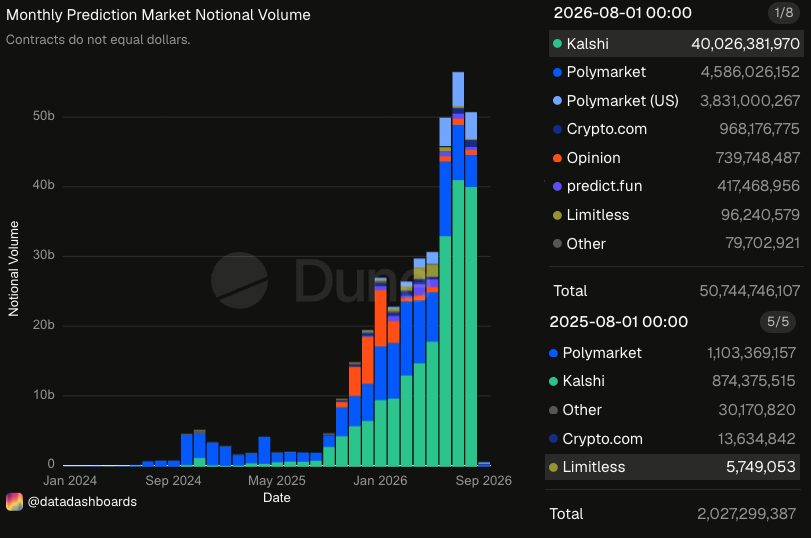
According to a Dune Analytics prediction market data dashboard, Kalshi recorded an astonishing $40 billion in notional trading volume in August. This represents an increase of approximately 4,500% from the $874 million reported a year earlier. This dramatic leap in trading volume far surpasses the growth in web traffic, indicating a significant increase in the average value or frequency of trades conducted on the platform.
The broader prediction market industry has mirrored this trend, albeit at a slightly less concentrated pace. Across the entire sector, monthly notional volume has surged to $50.7 billion from approximately $2 billion over the same period. Kalshi alone accounts for nearly 79% of this substantial current total, cementing its dominant position within the global prediction market landscape.

The nature of these contracts is a key factor in the ongoing regulatory debate. A significant portion of Kalshi’s trading volume, specifically 83% in July, is derived from sports-related contracts, as reported by Barron’s on Thursday. This heavy reliance on sports betting-adjacent markets is central to the legal arguments questioning whether these products constitute unregistered securities or are instead forms of gambling.
Kalshi Attracts Growing Traffic from Jurisdictions Where Direct Access is Prohibited
Intriguingly, Kalshi is also experiencing a notable increase in web traffic from countries where its user agreement explicitly prohibits direct access to its platform. This phenomenon raises questions about how users in these restricted jurisdictions are engaging with the platform and the efficacy of existing geographical restrictions.
Canada, for instance, generated approximately 450,000 visits to Kalshi’s website in July, a substantial increase from roughly 50,000 visits in August of the previous year. Similarly, traffic from the United Kingdom rose to 296,000 visits from 31,000 in the same comparative period. Both Canada and the UK are listed among the jurisdictions where Kalshi’s member agreement explicitly prohibits users from directly accessing or trading on its platform.
This situation has led to an interesting dynamic: while direct access is forbidden, Kalshi has actively sought alternative avenues for market penetration. In June, the company announced a partnership with Wealthsimple, a Canadian financial services company. This collaboration aims to provide access to nearly 4,000 eligible Kalshi contracts through a separate application, thereby circumventing direct platform access issues. The increased web traffic from these regions, despite direct prohibitions, may indicate a growing interest in the platform’s offerings, potentially through indirect means or a desire to circumvent existing restrictions.
Despite the absolute increase in visits from both Canada and the UK, their respective shares of Kalshi’s total traffic have slightly decreased. From August 2025 to July 2026, Canada’s share of Kalshi’s traffic slipped to 2.3% from 3.8%, while the UK’s share fell to 1.5% from 2.4%. This suggests that while traffic from these specific countries is growing, the explosive growth within the United States is outpacing it, further solidifying the US as Kalshi’s primary market.
Cointelegraph reached out to Kalshi for comment regarding the traffic originating from these restricted jurisdictions, but had not received a response by the time of publication.
Historical Context and Regulatory Landscape
The current regulatory and legal challenges facing Kalshi are not new to the prediction market industry. Platforms that allow users to bet on the outcome of future events have long occupied a gray area between financial markets and gambling. The U.S. Commodity Futures Trading Commission (CFTC) has historically asserted its authority over derivatives, including contracts for differences and futures contracts, classifying them as regulated financial instruments when they meet certain criteria.
Kalshi’s approach of offering contracts on a wide range of events, from economic indicators and political outcomes to sporting events, has drawn particular attention. The argument from regulators often centers on whether these contracts are designed as speculative investments or as wagers. If deemed speculative investments, they would fall under the CFTC’s jurisdiction, requiring registration and adherence to stringent rules designed to protect investors and ensure market integrity. If classified as gambling, they would be subject to state-level regulations, which vary significantly and are often more restrictive.
The legal dispute initiated by New Jersey, and now heading to the Supreme Court, is poised to set a significant precedent. The outcome of this case could determine the regulatory framework for Kalshi and other prediction market platforms operating in the United States for years to come. The platform’s rapid growth, both in user numbers and trading volume, amplifies the stakes of these legal proceedings. A favorable ruling could pave the way for further expansion and integration into mainstream financial activities, while an unfavorable one could lead to significant operational restrictions or even a complete overhaul of its business model.
The platform’s ability to attract such a substantial user base and trading volume in a relatively short period suggests a strong market demand for its unique product offering. Prediction markets tap into a fundamental human desire to anticipate future events and express opinions on them, offering a novel way to engage with news, politics, economics, and entertainment. Kalshi’s success in capturing this demand, particularly within the US, highlights its effectiveness in product design and user acquisition.
However, the legal uncertainties cast a long shadow over this rapid growth. The contrast between the platform’s booming commercial success and its precarious regulatory standing creates a complex and dynamic environment. The increasing volume of traffic from restricted jurisdictions also adds another layer of complexity, potentially drawing further attention from international regulators or prompting Kalshi to refine its international access strategies.
The broader implications of Kalshi’s trajectory extend beyond the company itself. Its growth is a barometer for the increasing acceptance and sophistication of prediction markets as a legitimate avenue for speculation and information aggregation. The platform’s ability to navigate the intricate legal and regulatory landscape will be a critical factor in determining whether prediction markets can achieve mainstream adoption as a financial product, or if they will remain confined to the fringes, subject to the whims of evolving legal interpretations. The ongoing legal battles, coupled with the undeniable surge in user engagement, paint a picture of an industry at a critical juncture, poised for either significant expansion or substantial regulatory recalibration.