Garick Elordi
The landscape of handheld gaming has undergone a significant transformation with the commencement of a public playtest for Asobi: Remote Play, a third-party application designed to bridge the gap between Sony’s PlayStation ecosystem and Valve’s Steam Deck. This new utility allows users to stream PlayStation titles directly to SteamOS and Linux-based devices without the requirement of a physical PlayStation 5 console, provided they maintain an active PlayStation Plus Premium subscription. While remote play from local hardware has been a staple of the Steam Deck community through various community-developed tools, the integration of direct cloud streaming represents a pivotal shift in how Sony’s exclusive library can be accessed on non-proprietary hardware.
The Evolution of Handheld Streaming
For several years, the Steam Deck has served as a versatile vessel for "remote play," a process where a user’s home console handles the graphical processing and transmits the video feed over a local network or the internet to the handheld. Applications such as Chiaki, Chiaki4Deck, and PSPlay have long facilitated this experience, allowing users to play their owned PS4 and PS5 games in bed or on the move. However, these solutions always required the user to own the underlying PlayStation hardware.
The emergence of Asobi: Remote Play’s latest feature changes this dynamic. By tapping into Sony’s PlayStation Plus Premium cloud infrastructure, the app allows the Steam Deck to function similarly to the PlayStation Portal’s recently updated cloud-streaming mode. This means that for the first time, a Steam Deck user can play titles like God of War Ragnarök or Horizon Forbidden West via the cloud, bypassing the need for a £450/$500 console investment.
Technical Specifications and Playtest Details
The developer, known as Ichenzo, announced the public playtest via the application’s dedicated subreddit, inviting users to test the robustness of the cloud integration. During this testing phase, Asobi is offering its "Premium" suite of features to all participants at no additional cost. These features include high-performance metrics that often exceed the capabilities of official streaming solutions on other platforms.
Key technical offerings during the playtest include:
- 60 FPS Performance: Ensuring fluid gameplay that matches the target framerate of most modern console titles.
- HDR Support: Leveraging the Steam Deck OLED’s high-dynamic-range display for improved color accuracy and contrast.
- 4K Upscaling: Utilizing advanced scaling algorithms to sharpen the image beyond the standard streaming resolution.
- Manual Bitrate Control: Allowing users with high-bandwidth connections to prioritize image quality or users on weaker networks to prioritize stability.
- Controller Haptics: Attempting to translate the nuances of the DualSense controller to the Steam Deck’s haptic motors.
Once the application moves out of its playtest phase and enters a full release on the Steam Store, the developer intends to implement a tiered model. The free version of Asobi is expected to be capped at a 1080p resolution and 30 frames per second, while the advanced features—including 60 FPS and HDR—will likely be locked behind a one-time purchase or "Premium" unlock. Pricing for this tier has yet to be finalized.
Strategic Context: Sony and the PlayStation Portal
The timing of Asobi’s expansion is particularly notable given Sony’s recent moves in the handheld space. In November 2024, Sony released a significant firmware update for the PlayStation Portal, its dedicated £220/$200 remote play device. This update finally enabled cloud streaming for PlayStation Plus Premium members on the Portal, a feature that was conspicuously absent at the device’s launch in late 2023.
By enabling cloud streaming on the Steam Deck, Asobi effectively positions the Valve handheld as a direct competitor to the PlayStation Portal. While the Portal offers the advantage of an 8-inch LCD screen and native DualSense ergonomics, the Steam Deck offers a more versatile operating system, an OLED screen option, and the ability to switch between PlayStation streaming, local Steam games, and various other media applications.
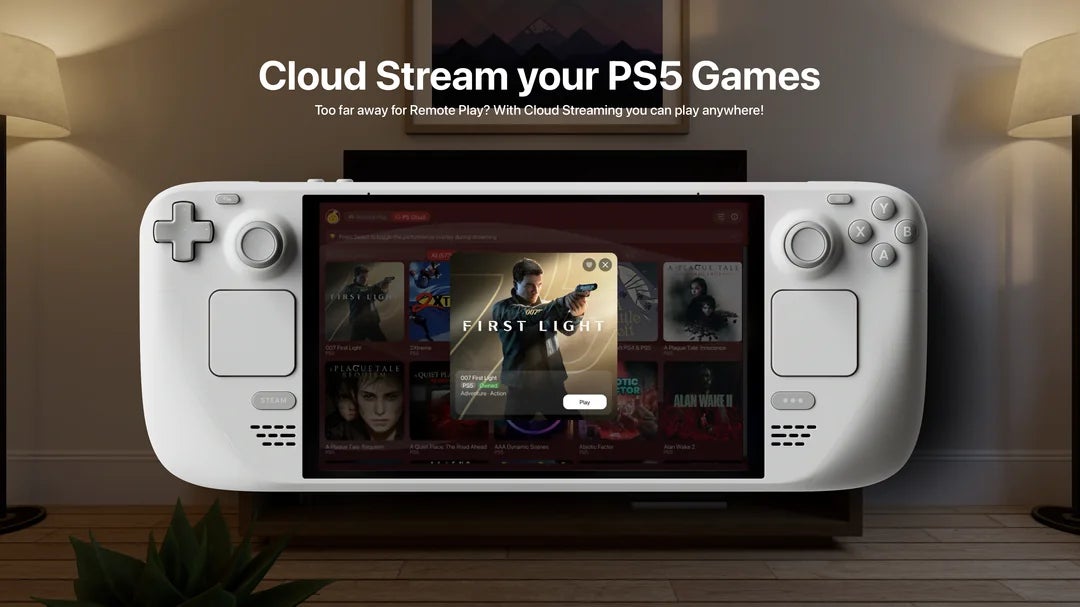
The PlayStation Plus Premium tier, which is required for Asobi’s cloud functionality, currently costs approximately £13.49 per month or £119.99 annually in the United Kingdom ($17.99/$159.99 in the US). This subscription provides access to a "Cloud Catalog" featuring hundreds of PS5, PS4, and classic titles. For gamers who do not wish to own a console but want access to Sony’s first-party prestige titles, the combination of a Steam Deck and an Asobi-enabled subscription presents a compelling value proposition.
Installation and Ecosystem Compatibility
Asobi: Remote Play is designed to run natively within the SteamOS environment. Unlike some third-party tools that require users to navigate the Linux desktop mode or execute complex terminal commands, Asobi aims for a more integrated experience. The developer has stated that there is no need to exit to the desktop or use external compatibility layers once the app is configured.
While the current focus remains on SteamOS and general Linux distributions, Ichenzo has confirmed that a Windows version of the application is currently in development. This would further expand the app’s reach to users of the ASUS ROG Ally, Lenovo Legion Go, and MSI Claw—handheld PCs that run Windows 11 and currently rely on the official, though often criticized, PlayStation Remote Play Windows app.
Market Implications and Third-Party Risks
The rise of Asobi highlights a growing trend of "platform-agnostic" gaming. As hardware costs rise and the "console wars" shift toward service-based competition, users are increasingly seeking ways to consolidate their gaming experiences onto a single device. The Steam Deck, with its open-source philosophy, has become the primary laboratory for this consolidation.
However, the use of third-party applications to access proprietary services carries inherent risks. Asobi is not an official Sony product and has no formal affiliation with PlayStation, Valve, or Steam. Historically, Sony has been protective of its ecosystem. While they have generally allowed third-party remote play clients like Chiaki to exist, the integration of cloud streaming involves tapping into Sony’s server-side infrastructure in a way that local remote play does not.
There is a precedent for platform holders taking action against third-party tools that they perceive as bypassing their hardware sales. If Sony views Asobi as a threat to the sales of the PlayStation Portal or the PS5 console itself, they could theoretically update their network authentication protocols to block the app. Conversely, if Sony views such tools as a way to increase the number of PlayStation Plus Premium subscribers, they may adopt a policy of "benign neglect," allowing the app to function as long as it does not facilitate piracy.
Community Reaction and Future Outlook
The response from the Steam Deck community has been largely positive. On social media platforms and dedicated forums, users have praised the developer for providing a feature that many felt Sony should have provided officially via a Linux-compatible app. Early testers have reported that the setup process, while requiring a PSN account login, is relatively straightforward compared to older community tools.
The broader implication for the gaming industry is the further de-coupling of software from specific hardware. If a player can enjoy a "PlayStation experience" on a Valve device with near-native performance, the traditional "walled garden" model of console gaming continues to erode. This benefits the consumer through increased choice and flexibility but poses a challenge for manufacturers who rely on hardware sales to anchor their ecosystems.
As the playtest continues, the developer is expected to refine the user interface and address any latency issues inherent in cloud streaming. The success of Asobi: Remote Play will likely depend on its ability to maintain a stable connection to Sony’s servers and its capacity to stay ahead of any security or protocol changes implemented by the platform holder. For now, Steam Deck owners have gained a powerful new tool that significantly expands the library of their device, turning it into a portable gateway to the PlayStation universe without the need for the console that defines it.