Chandra Wibowo

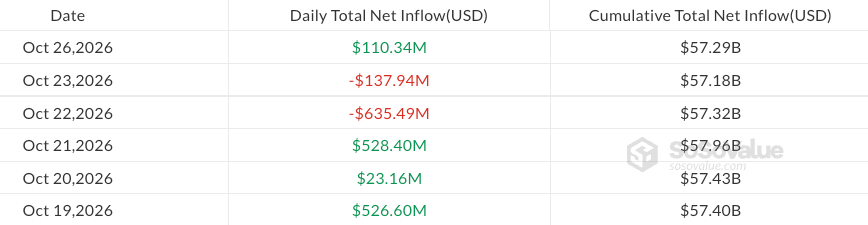
US-listed spot Bitcoin exchange-traded funds (ETFs) concluded October with a net outflow of approximately $202 million, a figure that underscores a period of investor caution despite a recent uptick in inflows. This trend highlights the ongoing volatility and sentiment shifts within the cryptocurrency market, even as institutional products designed to offer easier access to Bitcoin continue to attract attention.
The recent rebound saw these ETFs garner $110 million in net inflows on Monday. This positive movement came as a welcome development after a preceding two-day period that witnessed significant withdrawals totaling $774 million. The data, compiled by SoSoValue, suggests that while short-term sentiment may fluctuate, the broader monthly picture for October remained one of net divestment from these Bitcoin-backed investment vehicles.
A Month of Contradictions: Outflows Masked by Short-Term Gains
The $202 million in net outflows for October represents a significant figure for the nascent spot Bitcoin ETF market. Launched earlier in the year, these products were heralded as a potential catalyst for increased institutional adoption and price appreciation for Bitcoin. However, the consistent outflows throughout much of October indicate that investors, on balance, chose to reduce their exposure to Bitcoin through these regulated channels.
The inflows recorded on Monday offered a brief respite from this trend. This surge of $110 million can be interpreted in several ways. It might signal a renewed sense of optimism among a segment of investors, potentially reacting to perceived buying opportunities at lower price levels. Alternatively, it could be a short-term technical adjustment or a response to specific market news that temporarily boosted sentiment. Regardless of the exact cause, the immediate positive flow demonstrates that demand for Bitcoin ETFs is not entirely absent, even amidst broader outflows.

Market Context: Bitcoin’s Price Action and Investor Sentiment
The performance of Bitcoin ETFs is intrinsically linked to the underlying asset’s price and overall market sentiment. At the time of publication, Bitcoin was trading around $79,595, having experienced a 2.6% decline over the preceding seven days, according to CoinGecko. This price action suggests a period of consolidation or minor correction, which can often lead to increased investor apprehension.
Compounding this, the broader cryptocurrency market sentiment has also shown signs of weakening. The Crypto Fear & Greed Index, a popular metric for gauging market psychology, dipped to 48 from 50 the previous day. While still within the "Neutral" territory, this downward movement indicates a slight shift towards fear, away from the more optimistic "Greed" zone. A decline in this index often correlates with decreased investor confidence and a greater propensity for risk aversion, which can translate into outflows from investment products.
Retail Investor Activity and Whale Behavior
Further insights into market dynamics come from data provided by CryptoQuant. This analysis reveals a divergence in behavior between retail investors and large holders, often referred to as "whales." Over a 30-day period, retail investors reportedly increased their Bitcoin deposits to the cryptocurrency exchange Binance by nearly double, reaching $10.8 billion. In stark contrast, deposits from large holders to the same exchange saw a significant decrease, falling to $3.8 billion.
This pattern suggests a potential shift in market participation. The increase in retail deposits to an exchange like Binance could indicate that smaller investors are actively seeking to enter or re-enter the market, possibly taking advantage of price dips or anticipating a rebound. However, analyst Darkfost, writing on CryptoQuant, offered a nuanced interpretation. Darkfost posited that this surge in retail deposits might not necessarily signal an intent to buy, but rather an opportunity for smaller investors to "sell" during the recent price rebound. This perspective suggests that some retail investors might be using temporary price upticks to exit their positions, contributing to overall selling pressure.
The simultaneous reduction in deposits from large holders is also noteworthy. Whales, due to their significant holdings, can have a substantial impact on market prices. A decrease in their deposits to exchanges might imply several things: they could be holding onto their Bitcoin with a longer-term conviction, moving their assets to private wallets for safekeeping, or strategically selling at higher price points. If the latter is true, it could contribute to the downward pressure on Bitcoin’s price and, consequently, influence investor sentiment towards ETFs.
Historical Context: The Launch and Early Days of Spot Bitcoin ETFs
The approval and subsequent launch of spot Bitcoin ETFs in the United States in January 2024 marked a significant milestone for the cryptocurrency industry. For years, proponents had advocated for such regulated investment products, arguing they would legitimize Bitcoin as an asset class and attract a broader range of investors, including institutional funds and retirement plans that are often restricted from directly holding cryptocurrencies.
The initial launch saw a flurry of inflows, with several ETFs accumulating billions of dollars in assets under management within their first few months. This early success fueled optimism about Bitcoin’s future price trajectory. However, the market for these ETFs, like Bitcoin itself, has proven to be susceptible to cycles of enthusiasm and apprehension. Periods of sustained inflows have been interspersed with significant outflows, reflecting the inherent volatility of the underlying asset and the evolving risk appetite of investors.
The October outflows, while concerning, should be viewed within this broader context. The cryptocurrency market is still relatively young, and investor behavior can be highly sensitive to macroeconomic factors, regulatory developments, and shifts in technological narratives. The emergence of spot Bitcoin ETFs has provided a new lens through which to observe these dynamics, offering a quantifiable measure of institutional and retail interest in Bitcoin through regulated channels.
Analyzing the Implications: What Do the Outflows Mean?
The persistent net outflows from US spot Bitcoin ETFs in October carry several potential implications:
- Investor Caution: The most direct implication is that, on balance, investors are exercising caution regarding Bitcoin’s short-to-medium term prospects. This could be driven by a variety of factors, including concerns about inflation, interest rate policies, geopolitical instability, or simply a desire to lock in profits after earlier price surges.
- Profit-Taking: As suggested by analyst Darkfost, some investors may be using price rebounds to realize gains. This is a natural part of any market cycle, but when it occurs consistently, it can lead to net outflows.
- Rotation into Other Assets: It is possible that investors are reallocating capital from Bitcoin ETFs to other asset classes that they perceive as offering better risk-adjusted returns or more stability in the current economic climate.
- ETF Performance: While the ETFs track Bitcoin’s price, their performance is also influenced by the flow of money in and out of the funds. Sustained outflows can put downward pressure on the ETF’s net asset value, independent of Bitcoin’s price movements.
- Institutional Hesitation: While ETFs were expected to be a gateway for institutional capital, consistent outflows might suggest that some institutions are still adopting a wait-and-see approach, perhaps waiting for clearer market direction or more favorable economic conditions.
However, it is crucial to avoid drawing definitive conclusions based on a single month’s data. The cryptocurrency market is characterized by its rapid pace of change, and investor sentiment can shift quickly. The rebound in inflows on Monday demonstrates this inherent volatility.

Looking Ahead: Factors Influencing Future ETF Flows
The future trajectory of Bitcoin ETF flows will likely be influenced by a confluence of factors:
- Bitcoin Price Performance: The most significant driver will undoubtedly be the price of Bitcoin itself. A sustained upward trend in Bitcoin’s price is likely to attract more inflows, as it signals positive momentum and potential for further gains. Conversely, continued price declines could exacerbate outflows.
- Macroeconomic Environment: Global economic conditions, including inflation rates, central bank policies (such as interest rate decisions), and the overall health of financial markets, will play a crucial role. A more stable and predictable economic environment could encourage greater risk-taking.
- Regulatory Clarity: While the approval of spot Bitcoin ETFs was a major step, ongoing developments in cryptocurrency regulation globally can impact investor confidence and the perceived risk associated with Bitcoin.
- Technological Developments: Advances in Bitcoin’s underlying technology, such as scaling solutions or new use cases, could boost its long-term appeal and attract more investment.
- Halving Event: The upcoming Bitcoin halving event, which is expected to reduce the rate at which new Bitcoins are created, has historically been a bullish catalyst. Its impact on ETF flows will be closely watched.
The performance of US spot Bitcoin ETFs in October serves as a reminder that the path to mainstream adoption for cryptocurrencies is not linear. While the products offer a regulated avenue for investment, they remain tethered to the inherent volatility and evolving sentiment of the broader digital asset market. The recent rebound in inflows offers a glimmer of renewed interest, but the overarching trend of outflows in October underscores the caution that continues to permeate investor sentiment. The coming months will be critical in determining whether this month’s outflows represent a temporary pause or a more significant shift in investor strategy.