Chandra Wibowo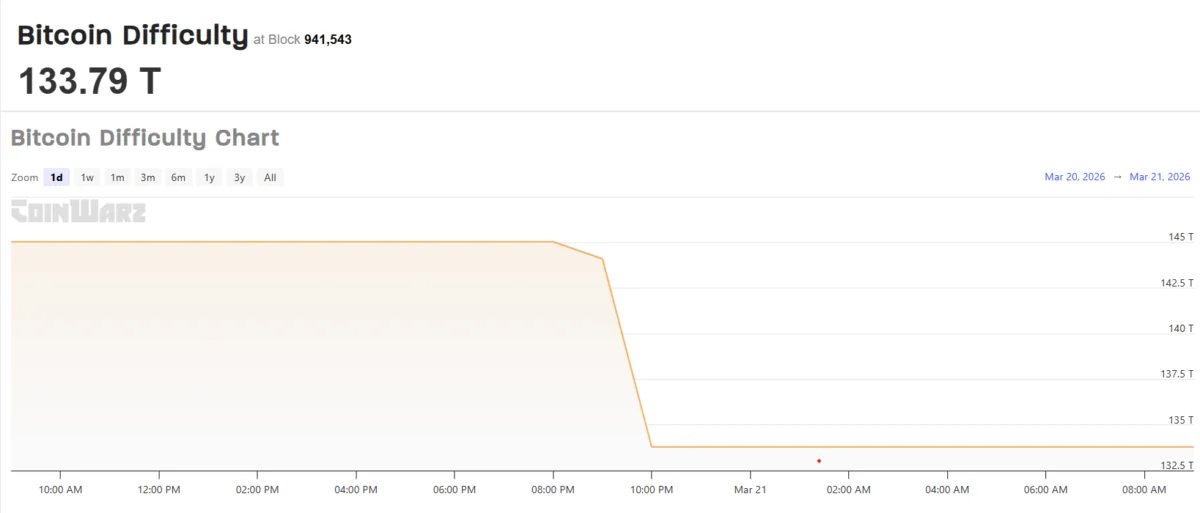
The Bitcoin mining difficulty experienced a significant decrease of approximately 7.7% during its latest adjustment on March 20, settling at 133.79 trillion at block height 941,472. This marks the most substantial decline observed since February, according to data compiled by CoinWarz. This downward adjustment follows a period of slower-than-target block production, a critical metric that influences the network’s self-regulating difficulty mechanism.
The recalibration has brought the mining difficulty down from an average of roughly 145 trillion in mid-March and a higher figure of approximately 148 trillion at the commencement of the year. A reduced difficulty level directly translates to a lessened computational effort required for miners to successfully mine a new block and earn the associated Bitcoin reward. Consequently, this can lead to a marginal improvement in revenue per unit of hashrate for mining operations that maintain continuous online activity.
Understanding Bitcoin Difficulty Adjustments
Bitcoin’s mining difficulty is a fundamental parameter within its protocol, designed to ensure a consistent issuance rate of new bitcoins. The network aims to produce a new block approximately every ten minutes. To achieve this, the difficulty is automatically adjusted roughly every two weeks, or more precisely, every 2,016 blocks. This dynamic adjustment mechanism is crucial for maintaining the predictable supply schedule of Bitcoin, a core tenet of its economic design.
When the collective computing power, or hashrate, dedicated to the Bitcoin network increases, the mining difficulty rises. This increase in difficulty serves to counteract the enhanced hashing power, preventing blocks from being mined too rapidly and thus preserving the ten-minute block time target. Conversely, if the hashrate on the network declines, the difficulty is automatically lowered. This reduction makes it easier for the remaining miners to find valid hashes, thereby stabilizing the block production rate.
The recent adjustment was triggered by an observed slowdown in block production over the preceding 2,016 blocks. Data from CloverPool indicated that the average block time during this period hovered around 12 minutes and 36 seconds, significantly exceeding Bitcoin’s ten-minute target. This deviation necessitated the network’s automated recalibration to bring the average block time back in line with the protocol’s design.
Historical Context: Weather Disruptions and Recovery
This is not the first significant difficulty adjustment in recent memory. In February, the Bitcoin mining difficulty experienced a sharp drop. This event was primarily attributed to severe weather-related disruptions across the United States, which temporarily forced a substantial number of American mining facilities offline. The cessation of operations by these large-scale miners led to a notable decrease in the global hashrate, prompting the network to lower its difficulty.
Following this period of disruption, as power conditions normalized and mining operations in the affected regions resumed, the hashrate on the network began to recover. This recovery was reflected in a subsequent rebound of the Bitcoin mining difficulty, which increased by approximately 15% as miners brought their operations back online and reconnected to the network. This cyclical pattern highlights the sensitivity of Bitcoin mining operations to external factors, particularly energy availability and infrastructure stability.
The Broader Trend: Miners Diversifying into AI and HPC
The latest difficulty adjustment for Bitcoin mining occurs against a backdrop of a significant strategic shift within the mining industry. Several publicly listed mining companies are increasingly exploring and investing in Artificial Intelligence (AI) and High-Performance Computing (HPC) infrastructure. This diversification is driven by the pursuit of more stable and potentially higher returns on their substantial investments in power and data-center capacity.
The convergence of Bitcoin mining and AI infrastructure is becoming a prominent theme. Crypto trader Ran Neuner, in a widely discussed commentary last week, posited that AI had emerged as Bitcoin mining’s most formidable competitor, particularly in the competition for electricity. He went as far as to suggest that "AI has killed Bitcoin forever," underscoring the perceived intensity of this competition for energy resources.
This sentiment is being translated into tangible actions by major players in the Bitcoin mining sector. Companies such as Core Scientific, MARA Holdings, Hut 8, and Cipher Mining have initiated processes to reallocate their existing infrastructure or pivot their operational focus towards AI workloads. Concurrently, some operators are reportedly reducing their overall hashrate or decommissioning less efficient mining rigs as profitability margins tighten due to various market pressures, including electricity costs and the diminishing block subsidy from Bitcoin halving events.

An example of this strategic realignment can be seen in Bitdeer’s actions. On February 21, Bitdeer liquidated approximately 943 BTC from its reserves and also sold newly mined coins, effectively reducing its corporate Bitcoin holdings to zero. In its most recent update on March 21, the company confirmed that its Bitcoin holdings remained at zero, indicating a clear move away from direct Bitcoin accumulation.
Implications for the Mining Ecosystem
The recent difficulty adjustment, while a routine occurrence in the Bitcoin network’s operation, carries several implications for the mining ecosystem.
-
Improved Profitability for Remaining Miners: A lower difficulty directly benefits miners who continue to operate. With less computational power needed to secure a block, the cost per Bitcoin mined decreases, potentially improving profit margins, especially for those with access to low-cost electricity and efficient hardware. This could provide a much-needed respite for miners facing economic pressures.
-
Potential for Increased Centralization Concerns: While a difficulty drop generally makes mining more accessible, if a significant portion of hashrate leaves the network due to operational challenges or pivots to other ventures, it could, in theory, lead to a temporary increase in the concentration of hashrate among the largest remaining entities. However, the decentralized nature of Bitcoin mining, with miners operating globally, mitigates this risk in the long term.
-
Signaling Market Conditions: The significant drop in difficulty can also serve as an indicator of the current state of the Bitcoin mining market. It suggests that a notable amount of hashing power has been withdrawn from the network, likely due to economic unviability for some operators. This could be a consequence of rising operational costs, falling Bitcoin prices, or a combination of both.
-
The AI Competition Dynamic: The ongoing pivot towards AI and HPC by mining companies highlights a critical juncture for the energy-intensive digital asset industry. The competition for electricity and data center resources between Bitcoin mining and the burgeoning AI sector is likely to intensify. This dynamic could lead to higher energy prices, impacting all energy consumers, and may also spur innovation in energy efficiency and renewable energy adoption within both industries.
-
Strategic Adaptation: The proactive diversification by major mining firms into AI and HPC demonstrates a strategic adaptation to evolving market conditions and technological advancements. By leveraging their existing expertise in managing large-scale computing infrastructure and energy consumption, these companies are seeking to create new revenue streams and reduce their reliance solely on Bitcoin mining, which is subject to the volatility of cryptocurrency markets and the inherent reductions in block rewards over time (halving events).
Looking Ahead: Future Adjustments and Industry Evolution
The next Bitcoin difficulty adjustment is currently projected to occur around April 3, although this estimate is subject to change with each newly mined block. The trajectory of future difficulty adjustments will depend on the aggregate hashrate of the network. If miners continue to bring more efficient hardware online or if those who temporarily disconnected resume operations, the difficulty is likely to increase again. Conversely, if more miners exit the network or reduce their operations, further downward adjustments could occur.
The evolving landscape, marked by the significant difficulty drop and the strategic shift towards AI, underscores the dynamic and adaptive nature of the Bitcoin mining industry. While challenges related to energy costs and market volatility persist, the industry’s ability to innovate and diversify suggests a resilience that could shape its future trajectory. The interplay between Bitcoin mining and the rapidly expanding AI sector will be a key factor to monitor in the coming months and years.
This period of adjustment and strategic re-evaluation within Bitcoin mining highlights the constant interplay between technological innovation, market economics, and the fundamental protocols that govern the cryptocurrency ecosystem. The network’s self-correcting difficulty mechanism, coupled with the strategic decisions of its participants, will continue to shape the landscape of digital asset mining.
Related: Cango reports $285M Q4 loss as Bitcoin mining costs surge in 2025
Would Bitcoin survive a 10-year power outage?