
 Clarissa Hana

Hackers attempted to exploit a critical GitLab vulnerability in Alpine Linux’s development infrastructure on October 20–21, prompting the open-source project to rebuild its GitLab server and reset all passwords over concerns of a possible compromise. The attacks targeted CVE-2026-97229, a maximum-severity remote code execution flaw, repeatedly crashing GitLab processes, with some attempts coming close to succeeding. Although Alpine Linux found no evidence that attackers executed code or tampered with its software packages and releases, it could not rule out a successful compromise due to missing logs and a lack of outbound connection records. "Because we cannot rule out code execution, and the evidence we would need to confirm it no longer exists, we took the harder route and rebuilt the GitLab instance from scratch," explained the Alpine Linux team.
The Nature of the Attack and Vulnerability
The incident highlights the persistent threat posed by sophisticated cyberattacks targeting open-source software supply chains. Alpine Linux, a foundational operating system known for its small footprint and security focus, is a critical component for numerous applications, particularly within the containerization ecosystem. Its GitLab instance serves as the central hub for its development activities, housing code repositories, facilitating code reviews, and managing continuous integration (CI) and continuous delivery (CD) pipelines. This makes it an attractive target for malicious actors seeking to inject vulnerabilities or gain unauthorized access to software that underpins a vast array of services.
The vulnerability at the heart of the attack, CVE-2026-97229, is a severe flaw within GitLab’s CI/CD functionality. Specifically, it’s an integer overflow vulnerability in the Onigmo regular expression compiler, which is bundled within Ruby. This flaw allows unauthenticated attackers to execute arbitrary code on the server by submitting a specially crafted regular expression within a CI/CD pipeline configuration. The maximum severity rating underscores the potential for widespread damage if exploited successfully, particularly against projects like Alpine Linux, where the integrity of their software packages and releases is paramount.
GitLab had officially disclosed this vulnerability and released patches on October 12th. However, the attack on Alpine Linux revealed a critical oversight in their patch implementation. Initially, Alpine Linux deployed GitLab version 19.3.4, which was not yet patched against CVE-2026-97229. A subsequent upgrade to version 19.3.6 also failed to fully address the vulnerability because the fix required a patch to Ruby itself. While GitLab’s official packages included the necessary Ruby update, Alpine Linux’s custom container image, which forms the basis of its operational environment, did not. This created a window of opportunity for attackers.

Chronology of the Incident
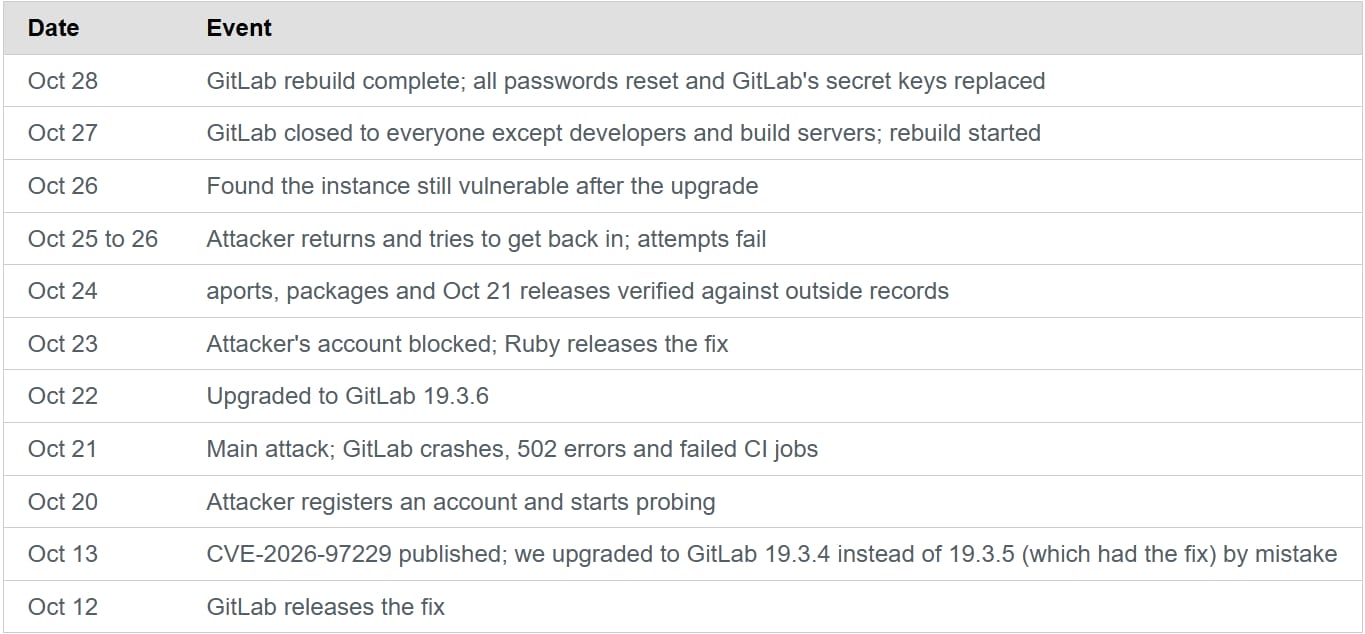
The timeline of events, as detailed by the Alpine Linux team, paints a clear picture of the escalating threat:
- October 12, 2026: GitLab publicly discloses CVE-2026-97229, a critical remote code execution vulnerability in its regex compiler, and releases patches.
- Pre-October 20, 2026: Alpine Linux’s GitLab server is running a version of GitLab that is susceptible to CVE-2026-97229, specifically due to an unpatched Ruby component within its custom container image.
- October 20-21, 2026: Attackers initiate a series of exploit attempts against Alpine Linux’s GitLab infrastructure, targeting CVE-2026-97229. These attempts resulted in eight worker crashes within the GitLab environment. While four of these crashes were described as "partially successful," none are believed to have fully succeeded in executing arbitrary code.
- During the Attack Period: Evidence suggests that attackers downloaded Alpine Linux’s GitLab container image. This action is a strong indicator of intent towards a potential supply-chain attack, where the goal would be to compromise the integrity of Alpine’s software distribution.
- Post-Attack Investigation: Alpine Linux launches an immediate investigation to assess the extent of any potential compromise.
- Up to October 27, 2026: The investigation reveals no evidence of tampering within repository commits, software packages, or official releases. Crucially, signing keys, which are not stored on the GitLab server, are also confirmed to be secure.
- October 27, 2026: Alpine Linux releases a new GitLab container image,
alpinelinux/gitlab:19.3.6, which includes the necessary Ruby patch (Ruby 3.3.13) to fully address CVE-2026-97229. - Following the Incident: In a proactive and precautionary measure, Alpine Linux rebuilds its entire GitLab instance from scratch and mandates a reset of all user passwords. This drastic step is taken due to the inability to definitively rule out code execution and the subsequent loss of crucial logging data that would confirm or deny such an event.
The Significance of Alpine Linux and its Infrastructure
Alpine Linux is not just another Linux distribution; it is a security-hardened, lightweight operating system that has become a cornerstone of modern cloud-native development. Its minimal design, based on musl libc and BusyBox, makes it an ideal choice for container images, such as those used by Docker and Kubernetes. The small attack surface and focus on essential components contribute to its reputation for enhanced security. Millions of containers worldwide rely on Alpine Linux as their base operating system, running everything from web servers and databases to complex microservices and AI applications.
The GitLab instance managed by Alpine Linux is therefore a highly sensitive and valuable asset. It is the central nervous system for the project’s development lifecycle. Any compromise of this infrastructure could have far-reaching implications for the entire open-source ecosystem that relies on Alpine Linux. The "aports" build recipes, which are managed within this GitLab environment, are the blueprints used to compile Alpine Linux’s official software packages. Tampering with these recipes could lead to the distribution of compromised software, impacting countless downstream users and services.
Analysis of Potential Impact and Data Exposure
While Alpine Linux has found no direct evidence of code execution or tampering with its released software, the potential for a successful compromise cannot be entirely dismissed. The attackers’ actions, including the download of the GitLab container image, strongly suggest an intent to conduct a supply-chain attack. Such attacks are particularly insidious because they aim to infiltrate trusted software, allowing malicious code to propagate widely before being detected.

The potential data that could have been exposed, had the attack been fully successful, is significant. This includes:
- User Details: Information about individuals contributing to or using Alpine Linux’s development platform.
- Password Hashes: Encrypted passwords, which, if cracked, could grant access to user accounts.
- Two-Factor Authentication (2FA) Secrets: Data used to generate or validate 2FA codes, a critical layer of security.
- CI/CD Secrets: Sensitive credentials and tokens used by automated build and deployment pipelines, which could grant attackers access to cloud infrastructure, code repositories, or other critical systems.
- Integration Credentials: API keys or other authentication tokens used to connect GitLab with external services.
- Private Project Content: Confidential code or data stored within private repositories hosted on the GitLab instance.
The fact that signing keys were not stored on the GitLab server is a testament to Alpine Linux’s security practices. However, the potential exposure of the other data types underscores the gravity of the situation and the rationale behind the project’s decision to perform a full rebuild and password reset. The missing logs, a consequence of the attackers’ actions or the nature of the exploit, further complicate the forensic analysis and contribute to the uncertainty surrounding the true extent of the breach.
Official Response and Recommendations
The Alpine Linux team’s response has been decisive and comprehensive, prioritizing the integrity of their project and the security of their users. The decision to rebuild the GitLab instance from scratch, rather than attempting to patch an existing compromised system, is a strong indicator of their commitment to security. This "harder route" ensures that no remnants of a potential compromise remain.
In addition to the infrastructure overhaul, Alpine Linux has issued clear guidance to its users:
- Password Reset: All users are strongly advised to reset their GitLab passwords immediately. This is a crucial step to mitigate any risk associated with potentially compromised credentials.
- Image Update: Users who pull Alpine Linux’s GitLab container image are urged to update to the latest version,
alpinelinux/gitlab:19.3.6. This version incorporates the necessary fix for CVE-2026-97229, including the patched Ruby component.
Broader Implications for Open-Source Security
This incident serves as a stark reminder of the ongoing challenges in securing the open-source software supply chain. The interconnected nature of software development means that a vulnerability in one component or project can have ripple effects across a vast ecosystem.
- Vigilance Against Known Vulnerabilities: The incident highlights the critical importance of timely and correct patching. Even when a vulnerability is disclosed and patches are available, the complex dependencies within software environments, especially custom container images, can lead to delayed or incomplete remediation.
- Supply Chain Attack Sophistication: The attackers’ apparent intent to download the container image suggests a growing sophistication in targeting the supply chain. This necessitates enhanced monitoring and security measures not just at the code repository level but also within the build and distribution pipelines.
- Importance of Robust Logging and Auditing: The lack of definitive evidence due to missing logs underscores the need for comprehensive and immutable logging systems. These systems are vital for incident response, forensic analysis, and establishing trust in software integrity.
- Proactive Security Posture: Alpine Linux’s decision to rebuild its entire GitLab instance, despite no confirmed compromise of released software, demonstrates a proactive and risk-averse security posture. This approach, while resource-intensive, is often necessary when dealing with critical infrastructure and potential advanced threats.
As the digital landscape becomes increasingly complex, the security of foundational open-source projects like Alpine Linux is of paramount importance. This incident underscores the need for continuous vigilance, robust security practices, and rapid response to protect the integrity of the software that powers much of the modern digital world. The open-source community, along with the broader cybersecurity industry, will undoubtedly learn from this event to further strengthen defenses against evolving threats.