Chandra Wibowo

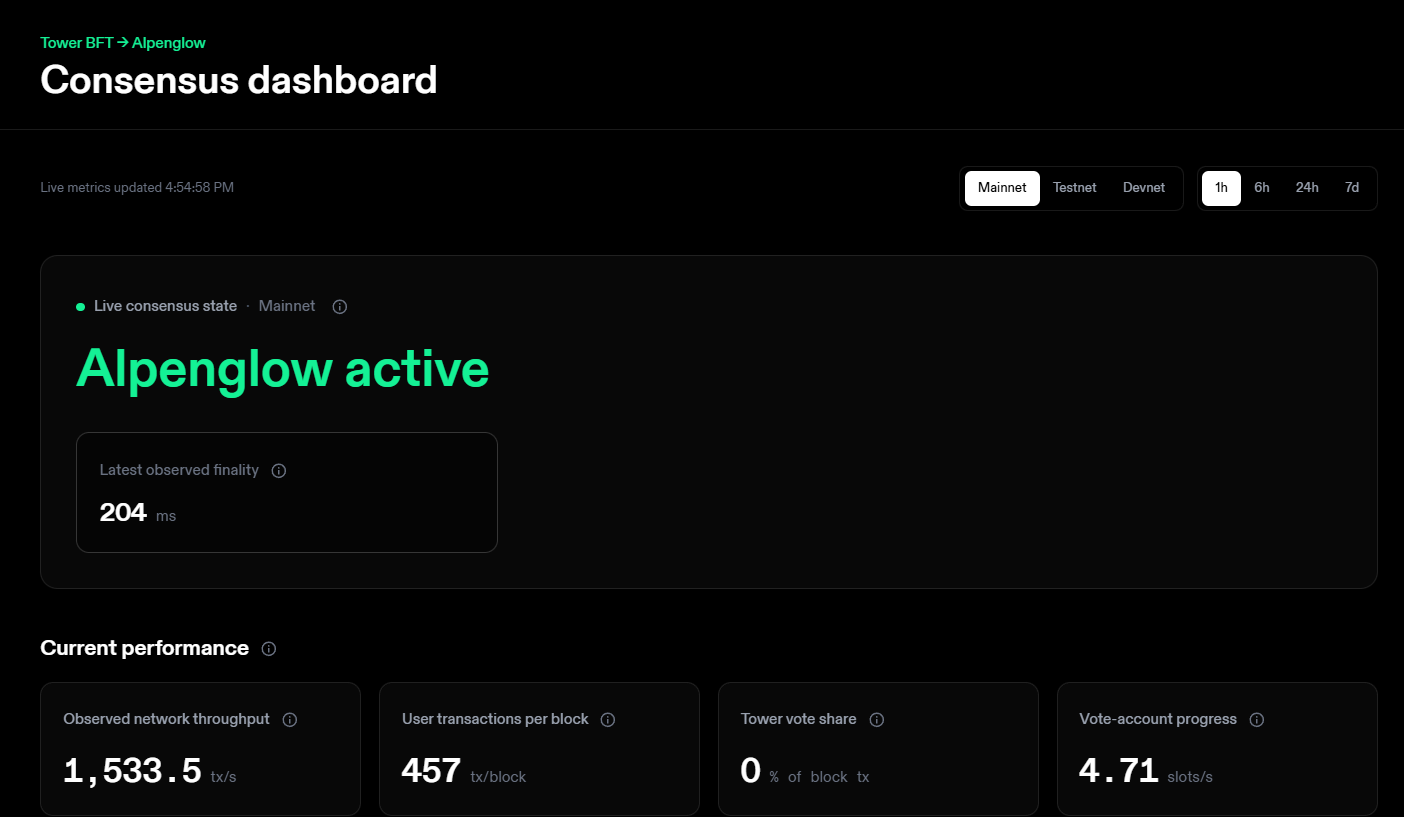
The Solana blockchain has officially activated its first significant consensus upgrade, codenamed Alpenglow, on its mainnet. The deployment, which commenced around 1:54 PM UTC on Wednesday, marks a pivotal moment in the network’s evolution, introducing substantial enhancements to its transaction processing capabilities. According to data from the Solana Foundation’s dedicated Alpenglow dashboard, this upgrade is engineered to dramatically reduce transaction finality times, a key metric for blockchain performance and user experience.
Revolutionizing Transaction Speed: The Alpenglow Promise
At the heart of the Alpenglow upgrade is an ambitious objective: to slash transaction finality by an astonishing 99%. Historically, Solana’s transaction finality hovered around 12.8 seconds. Alpenglow aims to bring this figure down to approximately 150 milliseconds. This near-instantaneous confirmation time is a leap forward, positioning Solana to compete more directly with the speed and responsiveness typically associated with traditional Web2 infrastructure. The Solana Foundation, in its July announcement detailing the upgrade, emphasized this target as a core driver for enhanced user experience and broader application viability.
Transaction finality refers to the point at which a transaction is considered irreversible and permanently recorded on the blockchain. In a decentralized network, achieving rapid and robust finality is a complex challenge. Alpenglow addresses this by fundamentally re-architecting Solana’s consensus mechanism.
Under the Hood: Votor and Rotor, The Core Components of Alpenglow
The Alpenglow upgrade is structured in phases, with the initial deployment focusing on the "Votor" component. Votor replaces the existing voting and finalization mechanism with a more streamlined approach. This new system enables direct validator voting and implements a certificate-based framework. The primary goal of Votor is to achieve the targeted 150-millisecond transaction finality.
A subsequent phase of the Alpenglow upgrade will introduce "Rotor." Rotor is designed as a new protocol for block data distribution, intended to supersede the current Turbine protocol. While Votor addresses the speed of transaction confirmation, Rotor is focused on optimizing the efficiency with which data is propagated across the network of validators, further contributing to overall network performance and scalability.

This upgrade represents the most substantial overhaul of Solana’s core protocol since its inception. It replaces the established TowerBFT consensus model, which has underpinned the network’s operations to date. The pursuit of near-immediate transaction finality is not merely a technical achievement; it carries profound implications for the types of applications and services that can be built and operated on Solana. Faster payments, near-instantaneous trade settlements, and more responsive decentralized applications (dApps) are all potential beneficiaries of this accelerated confirmation process.
Real-Time Performance and Initial Observations
As of press time, the Solana mainnet, under the influence of the Alpenglow upgrade, was exhibiting a transaction finality of approximately 6.6 seconds. While this figure is still a significant distance from the 150-millisecond target, it represents an improvement and indicates that the upgrade is actively influencing network behavior. Concurrently, the network’s throughput was recorded at 4,721 transactions per second (TPS), according to data from the Alpenglow dashboard.
It is important to note that achieving the full potential of a major network upgrade often takes time. The initial metrics reflect the network’s state immediately following activation, and further optimizations and adjustments are typically expected as validators and the network settle into the new consensus model. The Solana Foundation has been approached for comment regarding these initial finality measurements in testnet environments and their anticipated performance in live, real-world application scenarios.
A Milestone in Solana’s Development Trajectory
The Alpenglow upgrade is not an isolated event but rather a continuation of Solana’s ongoing efforts to enhance its performance and scalability. Researchers from Anza, an entity closely associated with Solana’s development, have described Alpenglow as the "biggest change to Solana’s core protocol" since its genesis. In a blog post published in May, Anza researchers Quentin Kniep, Kobi Sliwinski, and Roger Wattenhofer articulated the transformative potential of the 150-millisecond latency target. They posited that such speed would enable Solana to "compete with Web2 infrastructure in terms of responsiveness, potentially making blockchain technology viable for entirely new categories of applications."
This development builds upon previous optimizations. In August, Solana undertook a significant reduction in its slot time, a fundamental unit of time on the blockchain. This was part of a broader initiative by the Solana Foundation to halve slot times to 200 milliseconds, a move aimed at improving latency and accelerating transaction confirmations. This multi-stage process saw its fourth stage of slot reduction completed in October, laying the groundwork for further performance enhancements.
Looking Ahead: Future Upgrades and Ecosystem Growth
The successful deployment of Alpenglow sets the stage for subsequent developments within the Solana ecosystem. Following this major consensus upgrade, Solana validators are expected to focus on Agave 4.5. This upcoming upgrade proposes an increase in the number of accounts that can be supported by a versioned transaction, from 64 to 96. The Solana Foundation suggests that this enhancement could lead to improved swap routes and more favorable execution prices for users engaging in decentralized finance (DeFi) activities. Agave 4.5 is currently under development, with a projected release date in December 2026.
The continuous stream of upgrades underscores Solana’s commitment to iterative improvement and its proactive approach to addressing scalability challenges. The network’s development roadmap reflects a strategic vision to accommodate increasing demand and foster a robust environment for innovation.
Market Reaction and Broader Implications
The activation of the Alpenglow upgrade occurred against a backdrop of market activity for Solana’s native token, SOL. In the 24 hours leading up to the upgrade’s deployment, the SOL token experienced a price increase of nearly 3%. This uptick represents a partial recovery from a more significant decline, as SOL had seen a 42% decrease in value over the preceding year, according to data from CoinMarketCap. While market movements are influenced by a multitude of factors, significant network upgrades often generate positive sentiment and investor interest.
The implications of Alpenglow extend beyond raw performance metrics. For developers, the prospect of near-instant transaction finality opens up new avenues for building sophisticated applications that require real-time interactions. This could include high-frequency trading platforms, real-time gaming experiences, and other applications where latency is a critical factor. For end-users, the upgrade promises a smoother and more immediate experience when interacting with dApps, making blockchain technology more accessible and user-friendly.
Furthermore, the successful implementation of such a complex consensus upgrade demonstrates the resilience and ongoing innovation within the Solana community. Despite past challenges related to network stability, the continuous delivery of substantial upgrades signals a maturing and robust development ecosystem.
The Solana Foundation’s ongoing commitment to transparency, as evidenced by the public dashboard for the Alpenglow upgrade, allows the community and observers to track progress and performance. This open approach fosters trust and accountability within the decentralized ecosystem. As Alpenglow continues to be monitored and optimized, its success will be a key indicator of Solana’s ability to deliver on its promise of a high-performance, scalable, and responsive blockchain platform capable of supporting a new generation of decentralized applications. The journey towards 150-millisecond finality is a testament to the ambitious engineering efforts underway, aiming to redefine the boundaries of what is possible in the blockchain space.