Chandra Wibowo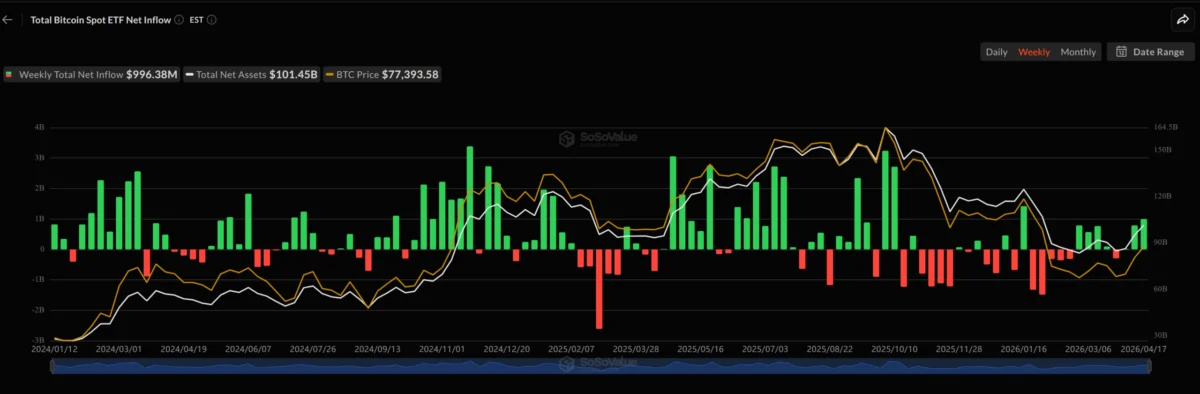
Spot Bitcoin exchange-traded funds (ETFs) experienced a significant surge in investor interest over the past week, drawing in close to $1 billion in net inflows. This robust performance, the strongest seen in more than three months, signals a notable shift in market sentiment towards risk assets, with investors seemingly more comfortable allocating capital to cryptocurrencies. The data, compiled by SoSoValue, highlights a renewed appetite for Bitcoin exposure through regulated investment vehicles.
Over the seven-day period concluding on Friday, spot Bitcoin ETFs collectively attracted $996 million in total net inflows. This figure represents the highest weekly intake since early January, a period when the then-newly launched ETFs garnered approximately $1.4 billion in inflows, marking the initial wave of institutional adoption following their approval by the U.S. Securities and Exchange Commission (SEC). The recent inflow trend indicates a potential second wave of sustained investor confidence, driven by evolving macroeconomic factors and a reduction in perceived geopolitical risks.
The week’s inflows were not evenly distributed, with Friday emerging as the standout day. On Friday alone, spot Bitcoin ETFs recorded an impressive $663.9 million in inflows, underscoring a strong end to the trading week. Earlier in the week, Tuesday saw substantial inflows of $411.5 million, followed by $186 million on Wednesday. Thursday’s activity was more subdued, with $26 million in inflows, while the trading week commenced with a $291 million outflow on Monday, suggesting an initial hesitancy that was quickly overcome by subsequent positive market developments.
The cumulative effect of these inflows has bolstered the total net assets held by spot Bitcoin ETFs, pushing the figure above the $101 billion mark by Friday. This substantial asset base reflects the growing acceptance and integration of Bitcoin into traditional investment portfolios. Concurrently, trading activity within these ETFs has seen a sharp increase, with daily trading volumes nearing $4.8 billion. This heightened trading volume indicates increased liquidity and investor participation, further solidifying the ETFs’ position as a viable and active investment avenue.
Market Dynamics: De-escalation and Reduced Safe-Haven Demand
Analysts at Bitunix have attributed the recent surge in Bitcoin ETF inflows to a broader market recalibration driven by evolving geopolitical tensions. The prevailing market sentiment appears to be moving from a stance of reacting to the possibility of conflict to one that is actively pricing in the likelihood of de-escalation. Specifically, a perceived easing of tensions, particularly concerning U.S.-Iran relations, has significantly diminished the demand for traditional safe-haven assets.
Historically, periods of heightened geopolitical uncertainty have led investors to seek refuge in assets perceived as stable and less susceptible to market volatility, such as the U.S. dollar and certain government bonds. However, with the perceived reduction in extreme risk scenarios, the allure of these traditional safe havens has waned. This shift in investor preference has, in turn, redirected capital towards assets with higher growth potential, including Bitcoin, which is increasingly viewed as a digital store of value and a hedge against inflation, rather than solely a speculative play.
Further contributing to this trend is the cautious approach maintained by the Federal Reserve. Expectations for immediate or significant interest rate cuts remain subdued, limiting the attractiveness of fixed-income investments. Simultaneously, growing concerns surrounding the demand for U.S. debt and persistently high long-term yields are beginning to erode confidence in traditional "risk-free" assets. This erosion of confidence in established financial instruments places additional pressure on the U.S. dollar and creates a more favorable environment for alternative assets like Bitcoin to attract investment.
"In crypto market structure, BTC is currently in a classic liquidity redistribution phase," noted the Bitunix analysts. They further elaborated that Bitcoin has been trading within a defined range, encountering resistance above the $75,000 mark and finding support near $72,000. Liquidation heatmaps, a tool used to identify areas of high leverage and potential price volatility, suggest that the market is consolidating and establishing a new equilibrium range, rather than being on the cusp of a dramatic directional trend. This indicates a period of accumulation and price discovery within a more stable framework.

Geopolitical Triggers: Strait of Hormuz Reopens, Boosting Bitcoin
A pivotal event that significantly influenced market movements and contributed to the surge in Bitcoin prices was the announcement regarding the reopening of the Strait of Hormuz to commercial shipping. On Friday, Iran’s foreign minister declared that the critical oil transit route would remain open for the duration of the current ceasefire. This declaration was swiftly corroborated by U.S. President Donald Trump, providing immediate reassurance to global markets.
The Strait of Hormuz is one of the world’s most vital chokepoints for oil transportation. Any perceived threat to its accessibility has historically triggered significant volatility in energy markets and broader financial sentiment due to the potential for oil supply disruptions. The reopening of the strait effectively diffused immediate fears of such disruptions, leading to rapid and pronounced reactions across global financial assets.
In the immediate aftermath of this news, Bitcoin experienced a notable price appreciation, surging above the $77,000 level. This upward movement coincided with a sharp decline in Brent crude oil prices, which fell by approximately 10% to around $85 per barrel. This inverse correlation between Bitcoin’s performance and oil prices, particularly in the context of geopolitical de-escalation, further underscores the narrative of Bitcoin acting as a risk-on asset that benefits from reduced global uncertainty and a weakening dollar.
Historical Context and Broader Implications
The launch of spot Bitcoin ETFs in January 2024 marked a watershed moment for the cryptocurrency industry, providing a regulated and accessible pathway for traditional investors to gain exposure to Bitcoin without the complexities of direct custody. The initial inflows were substantial, demonstrating pent-up demand from institutional and retail investors alike. However, subsequent weeks saw fluctuations in inflows, influenced by macroeconomic data, regulatory developments, and shifting market sentiment.
The current inflow trend of nearly $1 billion in a single week is particularly significant as it occurs against a backdrop of a maturing ETF market. While the initial euphoria of the ETF launches has subsided, this sustained inflow suggests that Bitcoin ETFs are becoming an integral part of diversified investment strategies. The increasing total net assets underscore the growing trust and adoption of these products.
The interplay between geopolitical events and cryptocurrency markets continues to be a key area of analysis for investors. The recent events demonstrate how perceived risks to global stability can directly impact asset allocation decisions, pushing investors towards both traditional safe havens and, increasingly, alternative assets like Bitcoin. The reopening of the Strait of Hormuz serves as a clear example of how swift resolutions to geopolitical flashpoints can unlock capital that was previously on the sidelines, seeking more speculative or growth-oriented opportunities.
Furthermore, the sustained inflows into Bitcoin ETFs, coupled with the increasing trading volumes, signal a growing acceptance of Bitcoin as a legitimate asset class within the traditional financial system. This integration is likely to continue as more financial institutions and asset managers develop their strategies around digital assets. The ability of Bitcoin to react positively to de-escalating geopolitical tensions and the weakening of traditional safe havens reinforces its narrative as a potential hedge against systemic risks and a store of value in an increasingly complex global economic landscape.
The performance of spot Bitcoin ETFs is closely watched as an indicator of institutional sentiment towards the cryptocurrency market. The recent influx of nearly $1 billion suggests that, despite ongoing macroeconomic uncertainties, investors are finding compelling reasons to allocate capital to Bitcoin, driven by a combination of reduced geopolitical risk and a reevaluation of traditional asset classes. As the market continues to evolve, the dynamics observed in the past week are likely to inform future investment strategies and further solidify Bitcoin’s role in the global financial ecosystem. The coming weeks will be crucial in determining whether this strong inflow trend is sustainable and indicative of a sustained shift in investor behavior.