Chandra Wibowo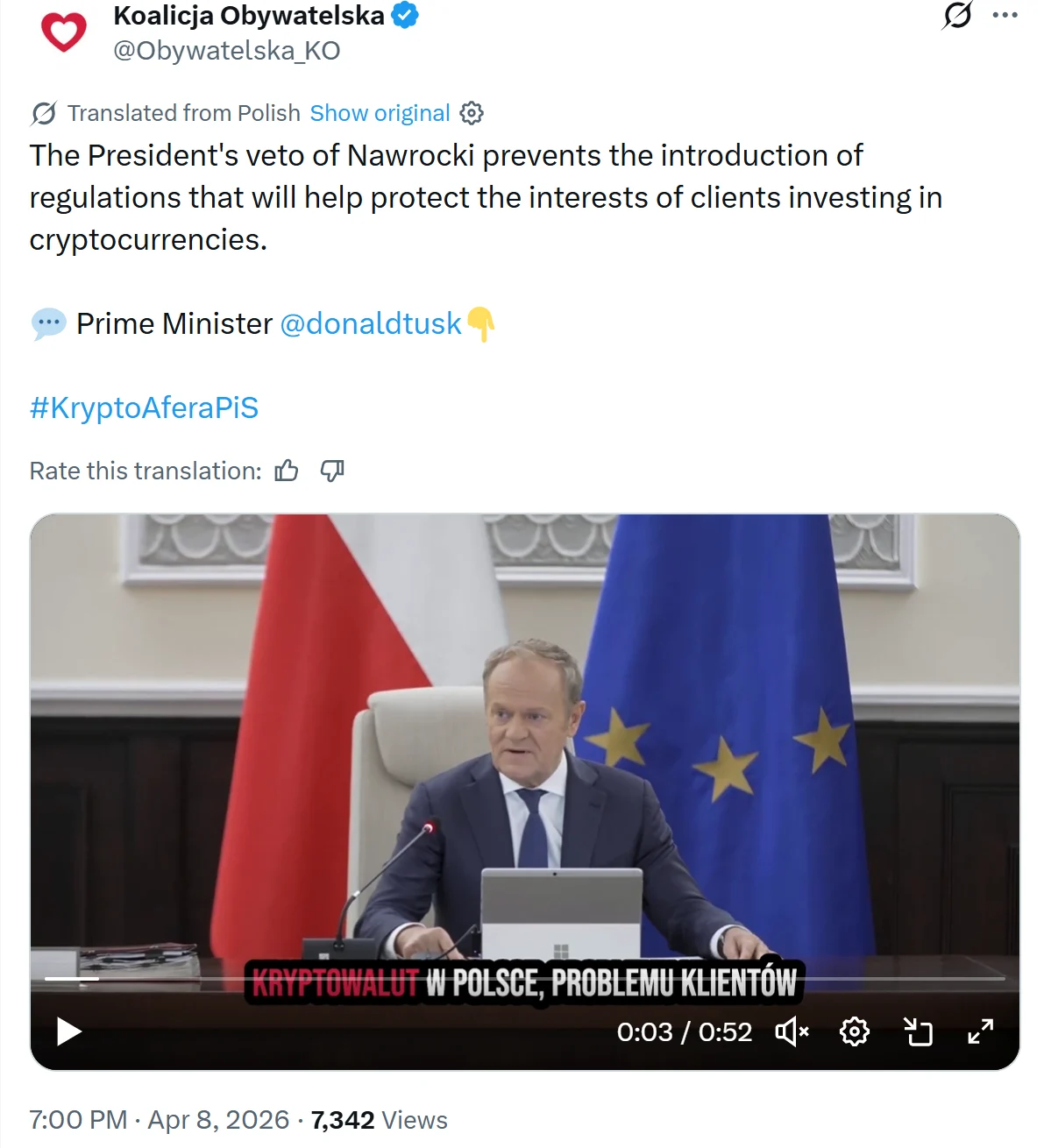
Poland’s legislative body has once again failed to secure the necessary votes to overturn a presidential veto on a pivotal cryptocurrency regulation bill, prolonging a significant political deadlock over the nation’s approach to digital assets. The outcome of a vote held on Friday leaves Poland as the sole European Union member state yet to implement the bloc’s comprehensive Markets in Crypto-Assets Regulation (MiCA).
In a session that underscored the deep divisions within the Polish government on digital asset policy, lawmakers fell short of the 263 votes required to override the veto issued by President Karol Nawrocki. Local outlet TVP World reported that 243 Members of Parliament (MPs) voted against the veto, while 191 supported its continuation. This latest parliamentary maneuver marks the second unsuccessful attempt by the current government to enact legislation designed to align Poland with the EU’s MiCA framework, which came into effect across the Union in 2024 to establish a harmonized regulatory landscape for crypto assets, including their issuance, trading, and custody.
The bill, championed by Prime Minister Donald Tusk’s administration, is intended to integrate Poland into the EU’s unified approach to crypto regulation. This alignment is crucial for fostering legal certainty, enhancing investor protection, and preventing regulatory arbitrage within the single market. However, President Nawrocki has consistently voiced his objections, citing concerns that the proposed legislation imposes excessive regulatory burdens, lacks sufficient transparency, and could place undue strain on small businesses operating within the burgeoning digital asset sector.
The government, on the other hand, argues that the continued absence of clear and comprehensive regulation leaves Polish investors and the broader financial ecosystem vulnerable. Finance Minister Andrzej Domański has reportedly warned that the lack of a defined regulatory framework risks transforming the Polish crypto market into a "El Dorado for fraudsters," where both consumers and legitimate businesses are exposed to significant risks of exploitation and financial crime. This divergence in perspective highlights a fundamental disagreement on the balance between fostering innovation and ensuring robust consumer and market protection.
A Chronology of Legislative Hurdles and Presidential Objections
The path to regulating crypto assets in Poland has been fraught with legislative challenges, characterized by repeated rejections and a persistent standoff between the executive and presidential offices. The initial iteration of the crypto regulation bill, designed to transpose the EU’s MiCA directive into Polish law, faced its first significant hurdle in December of the previous year. Lawmakers at that time also failed to garner enough support to override a presidential veto.
Despite this initial setback, the government demonstrated its commitment to pushing the legislation forward by reintroducing a revised draft within days of the December rejection. Proponents of the bill claimed that this new version represented an "improved" approach to regulation. However, critics within the parliamentary opposition and certain industry observers suggested that the substantive changes were minimal, leading to questions about the true impact of the revisions. President Nawrocki subsequently vetoed this re-submitted bill in February of this year, stating his firm conviction that a flawed law, regardless of its repeated passage by the parliamentary majority, remained fundamentally problematic. "I will not sign a wrong law just because it was passed again by the parliamentary majority," he remarked at the time, emphasizing his unwavering stance on what he perceives as regulatory overreach.
This recurring pattern of legislative efforts being stymied by presidential opposition has created an extended period of regulatory uncertainty in Poland’s digital asset space. The country now finds itself isolated among EU member states in its failure to adopt the MiCA framework, a situation that has implications for both domestic businesses and the broader European digital economy.
Broader Implications for Poland’s Digital Asset Ecosystem
The ongoing political impasse has significant ramifications for Poland’s digital asset industry. Without a clear regulatory framework aligned with EU standards, Polish crypto businesses may face difficulties operating seamlessly within the European single market. This could lead to businesses seeking to establish their operations and obtain licenses in other EU member states that have successfully implemented MiCA, potentially resulting in a "brain drain" of talent and capital away from Poland.

The absence of robust regulation also poses a direct threat to consumer protection. As Finance Minister Domański pointed out, an unregulated market is fertile ground for illicit activities. Investors, both retail and institutional, are left without the safeguards and recourse mechanisms that MiCA aims to provide, such as clear rules on crypto asset service providers’ conduct, capital requirements, and transparency obligations. This vulnerability can lead to increased instances of fraud, market manipulation, and the loss of investor funds, undermining confidence in the digital asset sector.
Furthermore, the delay in implementing MiCA could impact Poland’s ability to attract foreign investment in the fintech and blockchain sectors. International investors often prioritize jurisdictions with stable and predictable regulatory environments. The current situation in Poland, marked by legislative gridlock, may deter such investments, hindering the country’s potential to become a significant player in the global digital economy.
The Zonda Controversy: A Symbol of Deeper Divisions
The political dispute over crypto regulation has become entangled with a high-profile controversy involving Zonda, Poland’s largest cryptocurrency exchange. Reports suggest that Zonda has actively lobbied against the proposed bill, raising concerns about its potential impact on its operations. The situation escalated when Prime Minister Tusk publicly accused Zonda of having links to illicit funding, citing intelligence reports that allegedly connect the exchange’s origins to Russian criminal networks.
These allegations have been vehemently denied by Zonda’s leadership. CEO Przemysław Kral has publicly stated that attempts to involve him and Zonda in "current political squabbles" are "absurd as they are harmful to the Polish innovation market." Kral has indicated his intention to pursue legal action to protect his personal rights against what he perceives as unfounded accusations.
Adding another layer of complexity to the Zonda situation, Kral also recently addressed concerns regarding a cryptocurrency wallet reportedly holding approximately $330 million. He asserted that he does not control access to this wallet, claiming that it remained under the stewardship of former CEO Sylwester Suszek prior to his disappearance in 2022. This ongoing controversy surrounding Zonda underscores the broader challenges of transparency and accountability within the digital asset space and has further fueled the contentious debate surrounding crypto regulation in Poland.
Expert and Industry Reactions
While official statements from President Nawrocki and Finance Minister Domański represent the primary governmental positions, reactions from the broader crypto community and legal experts have been largely consistent in their call for regulatory clarity. Industry bodies and international organizations have repeatedly emphasized the benefits of adopting harmonized regulations like MiCA, citing its role in fostering innovation, ensuring market integrity, and protecting consumers across the EU.
Analysts have pointed out that Poland’s current position risks isolating it from the mainstream of European digital finance. The absence of a clear legal framework can create operational challenges for businesses, increase compliance costs if they are forced to navigate disparate national interpretations of EU law, and potentially lead to a less secure environment for investors. The continued vetoing of the bill suggests a fundamental disagreement on the appropriate scope and nature of regulation, with the President favoring a more cautious, perhaps even minimalist, approach, while the government and many EU counterparts advocate for a more comprehensive and protective framework.
The repeated failures to enact crypto legislation highlight a significant governance challenge in Poland, where differing visions for the digital asset economy are clashing. The coming months will be crucial in determining whether a consensus can be reached, or if Poland will continue to lag behind its European peers in establishing a robust and compliant digital asset sector. The continued political standoff not only impacts the crypto industry but also sends a broader message about Poland’s readiness to embrace and regulate emerging technologies within a rapidly evolving global landscape.