Sisilia Frederika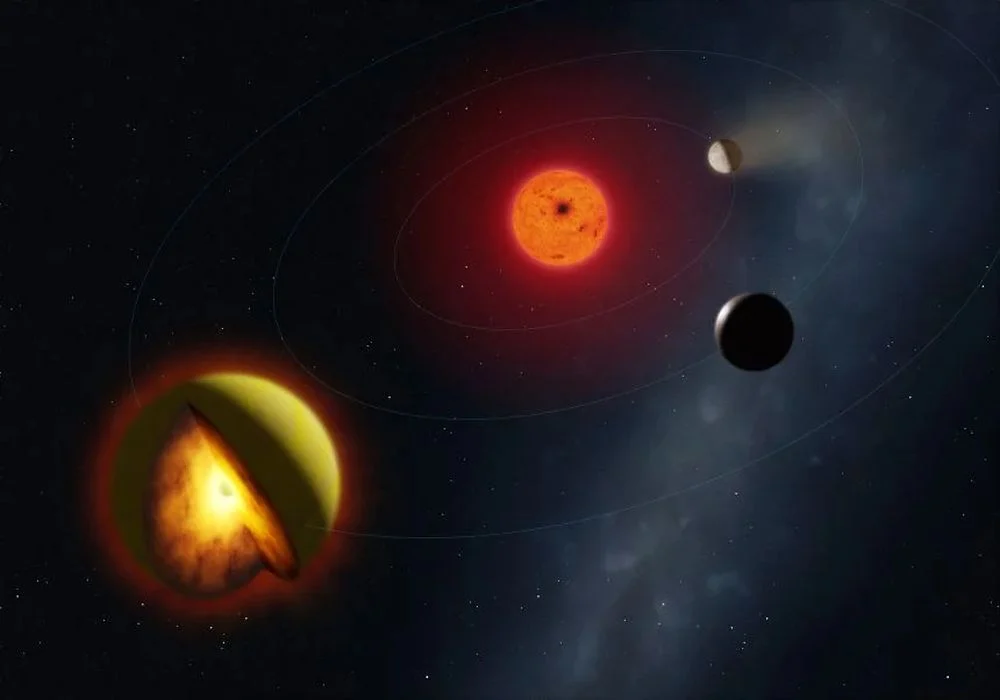
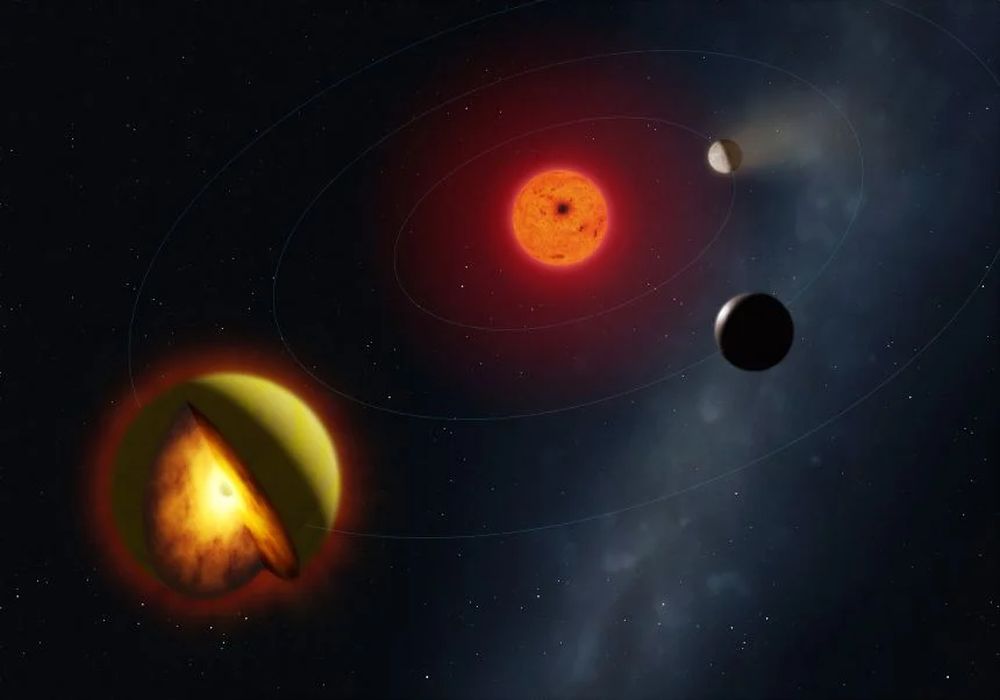
The discovery of a new class of exoplanets has challenged the conventional understanding of planetary evolution and atmospheric persistence. According to a study published in Nature Astronomy, the exoplanet L 98-59 d, which was first identified by NASA’s Transiting Exoplanet Survey Satellite (TESS) in 2019, represents a unique category of celestial bodies: planets that maintain vast, deep magma oceans for billions of years due to an exceptionally high concentration of sulfur. This research, led by Harrison Nicholls and a team from the Department of Physics at Oxford University, suggests that our current taxonomies for small planets—typically divided into "gas dwarfs" or "water worlds"—are insufficient to describe the geological and atmospheric complexity of the universe.
The Geological History of Magma Oceans
To understand the significance of L 98-59 d, scientists look to the early history of our own Solar System. Theoretical models of planetary formation suggest that all rocky worlds, including Earth, began as magma ocean worlds. During the chaotic period of accretion, the energy from frequent impacts and the decay of radioactive isotopes generated enough heat to melt the entire planetary surface and interior.
On Earth, this phase was relatively short-lived in geological terms. As the planet cooled, the outer layers solidified into a mantle and crust, while only the outer core remained molten. This specific arrangement—a liquid outer core rotating around a solid inner core—is critical for the generation of Earth’s magnetosphere via the dynamo effect, which protects the atmosphere from solar radiation.
Sulfur has always played a supporting role in this process. As a "siderophile" or "iron-loving" element, sulfur was dragged into Earth’s core during the process of differentiation, where heavy metals sank to the center. It is estimated that sulfur makes up approximately 2% of Earth’s core. This small percentage is vital because sulfur significantly lowers the melting point of iron, ensuring that the outer core remains liquid even as the planet continues to lose heat to space. However, on L 98-59 d, the sulfur content is significantly higher, leading to a radically different evolutionary path.
The Unique Profile of L 98-59 d
L 98-59 d orbits an M-dwarf star, a type of red dwarf that is cooler and smaller than our Sun, located approximately 35 light-years from Earth. While its proximity makes it an ideal candidate for study, its physical characteristics initially puzzled astronomers. Data from the James Webb Space Telescope (JWST) and other observatories revealed that the planet has a mass of 1.64 Earths but a radius of 1.627 Earths.
This results in a bulk density of approximately 2.2 g/cm³, which is only about 40% of Earth’s density. In the established catalog of exoplanets, such a low density for a planet of this size usually points to one of two compositions:
- Gas Dwarfs: Planets with a rocky core surrounded by a thick, puffy atmosphere of hydrogen and helium.
- Water Worlds: Planets where a significant portion of the total mass is composed of water in various phases (liquid, ice, or supercritical fluid).
However, the Oxford team’s analysis suggests that L 98-59 d does not fit either description. Instead, it is a "low-density super-Earth" whose volume is dominated not by gas or water, but by a massive, sulfur-enriched interior that has remained molten for billions of years.
Advanced Modeling and 5 Billion Years of Evolution
To uncover the secrets of L 98-59 d, the researchers employed a coupled atmosphere-interior evolutionary model. This allowed them to simulate the planet’s development over a 5-billion-year timeline, matching the age of its host star. The simulation accounted for various factors, including the planet’s initial "birth" conditions, secular cooling, atmospheric erosion caused by stellar winds, and the chemical interactions between the surface and the atmosphere.
The findings revealed a world with a mantle made of molten silicate, akin to the lava found in active volcanic regions on Earth. However, the simulation indicated that this mantle sits atop a gargantuan magma ocean that extends thousands of kilometers into the interior. This long-term liquid state is sustained by the high sulfur content, which prevents the interior from crystallizing into a solid state.
One of the most striking results of the study was the explanation for the planet’s atmosphere. JWST observations had previously identified an atmosphere rich in sulfur dioxide (SO2). Under normal circumstances, an exoplanet orbiting an M-dwarf for 5 billion years would have its atmosphere stripped away by the star’s intense ultraviolet (UV) radiation and stellar flares.
The Oxford research team discovered that L 98-59 d’s atmosphere is being constantly replenished. The vast magma ocean acts as a reservoir, outgassing sulfur-bearing molecules like hydrogen sulfide (H2S) to the surface. Once in the atmosphere, these molecules undergo photolysis—a chemical process where UV light from the star breaks down the H2S—resulting in the sulfur dioxide detected by telescopes.
Implications for Planetary Classification
The existence of L 98-59 d suggests that the "magma ocean" phase of planetary development is not merely a brief transitionary period but can be a stable state for billions of years under the right chemical conditions. This discovery has profound implications for how astronomers categorize exoplanets.
"What’s exciting is that we can use computer models to uncover the hidden interior of a planet we will never visit," said co-author Raymond Pierrehumbert, a Professor in the Department of Physics at the University of Oxford. He noted that while size and mass are the primary metrics currently available to astronomers, the ability to reconstruct the "deep past" of these worlds allows for the discovery of planetary types that have no equivalent in our Solar System.
The research suggests that L 98-59 d may have started its life as a much larger planet, perhaps similar to a sub-Neptune. Over billions of years, it lost its lighter gases, shrinking in size but retaining its volatile-rich interior. This "volatile-rich evolution" creates a class of planets that are neither purely rocky nor purely gaseous, but rather "molten super-Earths."
Supporting Data and Technical Observations
The study relied heavily on data from the JWST’s Near-Infrared Spectrograph (NIRSpec). The spectral data showed a distinct signature that matched models of a 98% sulfur dioxide atmosphere. This was a critical piece of evidence, as sulfur dioxide is a heavy molecule that is less likely to escape into space than hydrogen or helium, yet its presence in such high concentrations requires a continuous source of replenishment from the interior.
The density of 2.2 g/cm³ is the "smoking gun" for this new classification. If the planet were a water world, its radius would likely be different based on the pressure-temperature profiles of high-pressure ice. If it were a gas dwarf, the atmospheric pressure would be significantly higher than what was observed. The molten interior model provides the most consistent fit for the observed mass, radius, and atmospheric composition.
The Role of Future Missions: PLATO and ARIEL
As the scientific community digests the findings regarding L 98-59 d, attention is turning toward future missions that will help refine these new planetary categories. Two European Space Agency (ESA) missions, PLATO (PLAnetary Transits and Oscillations of stars) and ARIEL (Atmospheric Remote-sensing Infrared Exoplanet Large-survey), are expected to provide the data needed to see how common these sulfur-rich molten worlds are.
PLATO, scheduled for launch in 2026, will focus on finding and studying terrestrial planets in the habitable zones of Sun-like stars. While L 98-59 d is likely too hot to support life as we know it, PLATO will help determine if similar magma-ocean dynamics exist on planets that might otherwise be considered "Earth-like."
ARIEL, expected to launch in 2029, is specifically designed to study the chemical composition of exoplanet atmospheres. It will observe a large sample of approximately 1,000 exoplanets, allowing for a statistical analysis of how interior composition—such as sulfur content—correlates with atmospheric chemistry.
Conclusion: A More Granular Universe
The discovery of L 98-59 d as a representative of a new class of exoplanets highlights a turning point in astronomy. The field is moving away from broad, "one-size-fits-all" categories and toward a more granular understanding of planetary diversity.
Lead author Harrison Nicholls emphasized that while this specific molten planet is an unlikely candidate for habitability, it serves as a reminder of the vast range of possibilities in the cosmos. The "magma ocean" world of L 98-59 d is a testament to the fact that the chemical makeup of a planet—specifically its volatile and sulfur content—can dictate its destiny for billions of years, creating environments that are fundamentally alien to anything found in our own neighborhood.
As telescope technology and computational modeling continue to advance, the list of planetary types is expected to grow. The "low-density super-Earth" may soon be joined by other unexpected classifications, further revealing the complex and varied nature of the Milky Way’s planetary population. For now, L 98-59 d stands as a landmark case study in how the deep interior of a world, hidden beneath a thick and toxic atmosphere, can tell a story of evolution that spans the lifetime of a star.