Sisilia Frederika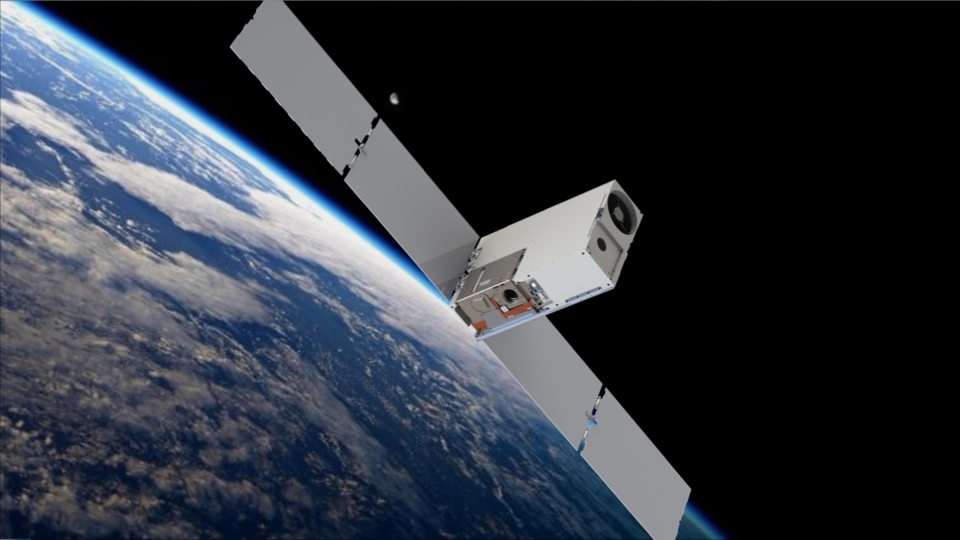
The Star-Planet Activity Research CubeSat (SPARCS), a pioneering astrophysics mission led by NASA and the School of Earth and Space Exploration (SESE) at Arizona State University, has successfully achieved its "first light" milestone, signaling a new era in the study of stellar environments and their impact on planetary habitability. Following its launch on January 11, 2026, the spacecraft directed its sophisticated ultraviolet instruments toward a distant star system on February 6, 2026, capturing high-resolution data that validates its operational readiness. This mission represents a critical shift in exoplanetary science, moving beyond the mere discovery of planets to the rigorous characterization of the high-energy environments in which these worlds reside. By focusing on the ultraviolet (UV) activity of the galaxy’s most common stars, SPARCS aims to answer fundamental questions about whether the billions of planets orbiting red and orange dwarfs could actually support life as we know it.
Mission Overview and the Significance of First Light
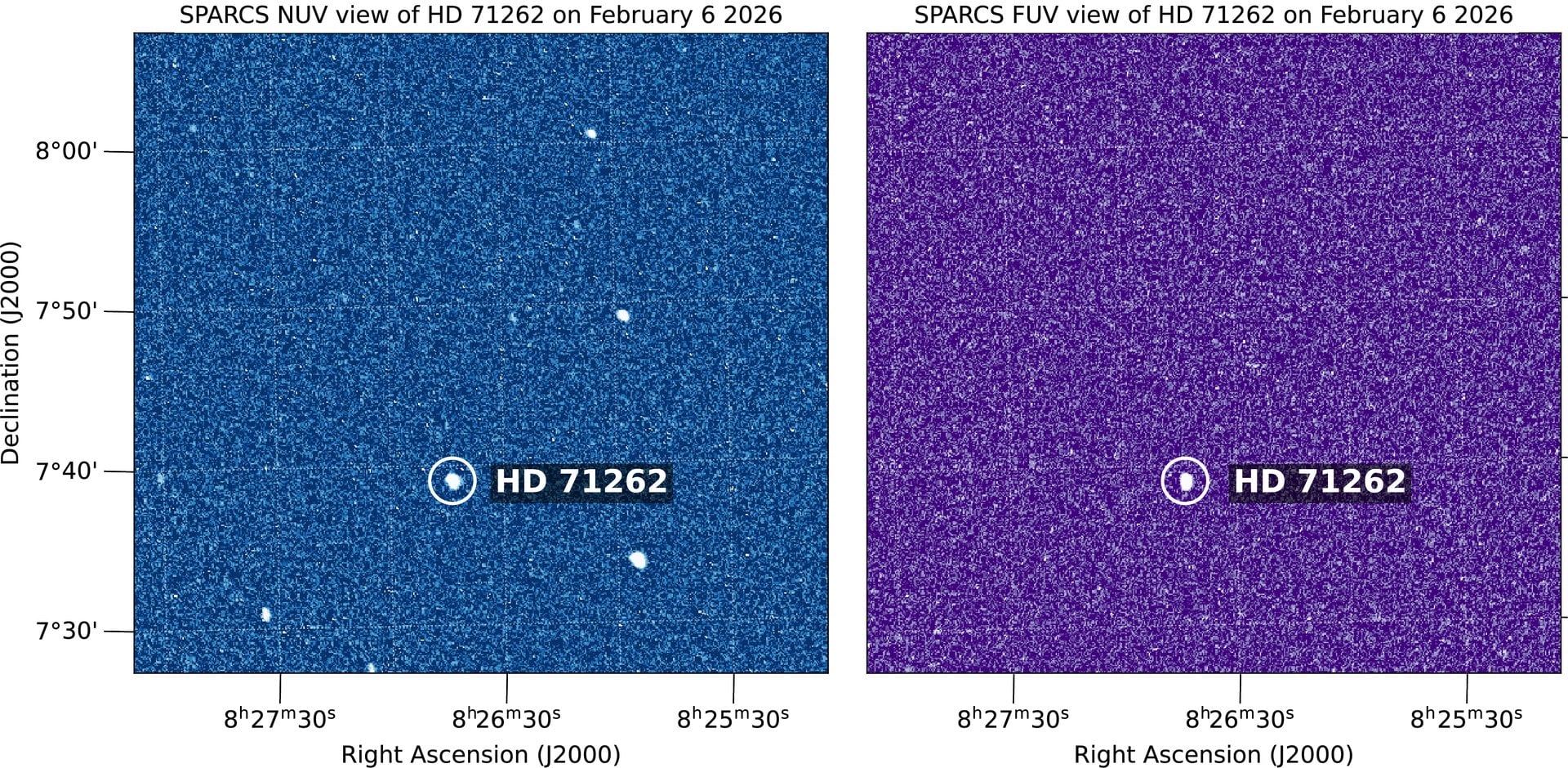
The successful acquisition of first light images is a watershed moment for any space-based observatory. For SPARCS, this event occurred less than a month after its deployment into Earth’s orbit. The target for this initial observation was HD 71262, a K-type star—often referred to as an "orange dwarf"—located approximately 650 light-years from Earth in the southern constellation of Sculptor. The mission team released a dual-frame observation showing the star simultaneously in near-ultraviolet (NUV) and far-ultraviolet (FUV) wavelengths.
In the far-UV image, HD 71262 appears as a solitary, bright beacon against the void, whereas the near-UV image reveals a more crowded field, capturing several background stars that are less visible in the higher-energy far-UV spectrum. This contrast is not merely aesthetic; it demonstrates the sensitivity and precision of the SPARCam, the mission’s primary instrument. The ability to distinguish between these wavelengths allows researchers to monitor the specific types of radiation that can strip a planet’s atmosphere or trigger complex chemical reactions on its surface.
"Seeing SPARCS’ first ultraviolet images from orbit is incredibly exciting," said Evgenya Shkolnik, the mission’s Principal Investigator and a professor of astrophysics at ASU’s SESE. Shkolnik, who has spent years advocating for the role of small satellites in high-impact science, noted that the images serve as a total validation of the spacecraft’s design. "They tell us the spacecraft, the telescope, and the detectors are performing as tested on the ground, and we are ready to begin the science we built this mission to do."
Chronology of the SPARCS Mission
The development of SPARCS followed a multi-year trajectory that blended academic innovation with federal space agency resources. The project was conceived as a low-cost, high-reward method to fill a gap in the existing fleet of space telescopes, many of which are either too large to dedicate hundreds of hours to a single star or are not optimized for long-duration UV monitoring.
The spacecraft was assembled and tested at ASU and NASA’s Jet Propulsion Laboratory (JPL) throughout the early 2020s. After rigorous thermal-vacuum testing and vibration checks to ensure it could survive the rigors of launch, it was integrated into its launch vehicle. On January 11, 2026, the mission successfully reached orbit. The subsequent three weeks were dedicated to "commissioning," a phase where engineers check the health of the power systems, communication arrays, and thermal controls.
The transition to science operations began in earnest on February 6, 2026, with the observation of HD 71262. With the first light images confirmed and analyzed, the mission is now moving into its primary science phase, which involves a curated survey of M-type and K-type stars. Over the next year, SPARCS will maintain a steady gaze on these targets, capturing the erratic "hiccups" of stellar flares that characterize these stellar populations.
Technical Innovation: Big Science in a Small Package
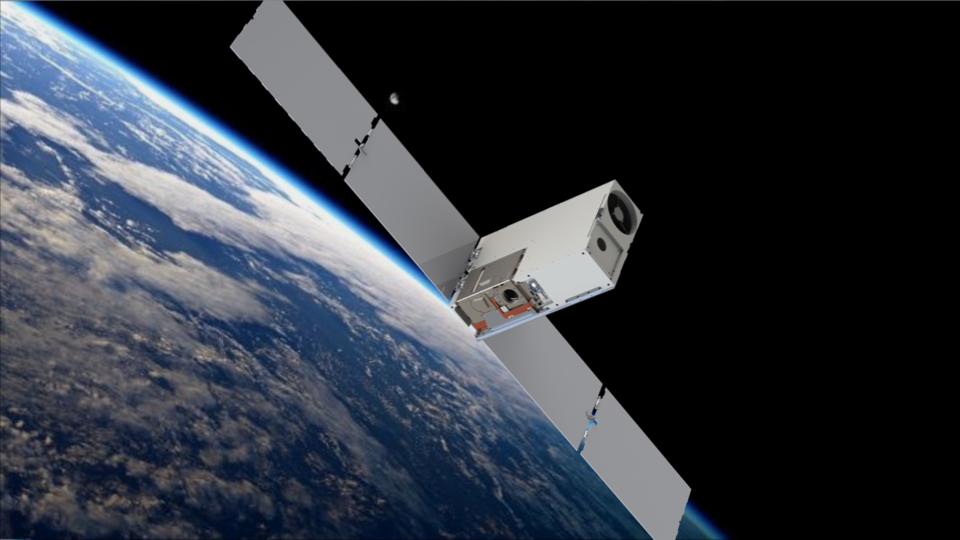
SPARCS is a 6U CubeSat, a designation that refers to its standardized modular size. One "unit" (1U) is a 10-centimeter cube; by joining six of these units, the SPARCS team created a spacecraft roughly the size of a large shoebox (approximately 10x20x30 cm). Despite its diminutive size, the technology packed within the frame rivals that of much larger observatories.
The heart of the mission is the SPARCam, which utilizes two "delta-doped" detectors developed at JPL’s Microdevices Laboratory. These detectors represent a significant leap in semiconductor technology. Standard silicon-based detectors, similar to those found in modern smartphones, are typically insensitive to ultraviolet light because the UV photons are absorbed very close to the surface of the silicon, where they are lost. "Delta-doping" involves adding a layer of atoms to the surface of the detector to create a highly sensitive interface that captures UV photons with unprecedented efficiency.
Furthermore, the SPARCS team pioneered the use of integrated filters. In traditional telescopes, filters are separate physical disks that must be moved into place, adding weight and mechanical complexity. On SPARCS, the filters were deposited directly onto the detectors themselves. This design eliminates the need for extra parts and allows the telescope to observe in two UV bands simultaneously without any moving components.
Shouleh Nikzad, the lead developer of SPARCam and chief technologist at JPL, emphasized the importance of this miniaturization. "We took silicon-based detectors—the same technology as in your smartphone camera—and we created a high-sensitivity UV imager," Nikzad stated. "Integrating filters into the detector to reject unwanted light is a huge leap forward to doing big science in small packages."
The Target Stars: Red and Orange Dwarfs
The primary motivation for the SPARCS mission lies in the sheer abundance of low-mass stars in the Milky Way. Our galaxy is populated by several types of stars, but M-type red dwarfs are by far the most numerous, accounting for approximately 75% of all stars. K-type orange dwarfs account for another 11% to 12%. Combined, these two classes of stars host the vast majority of the galaxy’s planets—estimated at over 50 billion in habitable zones alone.
However, being "habitable" in terms of distance from a star (the "Goldilocks Zone" where liquid water can exist) does not guarantee that a planet is hospitable to life. M-type stars, in particular, are known for being extremely active. They frequently produce massive solar flares that release bursts of high-energy UV radiation and X-rays. Because red dwarfs are cooler and dimmer than our Sun, their habitable zones are much closer to the star. This proximity means that planets in the habitable zone are frequently blasted by these flares.
SPARCS will provide the long-term monitoring necessary to understand the "UV environment" of these systems. By observing these stars for weeks at a time, the CubeSat will record how often they flare and how intense those flares are. This data is essential for climate modelers trying to determine if an exoplanet’s atmosphere could survive such a bombardment or if it would be stripped away, leaving a barren, radiation-soaked rock.
Autonomous Operations and Artificial Intelligence
Operating a space telescope requires constant adjustments, especially when trying to capture transient events like stellar flares. To maximize its scientific output, SPARCS utilizes an onboard computer equipped with machine learning algorithms. This allows the spacecraft to process data in real-time and autonomously detect the onset of a flare.
When the algorithm identifies a sudden increase in UV brightness, it can automatically adjust the observation parameters—such as the exposure time—to ensure the peak of the flare is captured without saturating the sensors. This level of autonomy is rare for CubeSats and serves as a technology demonstration for future NASA flagship missions. By reducing the need for constant ground-station intervention, SPARCS can react to stellar activity faster than human operators could, ensuring that no critical data is lost during the brief, violent life of a solar flare.
Broader Impact and Future Implications
The data gathered by SPARCS will serve as a foundational resource for the next generation of "Great Observatories." NASA is currently in the early planning stages for the Habitable Worlds Observatory (HWO), a massive space telescope designed specifically to image Earth-like planets around other stars. To interpret what the HWO sees, scientists need to know the history of the radiation that has hit those planets.
"The SPARCS mission brings all of these pieces together—focused science, cutting-edge detectors, and intelligent onboard processing," said David Ardila, the SPARCS instrument scientist at JPL. "By watching these stars in ultraviolet light in a way we’ve never done before, we’re not just studying flares. These observations will sharpen our picture of stellar environments and help future missions interpret the habitability of distant worlds."
Furthermore, SPARCS paves the way for the UltraViolet EXplorer (UVEX), another upcoming NASA mission intended to map the entire sky in UV light. As the space industry continues to embrace the "SmallSat" revolution, SPARCS stands as a testament to the fact that significant scientific discoveries no longer require billion-dollar price tags and decades of development. With its first light achieved, SPARCS is now positioned to provide the most detailed look yet at the volatile lives of the stars that most planets in our galaxy call home, bringing us one step closer to identifying which of those billions of worlds might actually be home to life.