Lina Irawan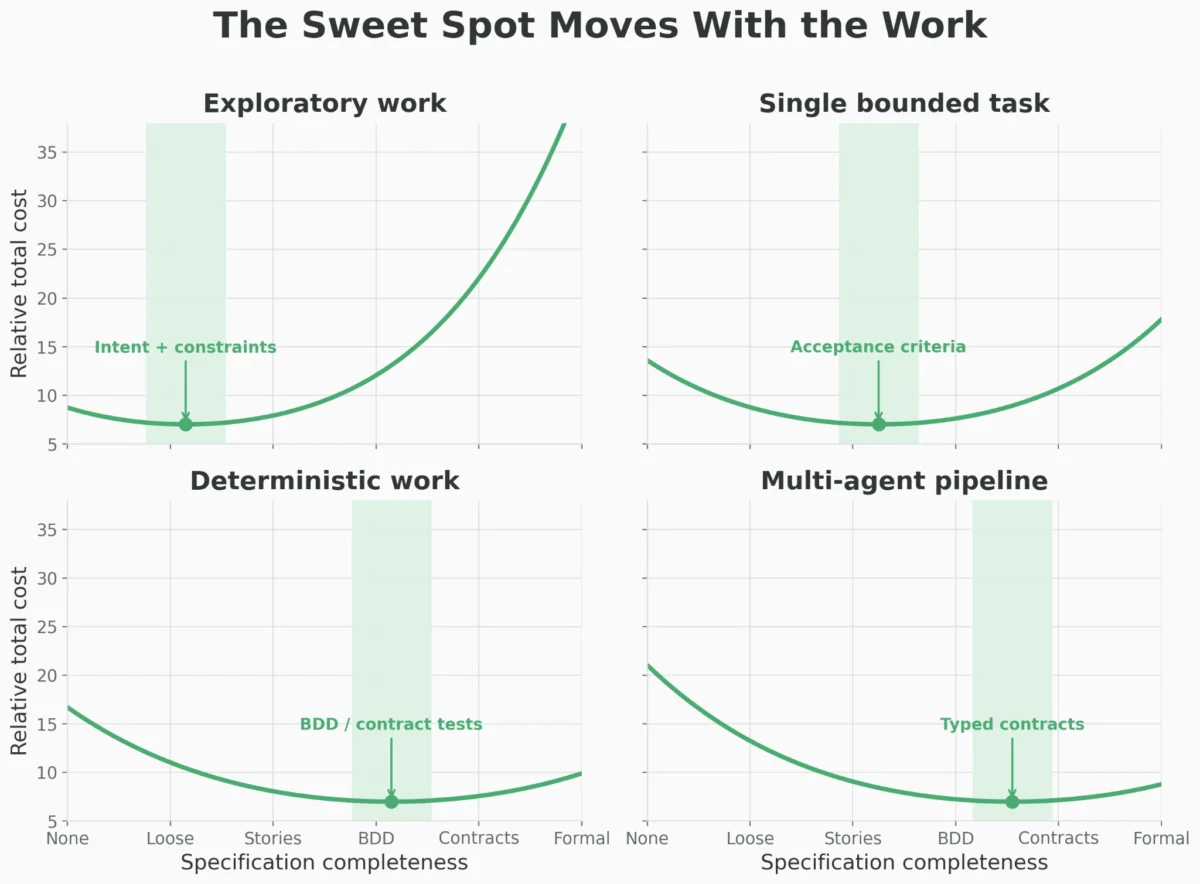
The landscape of software engineering is undergoing a fundamental transformation as autonomous agents begin to handle the bulk of code implementation. This shift has triggered a debate within the industry regarding the necessity of detailed specifications. While a growing segment of the developer community argues that traditional overhead is obsolete in favor of "rough goals" and iterative refinement, a deeper analysis of the economic and operational costs suggests that specification is not only relevant but is becoming the primary engineering challenge of the modern era.
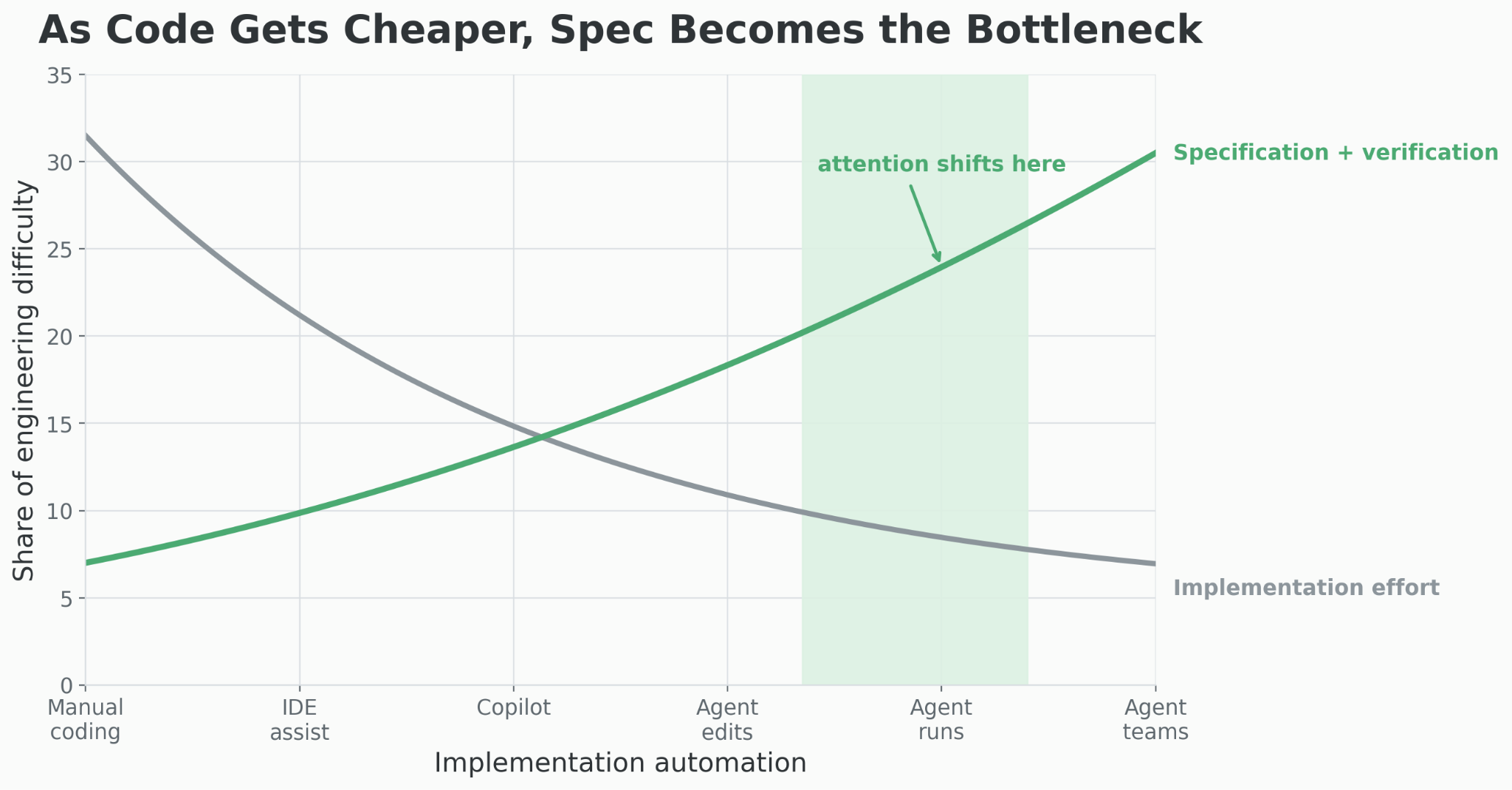
In the traditional software development lifecycle, implementation—the act of writing code—was the most time-consuming and expensive phase. However, as large language models (LLMs) and agentic workflows reduce the cost of implementation toward zero, the difficulty has migrated upstream. The primary bottleneck is no longer how to write the code, but how to define what "correct" looks like and how to verify that the machine has achieved it.
The Hidden Costs of Vibe-Coding and the Correction Loop
The temptation of "vibe-coding"—providing a model with a vague prompt and letting it explore the solution space—is driven by the low barrier to entry. This approach allows implementation to begin immediately, creating an illusion of high velocity. However, industry data indicates that underspecified prompts frequently lead to extensive correction loops.
In these scenarios, the human developer becomes the "oracle," a role that requires constant monitoring of output to clarify intent, identify gaps, and rerun tests. This manual intervention represents a significant hidden cost. Unlike automated tests, a human oracle is subject to fatigue and cognitive bias, leading to inconsistent quality control. When a developer reviews code five minutes before a lunch break or at the end of a long day, the likelihood of overlooking an edge case increases significantly.

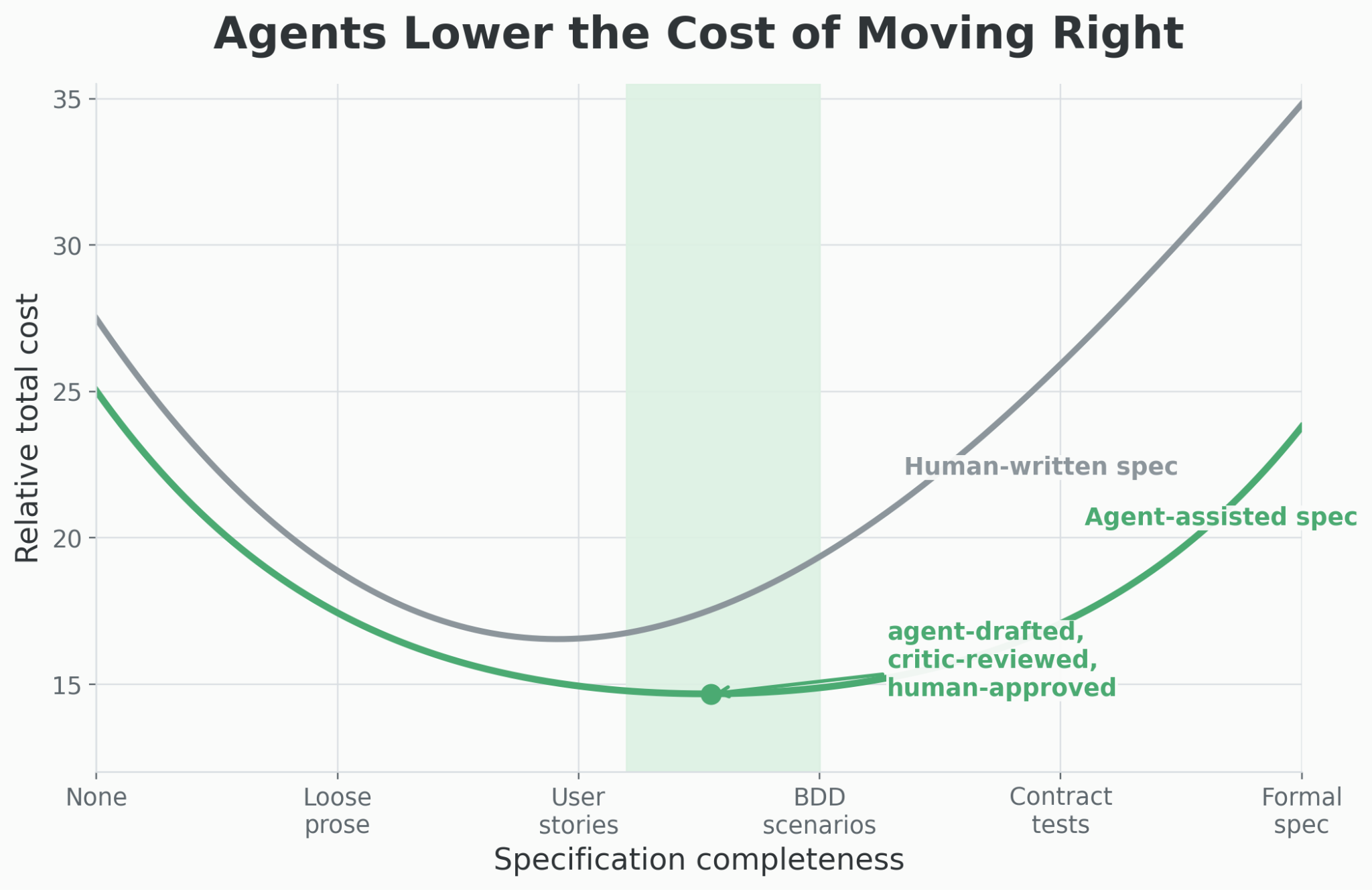
The trade-off is essentially one of front-loaded versus back-loaded costs. While formal specifications, such as Behavior-Driven Development (BDD) scenarios and contract tests, require substantial effort before a single line of code is written, they produce an "executable oracle." Once established, these checks can be run thousands of times at near-zero marginal cost, providing a consistent benchmark for the agent to meet.
Chronology of the Specification Evolution
The role of specification has evolved through several distinct phases as the tools of the trade have advanced:
- The Manual Era (Pre-2020): Requirements were translated by humans into code. Ambiguity was resolved through human friction—QA teams, peer reviews, and senior engineers who held the "tribal knowledge" of the system.
- The Assisted Era (2021–2023): Tools like GitHub Copilot introduced "autocomplete for code." Humans still drove the architecture, but the speed of typing increased. Specifications remained largely prose-based (Jira tickets, READMEs).
- The Agentic Era (2024–Present): Agents can now execute multi-step tasks, from architectural design to deployment. Implementation speed has outpaced human review speed, making vague requirements a liability rather than a minor inconvenience.
In the old world, vague requirements were buffered by human slowness; the time it took to write code allowed for mid-course corrections. In the current agentic world, vague requirements collide with machine speed, resulting in the rapid generation of plausible but fundamentally flawed systems.
The Multi-Agent Problem and Interpretive Drift
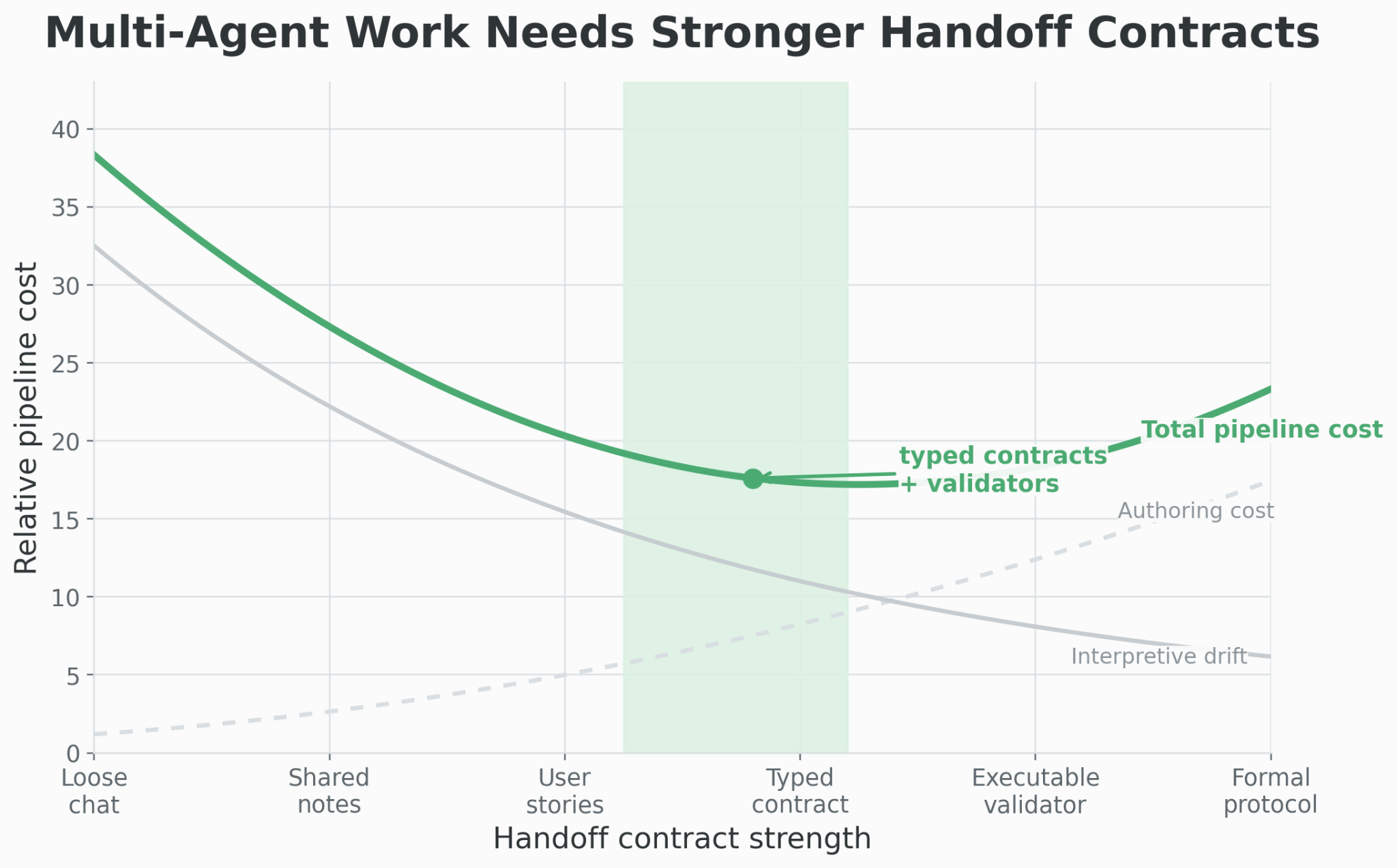
As organizations move toward multi-agent systems, where the output of one agent serves as the input for another, the need for rigorous specification becomes critical. This phenomenon, known as "interpretive drift," occurs when a minor misunderstanding in an initial requirement compounds across multiple layers of a system.
If Agent A misunderstands a requirement by 10%, Agent B—treating that output as ground truth—may build upon it in a way that further deviates from the original intent. By the time a human reviews the final product, the original error is buried under layers of seemingly competent code. To mitigate this, engineers are increasingly turning to "typed contracts."
A typed contract moves beyond simple prose to include:
- Strict Schemas: Defining exact data structures for handoffs.
- Invariants: Conditions that must always remain true.
- Validation Rules: Automated checks that prevent malformed data from passing between agents.
- Explicit Failure Behaviors: Instructions on how an agent should react when a contract is violated.
In this context, the specification functions as a legal contract between machine entities, ensuring that the system remains stable as it scales.
Data-Driven Analysis: Context Rot and Overspecification
While specification is essential, more text does not always equate to better results. Recent research, including studies on "Context Rot" by Chroma, highlights a significant limitation of current LLMs: performance degrades as the input context grows.
When a developer provides an agent with excessive design prose, historical tickets, and outdated documentation, the model may struggle to distinguish between active requirements and obsolete artifacts. This leads to "instruction drift," where the agent "averages" its behavior across competing sources of truth rather than following the most recent directive.
The data suggests a "sweet spot" for specification completeness. For exploratory work, a light touch focusing on boundaries and non-goals is most effective. For deterministic work, such as API integrations or CRUD flows, high-density specifications like BDD and contract tests yield the best ROI.
Industry Responses and the Rise of AI-Friendly API Design
Engineering leaders are responding to these challenges by advocating for "AI-friendly" architecture. The goal is to make the codebase itself act as a self-documenting specification. This approach reduces the amount of prose that must be stuffed into a prompt, thereby reducing the risk of context rot.
Key characteristics of AI-friendly APIs include:
- Explicit Discoverability: Avoiding "magic" functions or hidden conventions in favor of clearly named methods.
- Strong Typing: Using the type system to define legal inputs and outputs, which agents can inspect programmatically.
- Actionable Error Messages: Providing errors that suggest specific fixes, allowing agents to self-correct without human intervention.
- Task-Level Methods: Aligning API surfaces with real-world business tasks rather than low-level technical operations.
By improving API design, teams can reach the "code is the spec" milestone faster, allowing agents to learn the rules of the system by inspecting the existing codebase rather than reading external documentation.
The Survival of Agile and Extreme Programming (XP)
Contrary to predictions that AI would render traditional methodologies like Agile and Extreme Programming (XP) obsolete, these frameworks are proving more relevant than ever—albeit in modified forms.
The "ceremony" of Agile—inflated backlog grooming and manual status updates—is fading because agents can shift the shape of a project faster than a human can update a spreadsheet. However, the core principles of Agile and XP are thriving:
- Short Feedback Cycles: Essential for catching "convincing wrongness" generated by agents.
- Test-Driven Development (TDD): Executable checks are the only way to gate the high-speed output of an agent.
- Continuous Integration: Every change made by an agent must pass through an automated verification gate.
- Refactoring: Necessary because agents often prioritize functional code over maintainable architecture.
The role of "Pair Programming" is also shifting. Instead of two humans at one keyboard, it now often involves a human providing high-level design judgment while an agent handles the tactical implementation. Alternatively, it involves "Agentic Peer Review," where one model generates code and a second model, with a different prompt profile, critiques it for security flaws or architectural inconsistencies.
Broader Implications for the Software Industry
The shift toward specification-heavy engineering has profound implications for the labor market and project management. The "junior developer" role, which traditionally focused on implementation tasks, is being redefined. Entry-level engineers must now master the art of specification and verification rather than just syntax.
For organizations, the primary competitive advantage is shifting from "coding capacity" to "architectural clarity." The teams that succeed will not be those that prompt the fastest, but those that can most accurately define the boundaries of a problem and provide the machine with the necessary constraints to solve it safely.
In conclusion, while AI agents have made the act of coding nearly free, they have raised the stakes for engineering rigor. Specification validation is no longer a bureaucratic hurdle; it is a critical line item in the development budget. As the industry moves forward, the "human in the loop" will increasingly focus on deciding what should exist and what must never happen, leaving the "how" to the machines. The promise of agentic development is a world where implementation is trivial, but the responsibility of intent remains firmly with the engineer.