Sisilia Frederika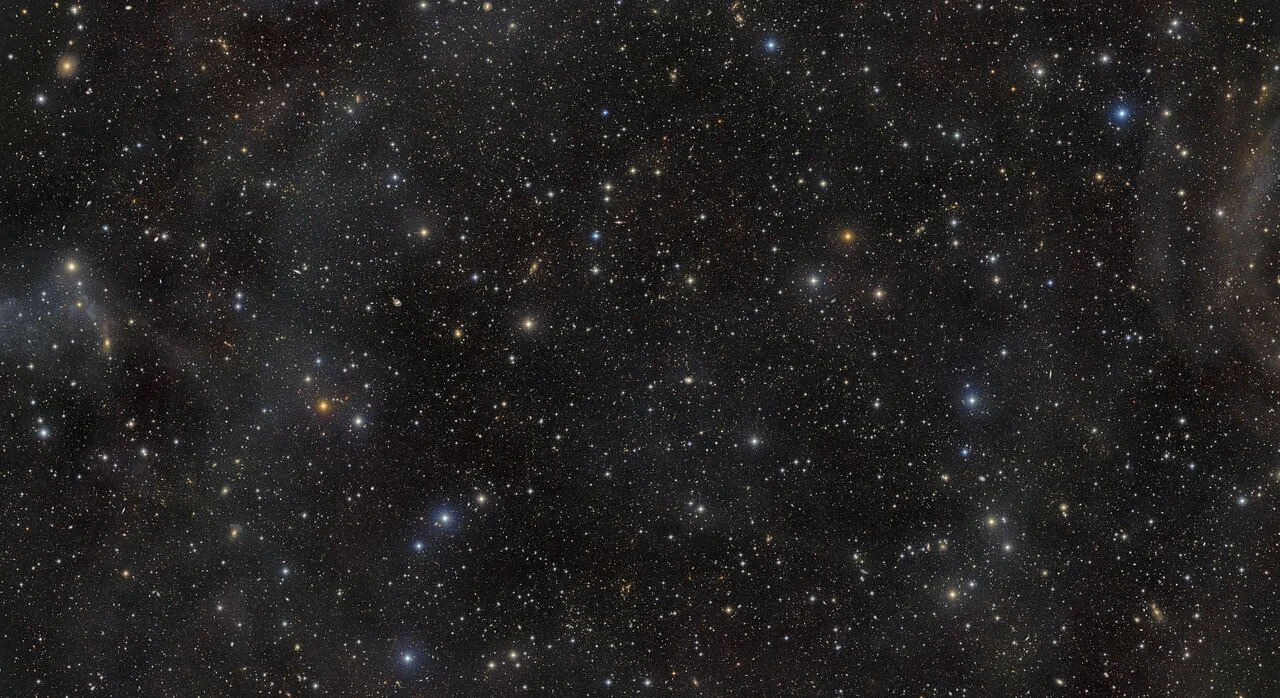
The Vera C. Rubin Observatory has achieved a significant milestone in modern astronomy by capturing the most detailed view to date of the COSMOS field, a well-known patch of the sky used by researchers to track the history of the universe. This achievement marks the first time the observatory’s Legacy Survey of Space and Time (LSST) Camera—the largest and most powerful digital camera ever constructed for astronomy—has produced an image and a corresponding catalog specifically for scientific research. Located in the constellation Sextans, the COSMOS field has long been a focal point for international astrophysical study, but the new data provided by Rubin offers a combination of depth and wide-field resolution that was previously unattainable.
The release of this image coincides with Rubin’s Early Data Preview 2 (EDP2), representing a critical phase in the observatory’s science validation period. By stacking hundreds of individual observations, the 3.2-gigapixel LSST Camera has revealed a cosmic tapestry containing more than 500,000 galaxies and approximately 50,000 individual stars within the Milky Way that lie along the line of sight. This data serves as a precursor to the upcoming ten-year Legacy Survey of Space and Time, which aims to map the entire southern sky with unprecedented frequency and detail.
The Legacy of the COSMOS Field
The Cosmic Evolution Survey (COSMOS) Deep Field is not a new discovery, but rather a storied "laboratory" in the sky. It was first brought to global prominence between 2003 and 2005, when the Hubble Space Telescope (HST) used its Advanced Camera for Surveys (ACS) to photograph the region in segments. The resulting mosaic was, at the time, the largest contiguous field ever imaged by Hubble. The choice of the Sextans constellation was deliberate; the region is relatively clear of the obscuring gas and dust found in the plane of the Milky Way, providing a "clear window" into the distant universe.
For over two decades, the COSMOS field has been the subject of intense scrutiny across the electromagnetic spectrum. It has been observed in optical light by Hubble and the Subaru Telescope, in X-rays by the Chandra and XMM-Newton observatories, in infrared by the Spitzer and James Webb Space Telescopes, and in radio waves by the Very Large Array (VLA). Because so much data already exists for this specific coordinate, it serves as the ultimate "gold standard" or reference point for new instruments. By aiming the LSST Camera at this field, astronomers can compare Rubin’s new data against decades of established observations to calibrate the camera’s sensitivity and ensure the accuracy of its automated processing pipelines.
Technical Prowess of the LSST Camera
The heart of the Rubin Observatory is the LSST Camera, a marvel of engineering developed at the SLAC National Accelerator Laboratory. The camera is roughly the size of a small car and weighs approximately 3,000 kilograms (6,600 pounds). Its focal plane consists of 189 individual sensors, providing a resolution of 3.2 gigapixels. To put this in perspective, it would take several hundred ultra-high-definition television screens to display a single full-size image from the camera at original resolution.
The LSST Camera’s primary advantage is its wide field of view, covering approximately 9.6 square degrees—about 40 times the area of the full moon in a single exposure. While the Hubble and James Webb Space Telescopes offer incredible depth, they have relatively narrow fields of view, akin to looking at the sky through a drinking straw. Rubin, conversely, acts as a wide-angle lens, allowing it to capture vast swathes of the sky while maintaining the sensitivity required to detect extremely faint objects.
The new COSMOS image demonstrates this capability by capturing a diverse array of galactic structures. Within the frame, astronomers have identified barred spiral galaxies with distinct central structures and sweeping arms, smooth elliptical galaxies composed of older stars, and "distorted" galaxies that are currently in the process of merging. The image also reveals a multitude of faint, red galaxies, which are either inherently dim or appear red due to their extreme distance and the resulting cosmological redshift.
Chronology of Observation and Data Validation
The path to this scientific catalog involved a complex timeline of construction, testing, and observation. The Rubin Observatory, situated on the Cerro Pachón ridge in north-central Chile, has been under development for over a decade. The LSST Camera underwent years of rigorous testing at SLAC before being transported to Chile in early 2024.
The data used to create the new COSMOS field image was obtained during a science validation period. This phase is designed to "stress test" the observatory’s systems, from the telescope’s mirrors to the software algorithms that automatically detect and categorize celestial objects. The Early Data Preview 2 (EDP2) integrates observations taken between April 2025 and January 2026, providing a look at how the telescope performs over a sustained period of time.
Phil Marshall, Deputy Director of Rubin Observatory, emphasized the strategic importance of this field. "The COSMOS field’s wealth of prior observations, and its repeated targeting both during commissioning and as one of the LSST’s deep fields, will make it very valuable as a testing ground for scientists as they get ready to take on the survey data," Marshall stated. The repeated visits are a cornerstone of Rubin’s mission, as they allow for the creation of "deep-stacked" images that reveal objects too faint to be seen in a single exposure.
Scientific Objectives and the "Movie of the Universe"
While the initial COSMOS image is a static snapshot, the true power of the Rubin Observatory lies in its temporal resolution. Unlike previous surveys that might visit a patch of sky once every few years, Rubin will scan the entire visible southern sky every few nights for a decade. This will effectively create a "movie" of the universe, allowing astronomers to monitor transient and variable phenomena in real-time.
Supernovae, which are the explosive deaths of massive stars, are a primary target. By observing these events as they happen, scientists can better understand the life cycles of stars and use the brightness of specific supernovae (Type Ia) to measure the expansion rate of the universe. The observatory is expected to detect millions of such transients over its ten-year lifespan.
Additionally, the survey will play a vital role in the study of dark matter and dark energy. By mapping the positions and shapes of billions of galaxies, researchers can observe how the large-scale structure of the universe has evolved. Subtle distortions in the shapes of distant galaxies—a phenomenon known as weak gravitational lensing—can reveal the distribution of invisible dark matter that lies between the galaxies and Earth.
Community Impact and Global Collaboration
The Rubin Observatory is a joint project of the National Science Foundation (NSF) and the Department of Energy (DOE), operated by NSF’s NOIRLab and SLAC. Its impact, however, is deeply rooted in the local community in Chile. During the announcement of the COSMOS image, Bob Blum, Director of the Rubin Observatory at NSF NOIRLab, took a moment to address the human element of the project.
The region of Coquimbo, where the observatory is located, recently suffered from devastating storms. Blum dedicated the start of LSST science to the people of the region, noting that their support has been instrumental to the success of the AURA (Association of Universities for Research in Astronomy) observatories in Chile for decades. This acknowledgment highlights the symbiotic relationship between high-level international science and the local infrastructure and workforce that make such endeavors possible.
Implications for the Future of Astronomy
The release of the EDP2 and the COSMOS field image marks the end of the observatory’s "pre-science" era and the beginning of its operational life. The data products generated by Rubin are expected to be transformative, not just because of their quality, but because of their accessibility. The observatory is designed to process 20 terabytes of data every night, with alerts for moving or changing objects being sent to the global scientific community within 60 seconds of detection.
As the 10-year Legacy Survey of Space and Time officially commences, the scientific community anticipates a paradigm shift. The COSMOS field image is a proof of concept, demonstrating that the LSST Camera can deliver on its promise of high-resolution, wide-field imaging. For researchers, the catalog of half a million galaxies is just the beginning.
In the coming years, Rubin will move beyond the COSMOS field to map the Milky Way’s structure in unprecedented detail, identify thousands of small objects in our solar system (including potentially hazardous asteroids), and probe the very nature of space-time. The "Deep Field" in Sextans has served its purpose as a reliable guide, and now, with Rubin’s new vision, the boundaries of the known universe are set to expand once again. By combining the historical context of the COSMOS field with the cutting-edge technology of the LSST, astronomers are now better equipped than ever to answer the most fundamental questions about where we came from and where the universe is headed.