Sisilia Frederika
On Saturday, September 19, the Hubble Space Telescope (HST) achieved a historic milestone in its decades-long career by completing its 200,000th orbit of Earth. This achievement underscores the enduring legacy of an observatory that has fundamentally reshaped humanity’s understanding of the cosmos. Since its deployment in 1990, the telescope has traveled more than 8 billion kilometers (approximately 5 billion miles), a distance equivalent to traveling to Neptune and back, and then back to Neptune again. Over the course of its 34 years in operation, it has gathered more than 1.7 million observations, providing the data necessary for tens of thousands of scientific papers.
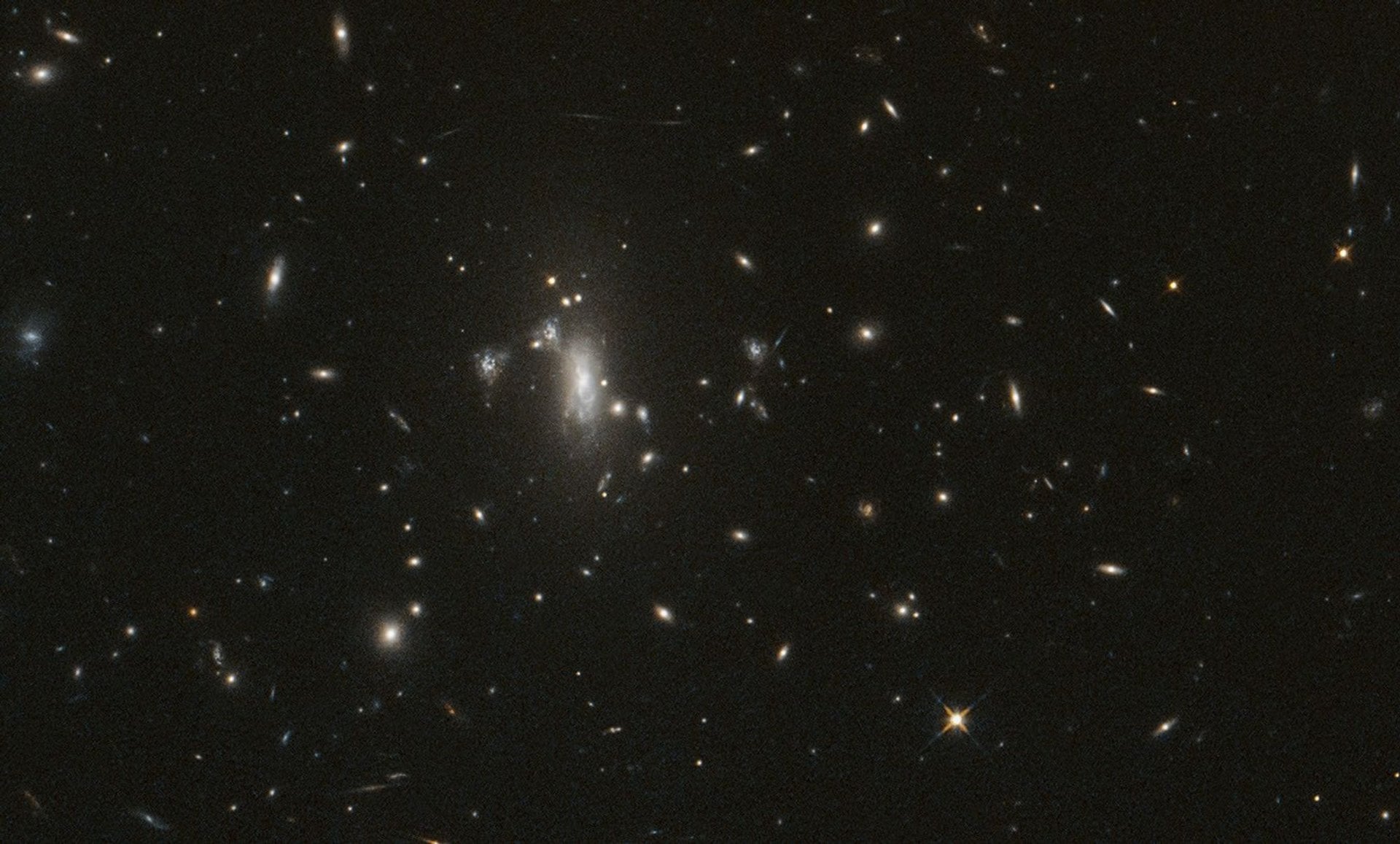
The timing of this milestone is particularly poignant as it coincides with the telescope’s 36th year of continuous service, a tenure that exceeds the operational life of the International Space Station by nearly a decade. To mark the occasion, NASA directed the telescope toward a target that reflects its core scientific mandate: the measurement of the expansion rate of the universe. The observation focused on MACS J0417, a massive galaxy cluster located approximately 4.65 billion light-years from Earth in the constellation Eridanus. This cluster serves as a natural cosmic magnifying glass, allowing astronomers to peer into the even more distant reaches of space and time.
A Legacy of Precision: The Hubble Constant and the Expanding Universe
The Hubble Space Telescope was named in honor of Edwin P. Hubble, the astronomer who in the late 1920s confirmed that the universe is expanding. The primary mission of the telescope has always been to refine the "Hubble Constant," the unit of measurement used to describe the speed at which the universe is moving apart. By observing distant celestial objects, Hubble has helped reduce the uncertainty in this value from roughly 50 percent to less than 3 percent.
The 200,000th orbit observation of MACS J0417 is a continuation of this legacy. Galaxy clusters like MACS J0417 are among the most massive structures in the universe, containing hundreds or thousands of galaxies bound together by gravity. Because of their immense mass, these clusters warp the fabric of spacetime around them. This phenomenon, known as gravitational lensing, was predicted by Albert Einstein’s General Theory of Relativity. It allows the cluster to act as a lens, bending and magnifying the light from objects located far behind it, which would otherwise be too faint for even our most powerful telescopes to detect.
The Hunt for Supernova Athena
The specific objective of the recent observations is the re-acquisition of a supernova nicknamed "Athena." This stellar explosion was first identified in 2023 by the James Webb Space Telescope (JWST). Supernovae are critical to the "Cosmic Distance Ladder," a series of methods used by astronomers to determine the distances to celestial objects. Specifically, Type Ia supernovae are often referred to as "standard candles" because they explode with a consistent peak luminosity. By measuring how bright a supernova appears from Earth, scientists can calculate exactly how far away it is.
Supernova Athena is unique because it is being viewed through the gravitational lens of MACS J0417. While the initial explosion has long since faded from its original perspective, the gravitational lens has created multiple paths for the light to reach Earth. Because these paths vary in length and pass through different concentrations of dark matter and gravity, the light arrives at different times.
Astronomers have been in a two-year hiatus waiting for the next "image" of Athena to appear. Based on complex mathematical models of the galaxy cluster’s mass distribution, scientists expect the supernova to become visible again between late 2024 and March 2027. Hubble will maintain a watchful eye on MACS J0417 during this window. By recording the exact timing and location of Athena’s reappearance, researchers can gain unprecedented insights into the distribution of both visible and dark matter within the cluster.
Technical Milestones and Orbital Endurance
Reaching 200,000 orbits is a testament to the engineering excellence of the late 20th century and the success of the Space Shuttle servicing missions. Hubble was launched aboard the Space Shuttle Discovery (STS-31) on April 24, 1990. Unlike most space telescopes, Hubble was designed to be modular and repairable in orbit. Between 1993 and 2009, five servicing missions were conducted to replace aging batteries, failing gyroscopes, and obsolete scientific instruments.
The telescope’s current longevity is a point of pride for NASA and the European Space Agency (ESA). While the International Space Station (ISS) began assembly in 1998, Hubble has been in orbit eight years longer, surviving the harsh radiation environment of Low Earth Orbit (LEO). Each orbit takes approximately 95 minutes, during which the telescope must maintain incredible stability to capture clear images of objects billions of light-years away. To put this precision into perspective, Hubble’s pointing stability is equivalent to holding a laser beam steady on a dime located 320 kilometers (200 miles) away.
The Symbiosis of Hubble and Webb
The search for Supernova Athena highlights the modern era of "multi-messenger" and multi-wavelength astronomy. While the James Webb Space Telescope is often described as Hubble’s successor, the two observatories actually perform different, complementary roles.
Hubble primarily observes the universe in the visible and ultraviolet (UV) spectra. Ultraviolet light is essential for studying the hot, young stars and the high-energy processes of the early universe, but it is blocked by Earth’s atmosphere, making a space-based observatory like Hubble indispensable. Conversely, the JWST operates in the infrared spectrum, allowing it to peer through thick clouds of interstellar dust and see the very first stars and galaxies that formed after the Big Bang.
The discovery of Athena by the JWST in infrared and the subsequent monitoring by Hubble in visible light provides a comprehensive data set that neither telescope could achieve alone. This partnership allows scientists to see the "full picture" of cosmic events. This synergy is expected to expand even further with the upcoming launch of the Nancy Grace Roman Space Telescope, currently scheduled for late 2026 or early 2027. The Roman telescope will have a field of view 100 times larger than Hubble’s, enabling it to conduct vast surveys of the sky that will identify new targets for Hubble and Webb to study in detail.
Scientific Implications: Refining the Hubble Tension
The data gathered during Hubble’s 200,000th orbit and the subsequent monitoring of Supernova Athena will contribute to resolving one of the most significant mysteries in modern physics: the "Hubble Tension."
Currently, there is a discrepancy between the expansion rate of the universe as measured by the Cosmic Microwave Background (the afterglow of the Big Bang) and the rate measured by observing "local" objects like supernovae and Cepheid variable stars. The two measurements differ by about 9 percent, a gap that is statistically significant and suggests that our current standard model of cosmology may be missing a key component—perhaps a misunderstanding of dark energy or the existence of a new type of subatomic particle.
By using gravitational lensing to observe Supernova Athena, astronomers can perform parallax measurements and calculate the recessional velocity of the host galaxy with extreme precision. This provides a high-confidence data point for the Cosmic Distance Ladder, helping to determine if the Hubble Tension is a result of measurement error or a signal of "new physics."
Statements and Reactions from the Scientific Community
While NASA’s official communications remain focused on the technical data, the sentiment within the astronomical community is one of profound respect for the "venerable observatory." Project scientists have noted that Hubble’s ability to continue producing top-tier science after three and a half decades is a "miracle of engineering."
"Hubble was built to answer the biggest questions in science, and it is still doing exactly that," noted a representative during a recent mission update. "The fact that we are using a 34-year-old telescope to follow up on discoveries made by our newest, most advanced infrared observatory shows how vital Hubble remains to the global scientific enterprise."
Looking Toward the Future
As Hubble continues its journey beyond 200,000 orbits, the focus remains on maximizing its remaining lifespan. Following a transition to a "one-gyro" control mode earlier this year to preserve the longevity of its pointing system, the telescope remains remarkably productive. NASA engineers anticipate that Hubble will continue to operate well into the 2030s, potentially overlapping with several next-generation missions.
The upcoming observation window for Supernova Athena’s reappearance will be a critical period for the mission. Should the supernova appear as predicted, it will validate the complex gravitational models used to map dark matter in the MACS J0417 cluster. If it appears earlier or later, it will force a re-evaluation of those models, leading to a deeper understanding of how mass is distributed in the largest structures of the universe.
Hubble’s 200,000th orbit is more than just a number; it is a milestone of human curiosity and technical persistence. From its rocky start in 1990 with a flawed mirror to its current status as a cornerstone of modern astrophysics, Hubble has proven that even as technology advances, there is no substitute for the unique perspective of this eye in the sky. As it continues to orbit 515 kilometers above the Earth, Hubble remains our most reliable window into the vast, expanding theater of the cosmos.