Sisilia Frederika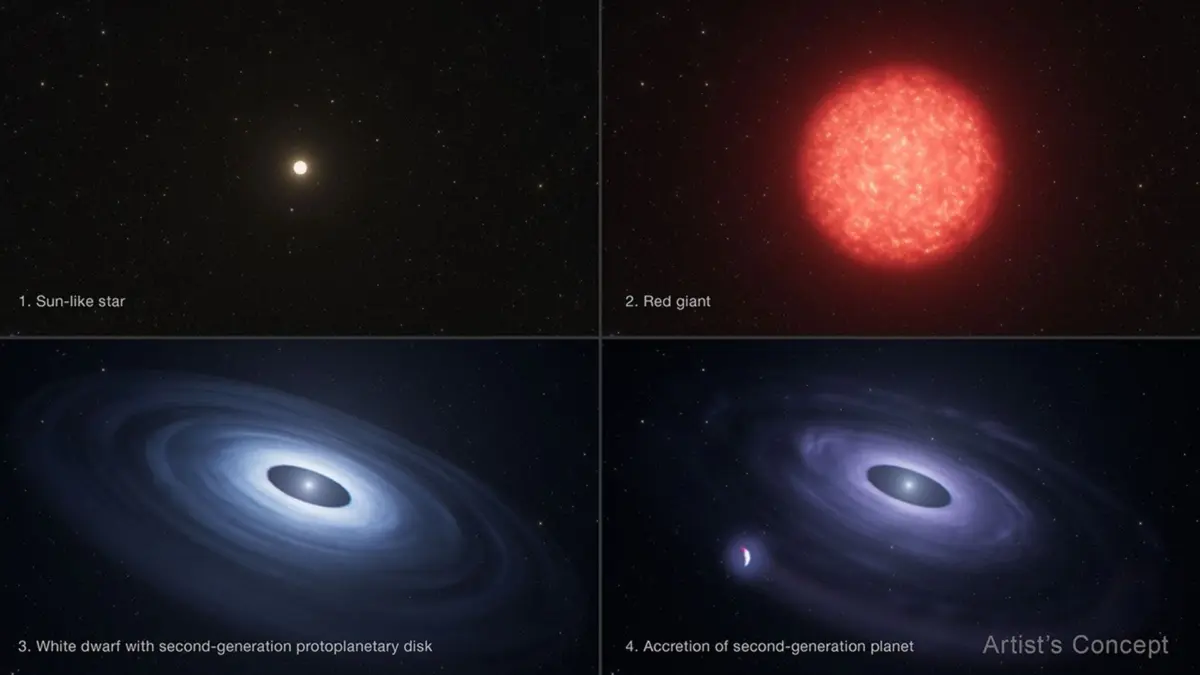
The narrative of planetary evolution has long been viewed through a linear lens, where planets form in the wake of a star’s birth and perish during its violent demise. However, a groundbreaking study led by researchers from the University of Warwick has challenged this paradigm, uncovering evidence of a "second-generation" planet candidate orbiting a white dwarf known as HS 0209+0832. This discovery, published in the journal Nature Astronomy on October 5, suggests that the death of a star may not be the final chapter for planetary systems, but rather a catalyst for a new cycle of celestial creation. By re-examining archival data from the Hubble Space Telescope and the Far Ultraviolet Spectroscopic Explorer (FUSE), the international team identified unique chemical signatures—specifically the heavy element niobium—that point toward a planet formed from the very material shed by the star during its final evolutionary stages.
The Life, Death, and Rebirth of Stellar Systems
To understand the significance of HS 0209+0832, one must first consider the standard lifecycle of stars. Most stars, including our Sun, spend the majority of their lives in the main sequence, fusing hydrogen into helium. As they exhaust their nuclear fuel, they expand into red giants, eventually shedding their outer layers to form a planetary nebula. What remains is a dense, hot core. For stars of moderate mass, this remnant is a white dwarf—an object roughly the size of Earth but with the mass of a star. In more massive cases, the collapse results in a neutron star or a black hole.
Traditionally, any planets orbiting a star during its red giant phase are either consumed by the expanding atmosphere or pushed into wider, unstable orbits. While "first-generation" planets—those formed from the original protoplanetary disk—can survive into the white dwarf stage, the concept of a "second-generation" planet involves a far more complex process. Astronomers have long theorized that the gas and dust ejected during a star’s death could settle into a new accretion disk. Over millions of years, this recycled material could coalesce to form entirely new worlds. The HS 0209+0832 system provides the most compelling evidence to date that this theoretical "phoenix" process actually occurs in the cosmos.
The HS 0209+0832 System: Physical Parameters
Located in the constellation of Cetus, HS 0209+0832 is a white dwarf that serves as a laboratory for extreme stellar physics. The star is approximately 60% as massive as the Sun, yet it has been compressed into a volume only 1% of the Sun’s radius. This extreme density creates an immense gravitational pull, which plays a crucial role in how astronomers detect surrounding material.
Because white dwarfs have such high surface gravity, heavy elements like iron, magnesium, or silicon should sink rapidly into the star’s interior, leaving an atmosphere of pure hydrogen or helium. When astronomers detect heavier elements—a phenomenon known as "pollution"—it serves as an indicator that the star is currently accreting material from an external source, such as a disintegrated asteroid or a nearby planet. In the case of HS 0209+0832, the pollution was not merely present; it was anomalous.
A 25-Year-Old Cold Case: The Role of Hubble and FUSE
The discovery is the culmination of a decades-long investigation. The Hubble Space Telescope first observed HS 0209+0832 in 1999 using its Space Telescope Imaging Spectrograph (STIS). At the time, the data revealed approximately 100 spectral lines that astronomers could not identify. These "unidentified flying signatures" remained a mystery for a quarter-century, as the chemical databases of the late 1990s were insufficient to match the complex ultraviolet fingerprints captured by Hubble.
The breakthrough came when a team led by Dr. Abigail Williams of the University of Warwick’s Centre for Exoplanets and Habitability applied modern computational tools and updated chemical databases to the archival data. By cross-referencing the Hubble spectra with data from the Far Ultraviolet Spectroscopic Explorer (FUSE) and the Transiting Exoplanet Survey Satellite (TESS), the researchers identified the mysterious element: niobium (Nb).
The Niobium Smoking Gun: Evidence of Second-Generation Formation
The detection of niobium is the linchpin of the "second-generation" theory. Niobium is a transition metal that does not form through standard thermonuclear fusion in the cores of living stars. Instead, elements heavier than iron are synthesized through the "r-process" (rapid neutron capture) or "s-process" (slow neutron capture), which occur during the violent "death throes" of a star—specifically during the asymptotic giant branch (AGB) phase or supernova events.
The presence of a high abundance of niobium in the atmosphere of HS 0209+0832 suggests that the star is currently consuming material that was enriched during its own transition from a red giant to a white dwarf. Nicholas Stone, a theoretical astrophysicist at the University of Wisconsin-Madison and co-author of the study, noted that niobium serves as a "signpost" of stellar expiration. Because the amount of niobium detected is so significant, it cannot be explained by the accretion of a simple asteroid. Instead, it implies the presence of a massive body—a planet—that formed from the enriched nebula left behind after the star’s primary life cycle ended.
Characterizing the Candidate Planet
Based on the spectral data and orbital dynamics, the research team has developed a profile of the suspected second-generation planet. The candidate is believed to be a gas giant, similar in size and mass to Jupiter. However, its environment is far more hostile than anything in our Solar System.

The planet orbits HS 0209+0832 at a staggering proximity of only 6 million kilometers (approximately 3.7 million miles). For comparison, Mercury, the innermost planet of our Solar System, orbits the Sun at a distance of 58 million kilometers. At this close range, the planet is subjected to intense ultraviolet radiation from the young, hot white dwarf.
The team theorizes that this radiation is actively stripping the planet’s atmosphere, creating a comet-like tail of gas and dust that follows the planet in its orbit. As this material spirals inward, it eventually falls onto the surface of the white dwarf. This "atmospheric cannibalism" is what allowed the Hubble Space Telescope to detect the niobium; the star is essentially "eating" the planet’s outer layers, revealing the chemical composition of a world born from recycled stellar remains.
Chronology of Research and International Collaboration
The validation of HS 0209+0832 as a host for a second-generation planet was an international effort involving institutions across the globe:
- 1999: Initial Hubble STIS observations detect unidentified chemical signatures.
- Early 2000s: FUSE mission provides complementary ultraviolet data, confirming the presence of heavy element pollution but leaving the specific elements unidentified.
- 2020-2023: The University of Warwick team initiates a "cold case" review of archival data using the latest atomic physics models.
- 2024: TESS data is integrated to analyze the light curves of the white dwarf, looking for transits or orbital modulations.
- October 5, 2024: The findings are published in Nature Astronomy, officially proposing the existence of the first confirmed second-generation planet.
The collaboration included experts from the Instituto de Astrofísica de Canarias (IAC), the Racah Institute of Physics, the Massachusetts Institute of Technology (MIT), and the Harvard & Smithsonian Center for Astrophysics (CfA), among others.
Analysis of Implications: A New Chapter in Astrobiology
The discovery of a potential second-generation planet has profound implications for our understanding of planetary habitability and the long-term future of the universe. If planets can form around white dwarfs from recycled material, it significantly expands the number of potential "habitable" environments in the galaxy.
White dwarfs are incredibly stable. Unlike main-sequence stars, which can exhibit volatile flares, white dwarfs cool down at a very predictable and slow rate over billions of years. Dr. Williams pointed out that once HS 0209+0832 cools further, the planet could settle into a stable habitable zone. Because white dwarfs can remain at consistent temperatures for trillions of years, these second-generation systems might actually offer a more stable environment for the long-term evolution of life than systems orbiting Sun-like stars.
Furthermore, this research shifts the perspective on white dwarfs from being "stellar graveyards" to "stellar nurseries." It suggests that the heavy elements forged in the hearts of dying stars are immediately put to use in the construction of new worlds, rather than simply drifting into the interstellar medium.
Future Research and Limitations
While the evidence for the second-generation planet is robust, the team emphasizes that it remains a "candidate" until direct imaging or further transit timing variations can provide 100% confirmation. The proximity of the planet to the star makes direct imaging difficult with current technology, but the James Webb Space Telescope (JWST) may be able to characterize the infrared signature of the planet’s dust tail.
The team plans to continue monitoring HS 0209+0832 to determine the rate of accretion and to search for other heavy elements that could further refine the planet’s composition. If more systems like this are found, it would confirm that second-generation planets are not cosmic anomalies but a standard feature of stellar evolution.
The study of HS 0209+0832 has effectively reopened the book on planetary formation. As Dr. Williams concluded, the white dwarf stage is no longer an epilogue, but a transition into a potentially much longer and more complex tale of cosmic survival and rebirth. For now, the scientific community looks toward the stars with the realization that even in death, a star may still have the power to create.