Sisilia Frederika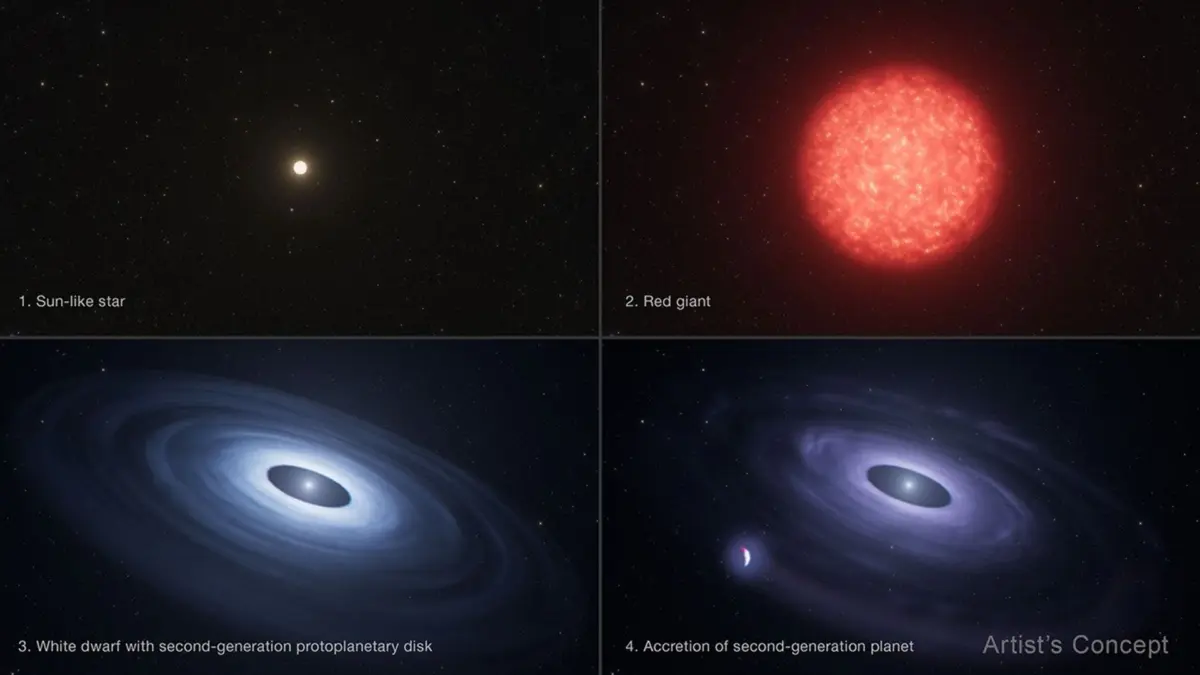
Astronomers have long operated under the assumption that the birth of a planetary system is a singular event, occurring in the turbulent aftermath of a star’s initial formation. However, a groundbreaking study led by researchers at the University of Warwick suggests that the life cycle of planetary systems may be far more complex and resilient than previously imagined. By analyzing archival data from the Hubble Space Telescope, an international team of scientists has identified a candidate planet orbiting the white dwarf HS 0209+0832—a world that appears to have formed not from the original nebula that birthed its parent star, but from the "corpse" of the star itself. If confirmed, this celestial body would represent the first "second-generation" planet ever discovered, marking a paradigm shift in our understanding of how matter organizes in the wake of stellar death.
The Phoenix Effect: Planets Rising from Stellar Ashes
The standard model of planetary formation, known as the nebular hypothesis, posits that planets form from a circumsolar accretion disk of gas and dust shortly after a star enters its main sequence. This process occurred in our own Solar System approximately 4.5 billion years ago, resulting in the "first-generation" planets we recognize today, including Earth, Mars, and Jupiter. However, when stars like our Sun reach the end of their lives, they undergo a violent transformation. They expand into red giants, consuming inner planets, before shedding their outer layers in a series of gravitational collapses and thermal pulses. This ejected material forms a nebula—a glowing shell of gas and dust—leaving behind a dense stellar remnant: a white dwarf.
For decades, the scientific community has speculated whether the material ejected during these "death throes" could settle into a new accretion disk, potentially giving rise to a second generation of planets. The discovery of HS 0209+0832 provides the most compelling evidence to date that this "Phoenix effect" is not merely a theoretical possibility but a physical reality. The system features a white dwarf that is approximately 60% as massive as the Sun but compressed into a radius only 1% of the Sun’s size. Within this extreme environment, the team found chemical signatures that suggest a massive, Jupiter-sized gas giant is orbiting the remnant at a distance of just 6 million kilometers—far closer than Mercury’s 58-million-kilometer orbit around our Sun.
Unlocking a Cold Case: The Role of Niobium
The identification of this candidate planet was the result of a "cold case" investigation involving data that had remained a mystery for over two decades. When the Hubble Space Telescope first observed HS 0209+0832 in 1999, it recorded nearly 100 distinct chemical signatures in the star’s spectrum that astronomers were unable to identify at the time. These spectral lines represent the "fingerprints" of elements present in the atmosphere of the white dwarf or the material immediately surrounding it.
The breakthrough came when a team led by researchers from the University of Warwick’s Centre for Exoplanets and Habitability utilized an updated chemical database to re-examine the archival Hubble data. They discovered that a significant portion of the unidentified signatures matched the element niobium (Nb). Niobium is a transition metal that, while found on Earth and used in various high-tech alloys, is exceptionally rare in the atmospheres of white dwarfs.
The presence of niobium is scientifically significant because of how it is synthesized. Unlike lighter elements such as hydrogen or helium, niobium and other elements heavier than iron are not produced through standard thermonuclear fusion in the cores of living stars. Instead, they are created through intense neutron-capture processes that occur during the final, violent stages of a star’s life. The detection of a high abundance of niobium suggests that the material currently falling onto the white dwarf—and presumably making up the candidate planet—was forged during the star’s transition into a remnant.
A Multi-Mission Chronology of Discovery
The verification of the HS 0209+0832 system required a synthesis of data spanning several decades and multiple space-based observatories. The timeline of the discovery illustrates the importance of data archiving in modern astrophysics:
- 1999: Initial observations by the Hubble Space Telescope detect anomalous spectral lines in the HS 0209+0832 system.
- 2000s: The Far Ultraviolet Spectroscopic Explorer (FUSE) mission, designed to explore the high-energy universe, collects additional ultraviolet data on the white dwarf before its retirement.
- 2018-2022: The Transiting Exoplanet Survey Satellite (TESS) monitors HS 0209+0832 for a period of four months, searching for periodic dips in brightness that would indicate a planet passing in front of the star.
- 2023: Researchers at the University of Warwick apply new computational models and updated atomic data to the combined Hubble, FUSE, and TESS datasets.
- October 5, 2024: The team publishes their findings in Nature Astronomy, proposing the existence of the first confirmed second-generation planet.
By cross-referencing the Hubble spectra with TESS photometry, the researchers were able to estimate the physical characteristics of the planet. The data suggests a gas giant with a mass and radius comparable to Jupiter, though its environment is far more hostile. Because HS 0209+0832 is a relatively young white dwarf, it remains intensely hot, emitting high-energy radiation that is actively stripping the atmosphere from the nearby planet.

Atmospheric Stripping and the Comet-Like Tail
The proximity of the candidate planet to its host star creates a dynamic and destructive interaction. At a distance of only 6 million kilometers, the planet is subjected to extreme tidal forces and blistering radiation. The researchers theorize that this radiation is heating the planet’s outer layers to the point where they are escaping into space, forming a comet-like tail of gas and dust that trails the planet in its orbit.
As this material spirals inward, it eventually falls onto the surface of the white dwarf—a process known as accretion. It is this "pollution" of the white dwarf’s atmosphere that allowed Hubble to detect niobium. In a "clean" white dwarf, heavy elements would quickly sink below the observable surface due to the star’s immense gravity. The fact that Hubble could see niobium in 1999 and again in later observations suggests a constant "rain" of material from a nearby source, providing strong circumstantial evidence for the existence of the planet.
International Collaboration and Expert Perspectives
The research was an immense collaborative effort, bringing together experts from prestigious institutions worldwide. The team included scientists from the University of Warwick (UK), the Instituto de Astrofísica de Canarias (Spain), the Racah Institute of Physics (Israel), the Institut für Theoretische Physik und Astrophysik (Germany), the University of Wisconsin-Madison, the Massachusetts Institute of Technology (MIT), the Laboratory for Atmospheric and Space Physics (LASP), the Harvard & Smithsonian Center for Astrophysics (CfA), and the Space Telescope Science Institute (STScI).
Nicholas Stone, a theoretical astrophysicist at the University of Wisconsin-Madison and co-author of the study, emphasized the rarity of the findings. He noted that the presence of niobium serves as a "signpost" of the star’s death throes. According to Stone, the synthesis of such heavy elements only occurs in the exotic conditions that emerge as a star dies, meaning any planet containing significant amounts of these elements must have been assembled from the "innards" of the star after they were expelled into space.
Lead researcher Williams expressed optimism about the planet’s future, noting that while it is currently losing its atmosphere, it is likely to survive the white dwarf’s cooling phase. As the star loses heat over millions of years, the radiation levels will drop, potentially allowing the planet to settle into a more stable state within what could eventually become a "habitable zone" for a white dwarf system.
Implications for the Future of Astronomy
The discovery of HS 0209+0832 has profound implications for several branches of astronomy. First, it suggests that planetary formation is a more robust process than previously thought, capable of occurring under the extreme conditions of a post-supernova or post-red-giant environment. This opens up a new demographic of exoplanets for study, which may have vastly different chemical compositions than the planets in our own Solar System.
Second, the study highlights the untapped potential of archival data. The signatures of this second-generation planet were hidden in plain sight for 25 years, waiting for chemical databases and computational power to catch up with the sensitivity of Hubble’s instruments. As AI and machine learning become more integrated into astronomical research, similar "cold cases" in the NASA and ESA archives may yield further discoveries of "zombie" systems or second-generation worlds.
Finally, the HS 0209+0832 system provides a grim but fascinating preview of the far-distant future of our own Solar System. While the Sun is not massive enough to go supernova, it will eventually become a white dwarf. Understanding how planets form or survive around these remnants gives scientists a clearer picture of the ultimate fate of planetary matter in the universe. The research team plans to continue monitoring the system for several more years, using next-generation observatories like the James Webb Space Telescope to characterize the planet’s tail and confirm its orbital parameters. For now, HS 0209+0832 stands as a testament to the fact that the end of a star’s life may simply be the beginning of a new, even more mysterious chapter in the story of its planetary companions.