
 Lina Irawan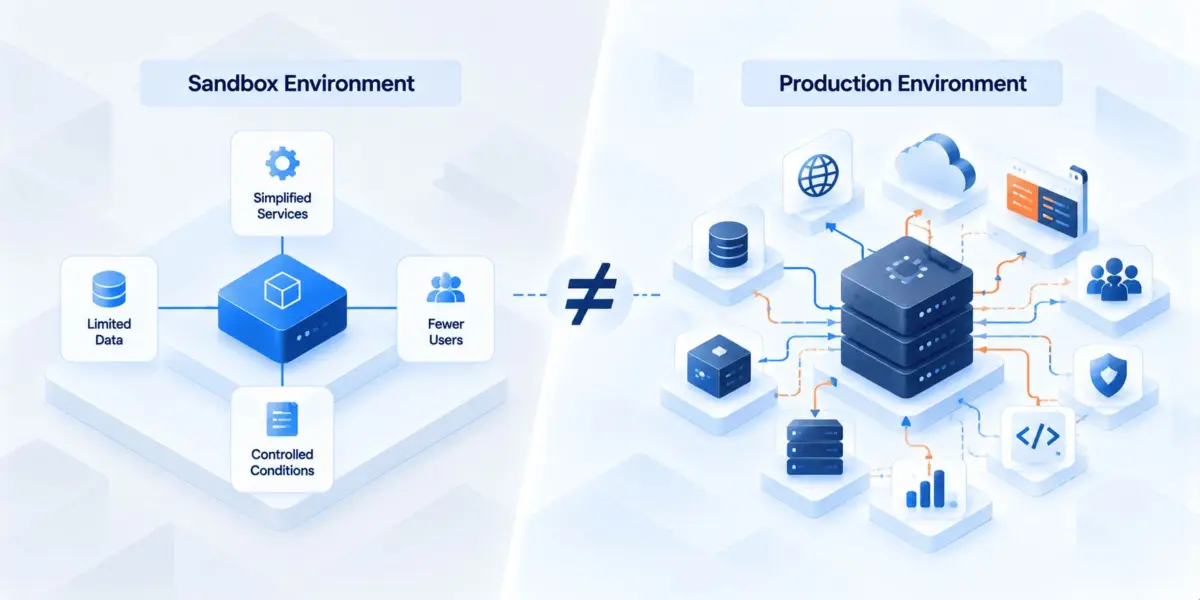
The structural gap between sandbox environments and production reality represents one of the most persistent challenges in modern software engineering, as these testing environments have historically failed to mirror the complexities of live systems. Whether due to a configuration variable set differently, a database seed that omits legacy record formats, or an upstream service that deployed a new response schema without a corresponding update to the simulation, the divergence is not an outlier but a structural certainty. This phenomenon, commonly referred to as "environment drift," manifests across teams of all scales, indicating that the problem is inherent to the architecture of distributed systems rather than a failure of individual execution. When engineering teams accept that the gap is structural, the focus of maintenance work shifts from a futile pursuit of total parity to a strategic management of behavioral accuracy.
The Architecture of Environmental Divergence
Drift accumulates primarily because production and sandbox environments operate on different schedules with distinct triggers, often lacking a centralized coordination mechanism. Production is a living entity, evolving through a constant stream of application deployments, infrastructure updates, upstream service API changes, database schema migrations, and third-party integration refreshes. Each of these events moves the production environment forward in at least one dimension. Conversely, the sandbox environment only advances when it is explicitly updated by a human operator or a secondary automation script.
The failure to synchronize these environments results in a widening chasm. Teams often misattribute this drift to the environment itself, when in reality, the drift is a consequence of the lack of deliberate scheduling. A sandbox does not track production automatically; it requires a systematic approach tied to real-world deployment events. Without a schedule that mirrors the production lifecycle, drift becomes the default state of the testing environment.
Categorizing the Gap: Infrastructure vs. Behavioral Contracts
To effectively manage environmental drift, it is necessary to distinguish between types of divergence. Not all drift is equal in its capacity to undermine the integrity of software testing. The gap generally falls into two categories: infrastructure divergence and behavioral contract drift.
Infrastructure Divergence
Infrastructure divergence involves differences in hardware, resource limits, and networking rules. This includes the use of smaller instance types (e.g., a t3.medium in a sandbox versus a production-grade instance), scaled-down replicas, or different subnet configurations. While these differences appear significant on a configuration diff, they rarely impact the efficacy of an integration test. For instance, an integration test validating how an application handles a payment service response will yield the same logic-based result regardless of whether it runs on a high-memory instance or a budget-friendly alternative. Infrastructure parity is often pursued because it is measurable and satisfying to "close the gap," yet it offers diminishing returns regarding actual bug detection.
Behavioral Contract Drift
The more critical category is behavioral contract drift. This occurs when the simulation of a dependency—such as an order service’s payment gateway—returns a response structure that no longer aligns with the actual upstream service. If the real service changes its schema but the simulation remains static, the tests will validate the application against an assumption that production will eventually contradict. In this scenario, the test suite returns a "pass" status, but the integration fails upon deployment. The sandbox has not failed its technical function; rather, the simulation has become an inaccurate representation of reality.
The Chronology of Simulation Decay
The lifecycle of a sandbox simulation typically follows a predictable path of decay that begins at the moment of creation. Understanding this timeline is essential for implementing corrective measures.
- Phase 1: Initial Accuracy: During the initial build of a sandbox, developers study the upstream service’s behavior and response structures. The resulting simulation is a high-fidelity reflection of the service at that specific point in time.
- Phase 2: Upstream Evolution: As the upstream service continues its own deployment cycle, it introduces changes. These may include making a previously optional field required, restructuring error formats, or adding new fields to a JSON response.
- Phase 3: Silent Divergence: Because these changes often occur without formal notifications to downstream teams, the simulation remains unchanged. The test suite continues to run against the old version of the contract.
- Phase 4: Systematic Failure: The test suite remains "green" and appears trustworthy. However, it is systematically wrong. When the code is deployed, it encounters the new format in production, leading to immediate failure on code paths that the tests claimed were safe.
This failure mode is particularly expensive because it provides a false sense of security. A suite that reliably validates against stale assumptions is more dangerous than a flaky suite, as it encourages deployment of fundamentally incompatible code.
Industry Data and the Cost of Environmental Inaccuracy
While specific data on sandbox drift is often proprietary to individual engineering organizations, broader industry trends highlight the financial and operational impact of testing failures. According to various industry benchmarks, the cost of fixing a bug caught in production can be up to 100 times higher than fixing it during the design or development phase. Furthermore, Gartner has previously estimated that the average cost of IT downtime is approximately $5,600 per minute, though this figure can be significantly higher for enterprises in the financial or e-commerce sectors.
Integration failures caused by behavioral drift contribute significantly to "Mean Time to Recovery" (MTTR). When a "green" test suite results in a production outage, the initial investigation often focuses on the code change itself, while the underlying cause—a stale simulation—may remain hidden. This extends the duration of the outage as teams struggle to reconcile why their testing environment failed to flag the incompatibility.
Shifting the Trigger: From Failure-Driven to Event-Driven Maintenance
The most successful engineering teams do not necessarily build more complex simulations; instead, they change the trigger for when simulations are updated. The traditional model relies on updating simulations only when a test fails or a production incident occurs. This ensures that the sandbox is incorrect for the entire duration between an upstream deployment and the eventual failure.
A more robust approach is to tie simulation updates to upstream deployment events. By treating an upstream deployment as the trigger for a simulation refresh, the window of drift is reduced from weeks or months to a matter of hours. This shift requires a move away from manually authored simulations toward observation-based approaches.
The Role of Observation-Based Testing and eBPF
Technological advancements in kernel-level observation are providing new ways to maintain simulation accuracy. Tools such as Keploy utilize eBPF (Extended Berkeley Packet Filter) to capture real HTTP traffic at the kernel level during interactions within staging or production environments. Unlike traditional mocking, which requires a developer to manually define what they believe a service returns, observation-based tools record what the service actually returned during a real session.
This method offers several advantages:
- Reality-Based Foundations: Simulations are built from observed data rather than potentially outdated documentation.
- Automated Diffs: When an upstream service changes, the tool can capture the new traffic and automatically highlight the differences (the "diff") between the old simulation and the new reality.
- Reduced Developer Overhead: Developers are no longer required to act as the primary authors of contract simulations, allowing them to focus on application logic.
By surfacing exactly which fields have changed in an upstream response, downstream teams can make informed decisions about whether their application code requires an update in tandem with the simulation.
Redefining the Goal: Targeted Accuracy over Full Parity
The objective of sandbox testing should not be the total replication of production. Such an endeavor is prohibitively expensive and often unnecessary for the purposes of integration testing. A sandbox does not need to replicate production’s data volume, traffic patterns, or infrastructure scale to be effective.
Instead, the goal is targeted accuracy for specific behavioral contracts. This includes:
- Request and Response Structures: Ensuring JSON or Protobuf schemas are current.
- Error Conditions: Accurately simulating how a dependency behaves when it times out or returns a 500-series error.
- State Transitions: Ensuring the simulated service reflects the correct state logic (e.g., an order cannot be "shipped" before it is "paid").
When these elements are maintained with high fidelity, a test failure in the sandbox becomes a reliable indicator of a real failure that would have occurred in production.
Broader Implications for Distributed Systems
The transition from "environment parity" to "behavioral accuracy" reflects a broader maturation in the field of DevOps and Site Reliability Engineering (SRE). As systems become more distributed and the number of microservices grows, the possibility of maintaining a perfect replica of production vanishes.
The sandbox is a tool for eliminating failures that do not require the scale of production to reveal. It is designed to catch logic errors and integration mismatches cheaply and early. Meanwhile, production remains the only environment capable of revealing emergent behaviors under heavy load, edge cases in live user data, and complex failure modes that require realistic traffic patterns.
Both environments have distinct roles. The sandbox covers everything within its defined boundary, while production reveals what is structurally impossible to cover in a simulated environment. The maintenance task for engineering leadership is to ensure the sandbox’s coverage remains accurate within its boundary, rather than attempting to expand that boundary to match the infinite complexity of production.
Conclusion: The Strategic Path Forward
Environment drift is not an enemy to be defeated, but a characteristic of distributed systems to be managed. The specific failure mode worth preventing is undetected drift in the behavioral contracts that integration tests depend on. By focusing on the triggers for simulation updates and utilizing observation-based tools to capture reality, organizations can bridge the gap between the sandbox and production.
Ultimately, the teams that avoid the "green suite, red production" trap are those that recognize the sandbox as a living document of their dependencies. By keeping simulations current and ensuring test data reflects the actual shapes of production records—including legacy formats—teams can catch the integration failures that matter most. This strategic alignment allows for faster deployment cycles and higher confidence, acknowledging that while the sandbox will never be production, it can certainly be an accurate enough map to navigate it safely.









