Galang Taruna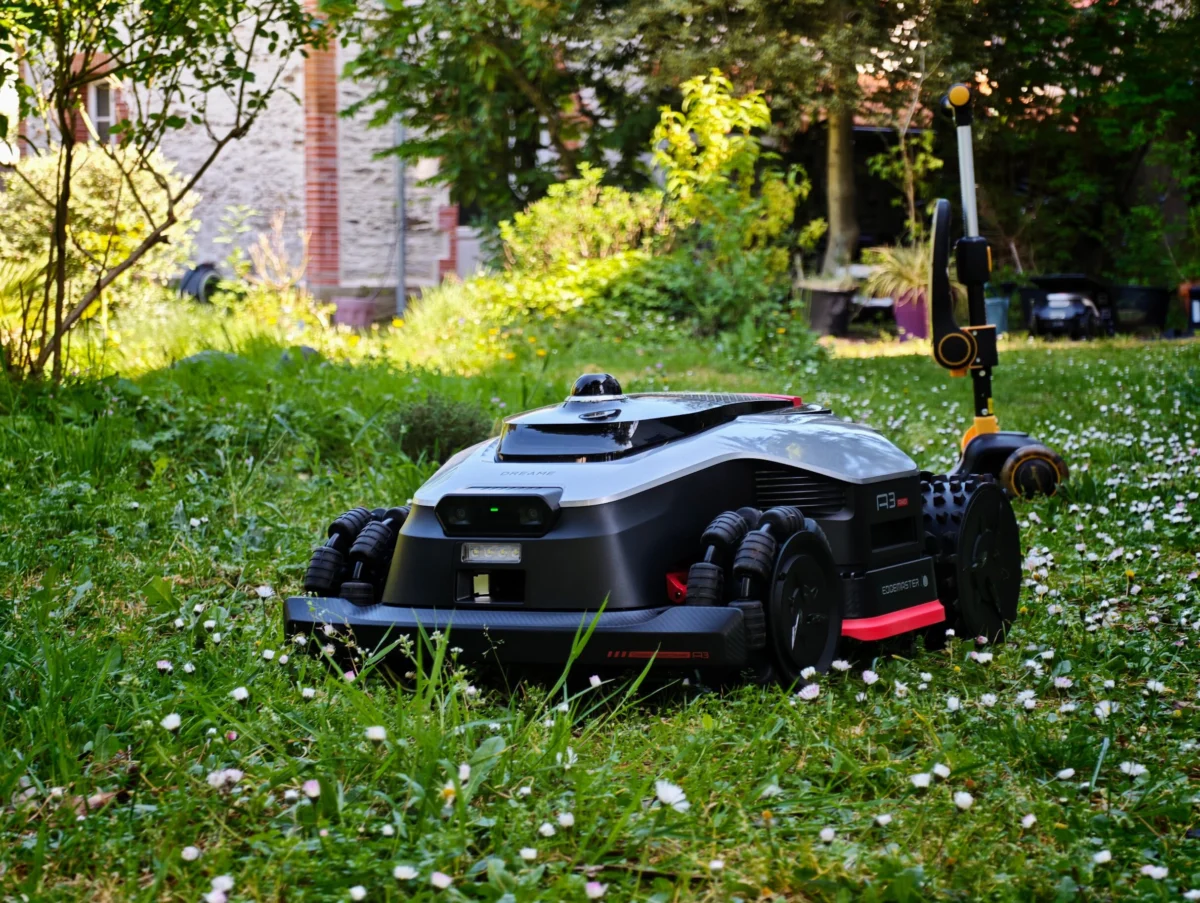
Following an intensive two-week evaluation of the Dreame A3 AWD Pro 3500 robotic lawnmower, a significant conclusion has emerged: the Chinese manufacturer has successfully delivered a formidable all-wheel-drive robot, positioning it as a serious contender against established rivals such as Mammotion, Navimow, and Worx, particularly on demanding and uneven landscapes. The extensive testing regimen, which included navigating steep slopes, executing precise edge cuts, and relying on its innovative RTK-free navigation system, revealed a device engineered to redefine autonomous lawn care.
Setting a New Standard for Terrain Adaptability
Dreame’s journey in the robotic lawnmower market saw its previous model, the A2, lauded for its robust design but noted for a critical omission: the lack of all-wheel-drive. This placed it at a disadvantage compared to competitors who had already embraced 4WD technology for tackling complex terrains. A year later, Dreame has responded emphatically with the A3 AWD Pro 3500, a model that not only addresses this gap but also introduces a suite of advanced features designed to enhance performance and user experience across a broader spectrum of garden environments.

The A3 AWD Pro 3500 represents a significant generational leap. It discards the rear-wheel-drive system of its predecessor in favor of true 4×4 wheel motors, a crucial upgrade for improved traction and stability. At its core, the robot integrates Dreame’s proprietary OmniSense 3.0 navigation system, which combines a 360° 3D LiDAR sensor with dual AI-powered cameras. This sophisticated sensor fusion allows the A3 AWD Pro 3500 to map and navigate up to 3,500 square meters per day with remarkable autonomy, largely eliminating the need for human intervention.
Advanced Navigation: The OmniSense 3.0 Advantage

A key differentiator for the Dreame A3 AWD Pro 3500 lies in its navigation philosophy. Unlike many competitors who rely on Real-Time Kinematic (RTK) technology—which often requires a fixed antenna in the garden for satellite signal correction—Dreame has committed to a LiDAR and binocular vision-centric approach. The OmniSense 3.0 system leverages a laser rangefinder that continuously scans the environment in 360 degrees, complemented by two 1080p HDR cameras providing forward vision.
This combination enables the robot to construct a real-time 3D map of the garden without depending on satellite signals. The immediate benefit is enhanced operational reliability in areas traditionally problematic for RTK systems, such as under dense tree cover, within narrow passages, or behind structures that obstruct satellite reception. The A3 AWD Pro 3500’s self-contained mapping capability ensures it always knows its precise location based on its visual and LiDAR data. Dreame claims centimetric precision and a detection range of up to 70 meters on highly reflective surfaces, showcasing the system’s robustness.

Robust Design and Build for Demanding Environments
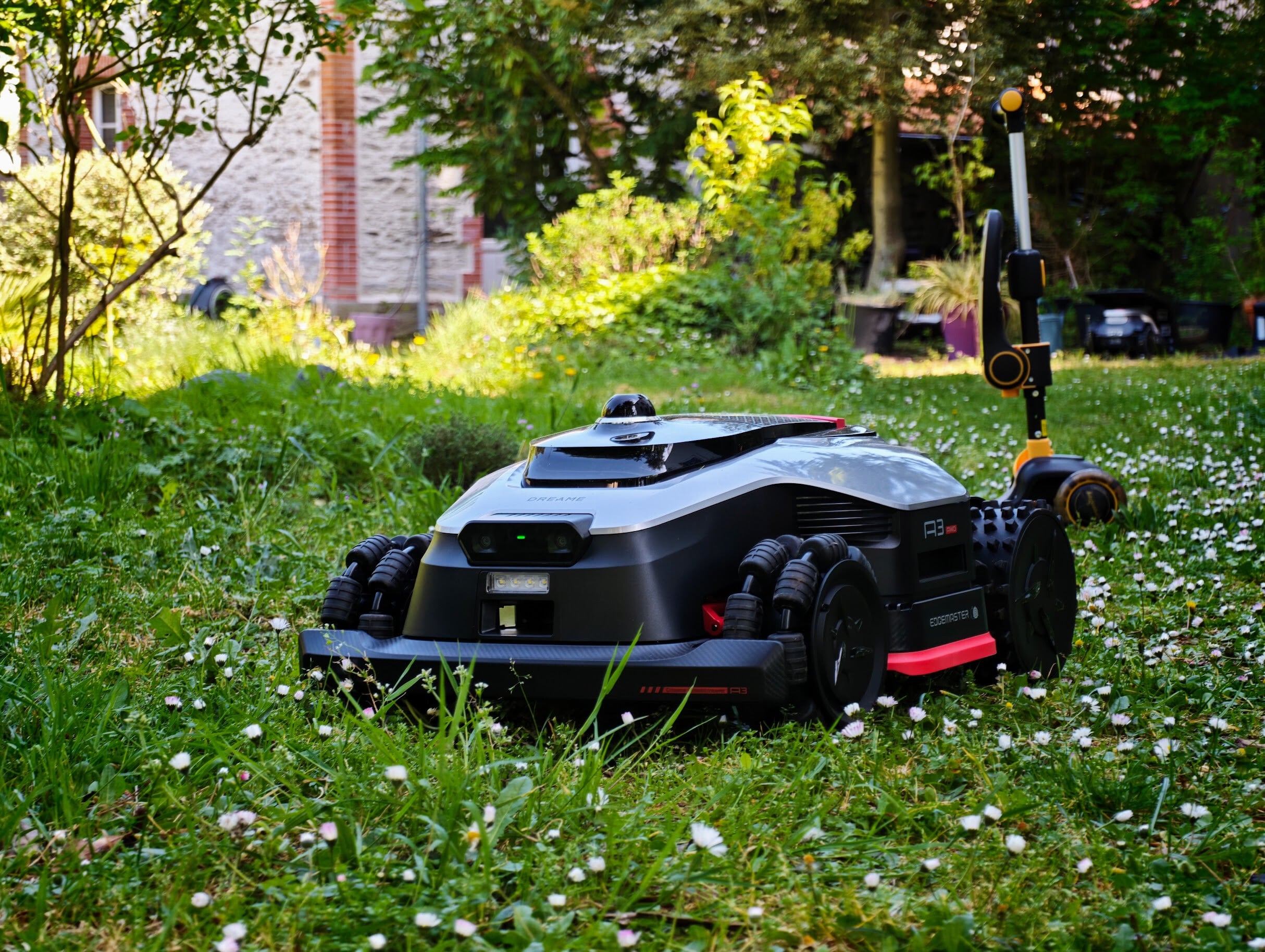
Weighing in at 23.9 kg and measuring 74 cm in length, the A3 AWD Pro 3500 exudes durability. Its construction features protective plastic panels on the sides, a substantial front bumper, and an overall finish that inspires confidence. The design evokes a "buggy-like" aesthetic, with ample ground clearance to navigate under low-hanging shrubs and other garden obstacles. Integrated carrying handles, a practical addition given the robot’s weight, further underscore its user-centric design.

Beneath the chassis, the A3 AWD Pro 3500 features two independent cutting discs, each 20 cm in diameter, combining for an impressive 40 cm total cutting width. Each disc is equipped with three quick-release razor blades, simplifying maintenance. The locomotion system comprises two omnidirectional front wheels with rollers for tight maneuvers and two cleated, all-terrain rear wheels designed for superior grip on soft or wet ground. This innovative combination allows the robot to pivot almost in place while maintaining excellent traction on inclines, a critical feature for gardens with varied topography.
Effortless Setup and Intuitive Control

The initial unboxing experience immediately highlights Dreame’s commitment to user convenience. The large package contains surprisingly few components: the charging base, a few stakes for securing it, and the power cable. Crucially, there is no RTK antenna to position, no perimeter wire to lay around the lawn, and no pole to orient towards the sky. This "zero hassle" approach significantly streamlines the installation process compared to previous generations of robotic lawnmowers, which often required complex and time-consuming physical setups.
An intuitive color screen on the robot’s top panel allows for initial setup, including PIN code definition, and direct access to primary functions without needing a smartphone. The Dreamehome application then takes over, facilitating quick pairing in under two minutes. It is important to note that a software update automatically initiates upon the first connection, a crucial step for addressing any initial manufacturing bugs and ensuring optimal performance.

Mapping the garden is the most attention-demanding step, offering both automatic and manual joystick-controlled options via the app. For gardens with intricate flowerbeds, light-colored borders, or ambiguous transitions between lawn and patio, the manual method is recommended. While the LiDAR system performs exceptionally well, a beige patio could potentially be misidentified as bare earth, leading to unintended mowing of non-lawn areas. The manual control, while using a single virtual joystick (compared to dual joysticks on some competitor models), is quickly mastered and allows for precise adjustments. Mapping a medium-sized garden typically takes about twenty minutes, requiring close proximity to the robot for a stable Bluetooth connection. Once mapped, users can define paths between zones, establish "no-go" areas, and even manage two entirely distinct maps for properties with separated garden sections.
Performance: Conquering Slopes and Obstacles

During operation, the A3 AWD Pro 3500 proves remarkably quiet, registering below 65 dB as advertised. This low noise level allows for comfortable outdoor activities, such as dining on the terrace, even while the robot is actively mowing nearby. Front LED lighting enables safe nocturnal mowing, while a rear light strip adds a distinctive, autonomous vehicle aesthetic.
On flat terrain, the A3 AWD Pro 3500 demonstrates metronomic precision. Its U-shaped path planning is highly efficient, ensuring comprehensive coverage without redundant passes, resulting in a consistently neat cut. Even on slightly overgrown lawns, the razor blades perform without strain. For optimal lawn health and to leverage natural mulching (where clippings are returned to the soil as fertilizer), regular mowing every two to three days is recommended.

The true test of the A3 AWD Pro 3500, however, lies in its performance on inclines. The 4-wheel drive system genuinely transforms the experience. On slippery, mossy slopes with uneven patches, the robot ascends effortlessly. Furthermore, its intelligent software prevents wheel spin by recognizing when a wheel loses traction, prompting it to reverse, adjust its approach angle, and reattempt the ascent. This sophisticated behavior mitigates common robot lawnmower issues such as turf damage from continuous spinning and mid-slope blockages. With an advertised climbing capability of 80% (38.7°), the A3 AWD Pro 3500 consistently navigates conditions that would halt many other models.
Obstacle detection is another standout feature. Dreame claims the robot recognizes over 300 types of objects, a promise largely validated during testing. Whether encountering a ball, a child’s toy, a shoe, or a garden rake, the robot reliably slows down, identifies the object, skillfully navigates around it, and then resumes its pre-programmed path. The sensitivity of obstacle detection is adjustable via the app, with the "high" setting enabling the detection of even very small items, providing significant peace of mind in gardens frequented by children or pets.

The EdgeMaster 2.0 system warrants particular attention as a key differentiator for the A3. This innovative feature laterally shifts the cutting deck during perimeter passes, allowing the blades to approach within 3 cm of the garden boundary. In practical tests against walls and fences, the A3 AWD Pro 3500 consistently left an unmowed strip of only 7 to 8 cm, a significant improvement over the 12 to 15 cm observed with a concurrently used Mammotion Luba 3. This reduction in the uncut margin considerably lessens the need for manual trimming with a string trimmer. A notable caveat, however, is that for safety reasons, the cutting height is automatically set to 3 cm during EdgeMaster operations. This height may be too low during summer months, potentially causing grass to yellow along the edges, suggesting that users may prefer to disable this function seasonally.
Dreamehome Application: Feature-Rich, with Room for Enhancement

The Dreamehome application, shared across Dreame’s ecosystem of smart devices including robot vacuums, demonstrates significant progress in user interface and functionality. The home screen provides an overview of battery status, direct access to the onboard camera, quick-launch buttons, and a return-to-base command. The garden map, displaying distinct zones and the robot’s real-time trajectory, occupies the central area.
The app offers a comprehensive suite of customization options, though some might find the sheer number of settings overwhelming. Users can define mowing speed (standard, efficient, rush), adjust cutting height in half-centimeter increments, set strip directions, activate or deactivate EdgeMaster, fine-tune obstacle avoidance sensitivity, designate no-go zones, establish paths between areas, schedule seasonal mowing plans (summer/winter), enable a "do not disturb" mode, and even activate a night mode with reduced speed to protect small animals. A particularly clever feature is the option for the robot to slightly vary its path on each pass, preventing repetitive wheel marks on the lawn. The "obstacle avoidance on paths" function is also highly practical, allowing the robot to circumvent unexpected blockages on designated routes between zones.

Despite its robust feature set, the application has a few notable limitations. It lacks a random mowing mode, which some users might prefer for varied cutting patterns. Furthermore, the live video feed and "Garden Guardian" patrol mode are restricted to Wi-Fi connectivity, even though the robot incorporates a 4G SIM card. This 4G connectivity is currently limited to geolocation and out-of-Wi-Fi-range notifications, a significant missed opportunity, especially for properties extending beyond typical Wi-Fi coverage. A future software update to enable full 4G functionality for video and patrol modes would be a substantial improvement.
For security, the A3 includes anti-theft measures such as lift alerts, geolocation via Link services, and compatibility with Apple AirTag (sold separately). Given its premium price point of €2,599, these security features are a welcome and necessary addition.

Simplified Maintenance for Lasting Performance
The A3’s maintenance regimen is one of its most thoughtfully designed aspects. With an IPX6 certification, the robot can be safely rinsed with a standard water jet, including its underside. However, high-pressure washers (Karcher-style) are to be avoided, as the intense pressure could compromise the watertight seals. A soft brush, bottle brush, or even an old toothbrush suffices to remove accumulated grass clippings from under the cutting deck.

To further simplify cleaning without requiring users to lift the 24 kg unit, the app allows for the definition of "maintenance points" on the map. Activating this option sends the robot autonomously to a specified location, such as a garage entrance or an outdoor faucet. This practical detail exemplifies a focus on real-world usability and time-saving convenience.
Blade replacement is a swift process thanks to the quick-release system: a simple press on a stud at the rear of the disc allows the blade to slide out, and a new one can be inserted. Over time, sap and grass residue might cause the mechanism to stiffen slightly, but a quick application of lubricant and a pair of pliers can resolve this. Regular cleaning of the top-mounted LiDAR sensor with a soft cloth (avoiding chemical products) is essential to maintain mapping accuracy. Users should also remember to reattach the small protective cap to the LiDAR unit when inverting the robot for underside cleaning, as it is no longer stored under the hood as in previous A1 and A2 models.

Comparative Analysis: A Generational Leap
The A3 AWD Pro 3500 represents a clear generational leap from the Dreame A2. While the A2 was a capable robot for flat, accessible terrains, its 2-wheel drive system struggled with wet slopes or irregular ground. The A3 addresses this with a true 4×4 system, more generous suspension, and a nearly doubled cutting width thanks to its dual discs. Other advancements include a richer sensor array, enhanced AI for obstacle detection, the EdgeMaster 2.0 system (absent in the A2), and a reinforced chassis that is less prone to scratches. This significant upgrade comes with increased weight (23.9 kg) and a higher price point. For users with flat, unobstructed lawns under 2,000 m², the A2 or A1 Pro remain viable options. However, for properties with varied topography, complex layouts, or larger areas, the A3 fully justifies its premium.

Market Positioning and Key Alternatives
Priced at €2,599 on Dreame’s official website, the A3 AWD Pro 3500 firmly establishes itself in the premium segment of wire-free 4×4 robotic lawnmowers. Its larger sibling, the A3 AWD Pro 5000, extends the range at €2,999, offering a 10 Ah battery and an advertised capacity of 5,000 m² per day.

The most direct competitor is the Mammotion Luba 3 AWD 3000, priced around €2,699 for a comparable coverage area. Mammotion’s core philosophical difference lies in its Tri-Fusion navigation system, which combines 360° LiDAR, NetRTK (a network-based RTK that negates the need for a physical antenna), and dual AI camera vision. While NetRTK offers centimetric satellite precision, it relies on robust cellular coverage and typically involves a subscription fee after an initial free period.
Another formidable challenger is the Segway Navimow X4, which began shipping in France in late March 2026. The Navimow X4 boasts a 4×4 drive, an impressive 84% (40°) slope climbing capability, a 43 cm cutting width, and an EFLS NRTK navigation system that integrates trifrequency network RTK, 360° vSLAM, and VIO. A significant commercial advantage for the X4 is its NRTK function, which is offered free for life, eliminating recurring subscription costs and altering the long-term value proposition.

Finally, the Roborock RockMow Z1, unveiled at IFA 2025 and launched commercially in 2026, also targets large, complex terrains up to 5,000 m² per day. It features all-wheel drive capable of ascending 80% slopes and clearing obstacles up to 8 cm. The Z1’s most distinctive technical innovation is its patented active steering system, where each front wheel has an independent steering motor. This allows for zero-turn maneuvering without damaging the turf, a radical departure from the omnidirectional roller wheels used by Dreame and Mammotion. In terms of navigation, two versions are available: the standard RockMow Z1 relies on RTK + VSLAM with stereo vision, while the RockMow Z1 LiDAR adds a laser rangefinder for enhanced performance in shaded areas.
The Dreame A3 AWD Pro 3500 enters a competitive but rapidly evolving market for wire-free robot lawnmowers. Its strong performance on challenging terrains, innovative RTK-free navigation, superior edge cutting, and user-friendly design make it a compelling option for homeowners seeking an advanced, low-maintenance solution for diverse garden landscapes. Its strengths lie in simplicity of setup and reliable operation in varied conditions, making it a powerful statement from Dreame in the premium segment.