admin
admin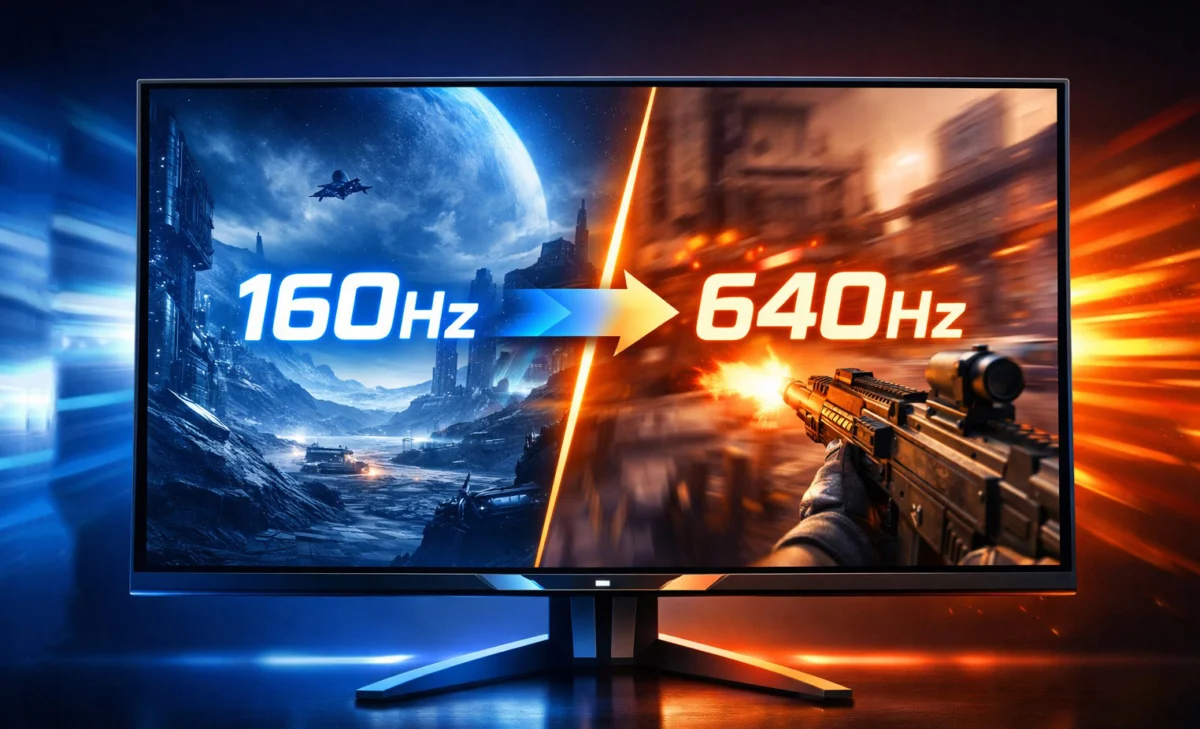
The global display industry is witnessing a significant shift in the paradigm of high-performance monitors as TCL China Star Optoelectronics Technology (CSOT) prepares to disrupt the market with a pioneering dual-mode display. According to reports initially surfaced by IT Home, the Chinese manufacturing giant is developing a monitor capable of a "quadruple" refresh rate jump, moving from a base of 160 Hz at high resolution to a staggering 640 Hz at a lower resolution. This development marks a departure from the current industry standard for dual-mode monitors, which typically offer a doubling of the refresh rate when switching modes. By quadrupling the frequency, TCL CSOT is positioning itself at the vanguard of the competitive gaming hardware sector, targeting professional eSports athletes and enthusiasts who demand the lowest possible input latency.
The Mechanics of Quadruple Refresh Rate Switching
Dual-mode technology in monitors is designed to solve the inherent conflict between visual fidelity and motion clarity. Traditionally, gamers had to choose between a high-resolution 4K panel for immersive, cinematic experiences and a high-refresh-rate 1080p panel for competitive play. Dual-mode monitors bridge this gap by allowing the hardware to switch between these two states. While existing models from competitors like LG and ASUS generally offer a 2X transition—such as switching from 4K at 240 Hz to 1080p at 480 Hz—the proposed TCL CSOT model introduces a 4X multiplier.
The reported specifications suggest the monitor will operate at a 4K resolution (3840 x 2160) with a 160 Hz refresh rate for standard use. When the user activates the high-speed mode, the resolution likely drops to 1080p (1920 x 1080), but the refresh rate scales dramatically to 640 Hz. This leap is achieved through advanced timing controllers (T-CON) and panel driving logic that can handle the massive data throughput required to refresh the screen 640 times per second. By reducing the resolution, the monitor frees up bandwidth and processing power, allowing the pixels to cycle at four times their standard speed without exceeding the limitations of the internal circuitry.
Contextualizing the High-Refresh-Rate Arms Race
The announcement from TCL CSOT does not exist in a vacuum; it is part of an escalating "hertz war" among display manufacturers. For years, 144 Hz was considered the gold standard for gaming. This was eventually surpassed by 240 Hz, then 360 Hz, and more recently, 540 Hz panels. Each iteration aims to reduce motion blur and input lag, providing a smoother experience in fast-paced titles like Counter-Strike 2, Valorant, and Overwatch 2.
In the current landscape, other manufacturers have also pushed the boundaries of dual-mode technology. HKC recently announced a 27-inch 4K monitor capable of reaching 800 Hz at 1080p, while ASUS has showcased the ROG Strix XG27UCG Gen 2, which utilizes 3X refresh rate switching. TCL CSOT’s entry into this specific niche is significant because the company is not just a brand but a primary manufacturer (OEM/ODM) that supplies panels to many of the world’s leading monitor vendors. Their success in perfecting a 4X switching panel could lead to a widespread adoption of this technology across multiple brands in the coming years.

TCL CSOT: A Dominant Force in Display Innovation
To understand the implications of this new monitor, one must look at the stature of TCL CSOT within the technology ecosystem. As a subsidiary of TCL Technology, CSOT has invested billions of dollars into research and development, particularly in the fields of HVA (High-contrast Vertical Alignment) and OLED technologies. The company operates some of the world’s most advanced fabrication plants, including G11 and G8.5 generations, which allow them to produce large-scale and high-density panels with high yields.
While it remains unconfirmed whether the new 640 Hz monitor will utilize an IPS (In-Plane Switching) or an OLED (Organic Light Emitting Diode) panel, TCL CSOT’s recent focus on IJP (Inkjet Printed) OLED technology suggests a potential premium offering. OLED panels are naturally suited for high refresh rates due to their near-instantaneous pixel response times. However, if the company opts for a high-performance IPS panel, it would likely be to ensure maximum brightness and durability, which are often preferred in brightly lit eSports arenas.
Technical Challenges: Bandwidth and Connectivity
Driving a monitor at 640 Hz presents significant technical hurdles, not only for the display itself but also for the source hardware and connectivity standards. To transmit a 1080p signal at 640 Hz, the interface must handle an immense amount of data. Current standards like DisplayPort 1.4 and HDMI 2.1 are reaching their practical limits with such high frequencies.
Industry analysts anticipate that for 640 Hz to be viable without heavy compression, the use of DisplayPort 2.1 (UHBR10, UHBR13.5, or UHBR20) may be necessary. DisplayPort 2.1 offers a significant increase in bandwidth compared to its predecessor, allowing for uncompressed high-refresh-rate signals. Furthermore, the PC driving such a monitor would require a top-tier CPU and GPU capable of generating frame rates that match the 640 Hz refresh rate. Even with modern hardware, achieving a stable 640 frames per second is currently only possible in less demanding eSports titles, making this monitor a highly specialized tool for a specific subset of the gaming community.
Chronology of Dual-Mode Evolution
The journey toward the 640 Hz dual-mode monitor has been marked by several key industry milestones:
- Early 2023: Initial concepts of dual-mode monitors are showcased at major trade shows, focusing primarily on the 4K/240Hz and 1080p/480Hz split.
- Late 2023: LG and Samsung begin shipping flagship OLED monitors featuring dual-mode capabilities, setting the 2X multiplier as the market standard.
- Early 2024: ASUS introduces the ROG Strix XG27UCG, experimenting with a 3X multiplier, signaling that the 2X standard was merely a starting point.
- Mid-2024: HKC stuns the market with an 800 Hz prototype, proving that the physical limitations of LCD/OLED driving logic could be pushed further.
- Present: TCL CSOT enters the fray with the 160–640 Hz 4X model, focusing on balancing high-end 4K productivity with extreme eSports performance.
Broader Market Impact and Professional Implications
The introduction of 640 Hz technology has implications that extend beyond mere marketing numbers. For professional gamers, the reduction in "persistence blur"—the blur caused by the human eye tracking moving objects on a screen—is critical. At 640 Hz, the frame time is approximately 1.56 milliseconds. This incredibly short window between updates makes motion appear almost perfectly fluid, mimicking the "sample-and-hold" characteristics that once made CRT monitors the preferred choice for competitive play.

Furthermore, the dual-mode nature of the monitor makes it a versatile investment for content creators who also game. A video editor can utilize the 4K mode for color-accurate work and high-resolution timeline management, then switch to the 640 Hz mode for gaming during leisure time or for testing high-frame-rate game builds. This "all-in-one" approach reduces the need for multi-monitor setups that occupy significant desk space.
Anticipated Pricing and Availability
While TCL CSOT has not yet released official pricing or a global launch date, historical trends for high-end panels suggest a premium positioning. Developing a T-CON capable of 4X switching is a costly endeavor, and the initial production runs are likely to be limited. Given that competitors’ dual-mode OLED monitors currently retail between $1,200 and $1,600, a 640 Hz variant could easily command a price at the higher end of that spectrum or above, especially if it incorporates OLED or advanced Mini-LED backlighting.
Market observers expect more details to emerge during upcoming major technology exhibitions, such as CES or IFA, where TCL typically showcases its latest display innovations. As the manufacturing process matures, the technology behind 4X switching is expected to trickle down to more affordable segments of the market, eventually becoming a standard feature in the mid-range gaming monitor category.
Conclusion: A New Benchmark for Fluidity
The report of TCL CSOT’s 160–640 Hz dual-mode monitor represents a significant technological achievement in the display industry. By moving beyond the 2X multiplier, TCL is challenging the established players and redefining what is possible in terms of motion clarity. While the hardware requirements to fully utilize 640 Hz are currently extreme, the existence of such displays pushes the entire ecosystem—including GPU manufacturers and game developers—to strive for higher performance. As display technology continues to evolve, the line between virtual motion and reality continues to blur, with TCL CSOT now leading the charge toward the next frontier of visual speed.