Sisilia Frederika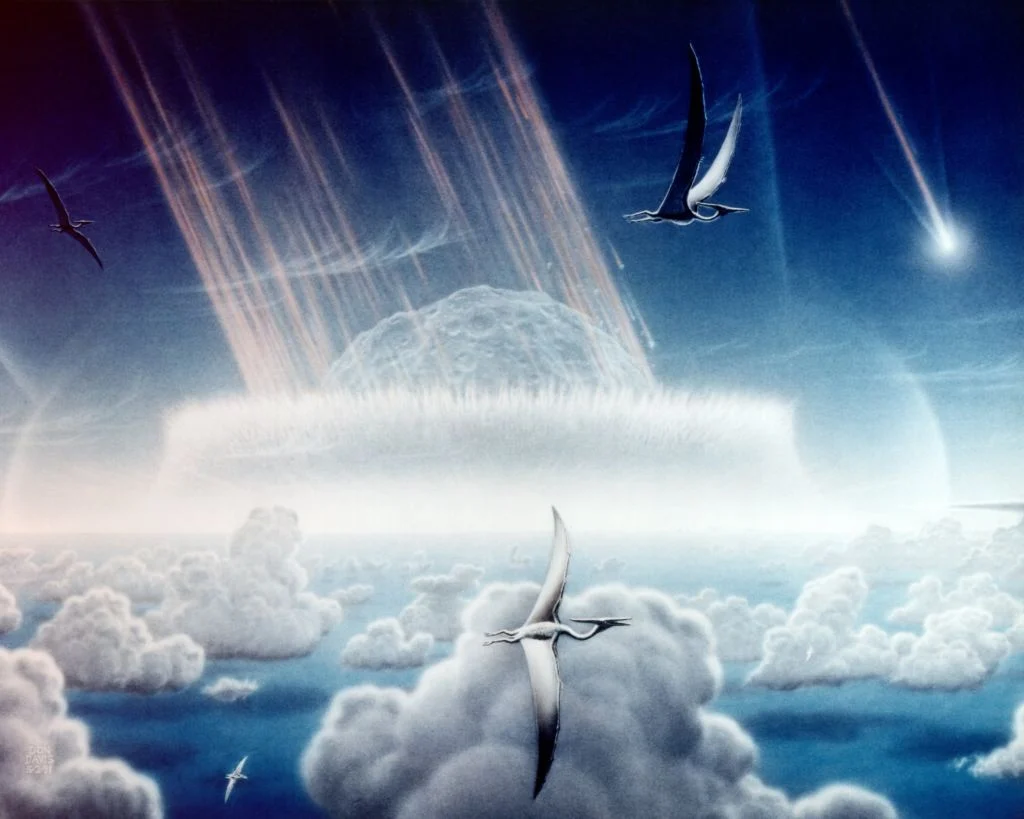
An international team of geochemists and planetary scientists has successfully identified the origin and composition of the massive object that struck Earth 66 million years ago, effectively ending the reign of the dinosaurs. According to a landmark study published in the journal Science Advances, the Chicxulub impactor was a rare carbonaceous (CO) chondrite, a primitive type of asteroid originating from the outer reaches of the solar system. This discovery, facilitated by high-precision nickel isotope analysis of global sediment samples, provides the most definitive evidence to date regarding the nature of the celestial body that triggered the Cretaceous-Paleogene (K-Pg) extinction event.
The impact, which occurred at the tip of the Yucatan Peninsula in present-day Mexico, released energy equivalent to billions of atomic bombs, resulting in the extinction of approximately 75% of all plant and animal species. While the location and scale of the impact have been well-documented since the late 20th century, the precise chemical makeup and origin of the impactor remained a subject of intense scientific debate. The new findings narrow the possibilities significantly, suggesting the impactor was not a common "stony" asteroid from the inner asteroid belt, but a far more ancient and volatile-poor object from the outer solar system.
The Chemical Fingerprint of an Extinction Level Event
To solve the 66-million-year-old mystery, researchers focused on the thin layer of clay that marks the K-Pg boundary in the geological record. This layer, found globally, contains high concentrations of platinum-group elements (PGEs) such as iridium, ruthenium, and nickel—elements that are rare in Earth’s crust but abundant in asteroids. By analyzing these elements, scientists can essentially reconstruct the "DNA" of the object that delivered them.
Postdoctoral researcher Georgy V. Makhatadze of the Institut de Physique du Globe led the effort, utilizing advanced mass spectrometry to measure nickel isotopes in samples collected from sites across Europe and North America. Unlike previous studies that focused on ruthenium, nickel isotope analysis provides a more granular look at the isotopic signatures that distinguish different classes of meteorites. The team compared the isotopic ratios of nickel-58 and nickel-62 found in the K-Pg boundary clay with those found in various meteorite samples stored in global collections.
The results were conclusive: the isotopic signature of the Chicxulub impactor matched that of carbonaceous chondrites, specifically the Ornans-like (CO) class. These are among the most primitive materials in the solar system, having remained largely unchanged since the formation of the Sun and planets roughly 4.5 billion years ago.
A Chronology of Discovery: From Iridium to Isotopes
The quest to identify the Chicxulub impactor has spanned over four decades of multidisciplinary research. The timeline of this scientific journey reflects the evolution of modern geochemistry and planetary defense.
- 1980: Physicist Luis Alvarez and his son, geologist Walter Alvarez, first proposed the impact theory after discovering anomalously high levels of iridium in the K-Pg boundary layer in Italy and Denmark. They hypothesized that a large asteroid strike was responsible for the mass extinction.
- 1991: Geophysical surveys for oil in the Gulf of Mexico led to the confirmation of the Chicxulub crater, a 180-kilometer-wide structure buried beneath limestone sediments. The crater’s age was found to align perfectly with the extinction event.
- 2000s: Various studies attempted to classify the asteroid using ruthenium isotopes, pointing toward a carbonaceous origin but leaving room for ambiguity regarding the specific subclass.
- 2016: The International Ocean Discovery Program (IODP) conducted a massive drilling expedition into the Chicxulub crater’s peak ring, recovering core samples that detailed the immediate aftermath of the impact.
- 2024: The current study by Makhatadze and his colleagues utilizes nickel isotope precision to finalize the classification as a CO chondrite, ruling out other common asteroid types.
The Nature of Carbonaceous Chondrites
Carbonaceous chondrites are a rare and enigmatic class of meteorites. While they represent only about 5% of all meteorites that fall to Earth today, they are of immense interest to scientists because they contain organic compounds, water, and minerals that predate the formation of the Earth.
The Ornans (CO) class, specifically identified in this study, is characterized by small chondrules (spherical mineral grains) and a specific depleted profile of volatile elements. Dr. Philippe Claeys, a visiting professor at the University of British Columbia (UBC) and a co-author of the study, noted that these rocks are distinct from the typical "S-type" or silicaceous asteroids that dominate the inner asteroid belt.
"Carbonaceous chondrites of the Ornans class are definitely not like the typical meteors you find in museum collections," Dr. Claeys stated. "A CO contains much less volatile elements—like carbon, zinc, water, and particularly sulfur—than other classes of meteorites we’ve discovered so far on Earth."
This compositional detail is crucial for climate modeling. For decades, scientists believed the sulfur released by the impactor itself contributed significantly to the "impact winter"—a period of global cooling caused by aerosols blocking sunlight. However, if the impactor was a sulfur-poor CO chondrite, the devastating atmospheric effects must have been driven primarily by the target rocks at the impact site. The Yucatan Peninsula is rich in gypsum (calcium sulfate) and carbonates; the vaporization of these terrestrial rocks likely provided the bulk of the climate-altering gases.
Environmental Consequences and the "Nuclear Winter"
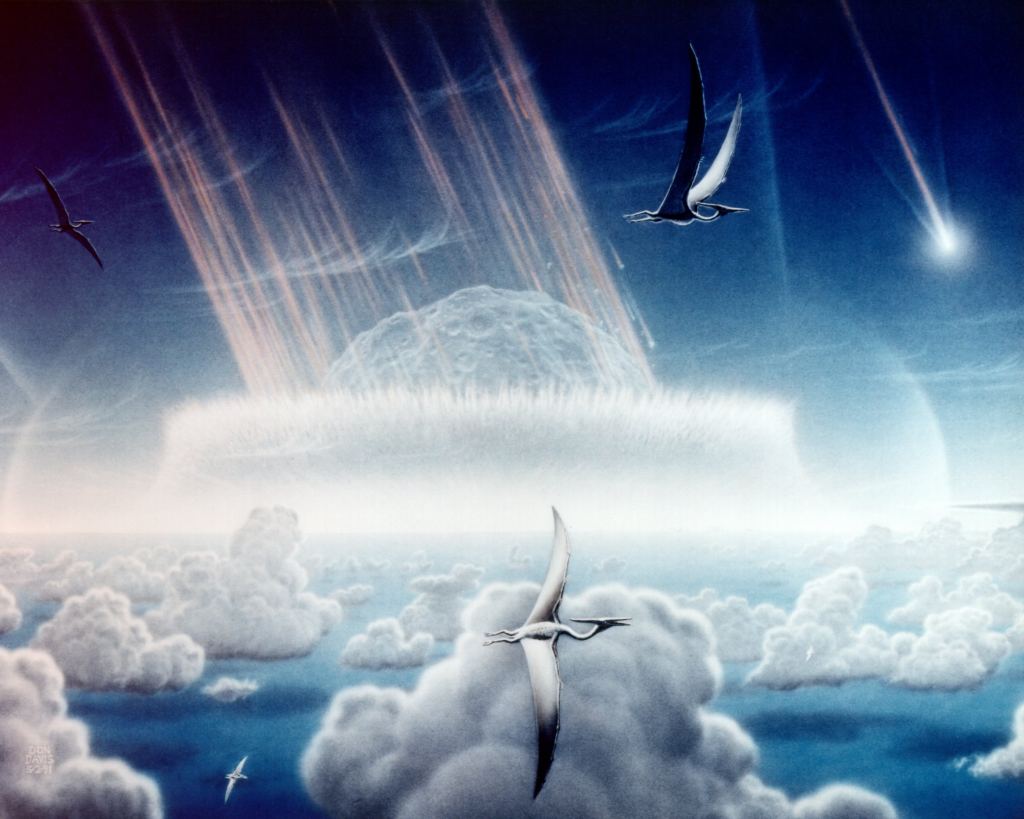
The identification of the impactor as a 10-to-15-kilometer-wide CO chondrite allows for more accurate simulations of the environmental collapse that followed the strike. When the object hit the shallow sea of the Yucatan, it did not merely leave a hole; it reorganized the planet’s biosphere.
The immediate effects included a massive thermal pulse that ignited global wildfires, followed by a series of mega-tsunamis reaching heights of over 100 meters. However, the long-term "killing mechanism" was the injection of pulverized rock and soot into the stratosphere. This debris layer remained suspended for years, effectively shutting down photosynthesis.
The lack of sunlight led to a collapse of the food chain, starting with phytoplankton in the oceans and plants on land. Herbivorous dinosaurs perished as their food sources vanished, followed by the apex predators that hunted them. The new research suggests that because the CO chondrite was relatively dense and arrived at high velocity from the outer solar system, the kinetic energy transfer was maximized, ensuring that enough fine particulate matter reached the upper atmosphere to maintain the "nuclear winter" for a decade or more.
Global Collaboration and Institutional Involvement
The study was a massive collaborative effort involving several of the world’s leading research institutions. In addition to the Institut de Physique du Globe, key contributions came from:
- Vrije Universiteit Brussel (VUB): The Archaeology, Environmental Changes & Geo-Chemistry group provided expertise in analyzing the stratigraphic layers of the K-Pg boundary.
- University of British Columbia (UBC): The Pacific Center for Isotope and Geochemical Research (PCIGR) facilitated the high-precision measurements required to distinguish between subtle isotopic variations.
- University of Vienna: The Department of Lithospheric Research assisted in the comparative analysis of meteorite samples from global repositories.
This level of international cooperation highlights the significance of the K-Pg event as a cornerstone of Earth history. By pooling resources and data, the team was able to overcome the limitations of previous studies that relied on less sensitive chemical markers.
Implications for Planetary Defense
Beyond resolving a historical mystery, the identification of a CO chondrite as the culprit has modern implications for planetary defense and space monitoring. Most current asteroid tracking efforts focus on the Main Asteroid Belt between Mars and Jupiter. However, CO chondrites and other carbonaceous objects often originate from more distant regions, such as the outer Asteroid Belt or the Kuiper Belt.
These objects are often darker (lower albedo) and harder to detect with traditional optical telescopes. Understanding that Earth has a history of being struck by large, primitive objects from the outer solar system underscores the need for infrared-based space surveillance, such as NASA’s Near-Earth Object (NEO) Surveyor mission.
Furthermore, knowing the physical properties of a CO chondrite—such as its density and structural integrity—is vital for future "deflection" missions. If an object of similar composition were found to be on a collision course with Earth, the strategies used to nudge it off course (such as kinetic impactors like the DART mission) would need to account for the specific material properties of a carbonaceous body.
Concluding Analysis: A Rare Relic of the Early Solar System
The conclusion that a rare, primitive "oddball" meteorite was responsible for the end of the Mesozoic Era adds a layer of irony to the history of life on Earth. A rock that had remained virtually unchanged for billions of years in the cold reaches of the outer solar system became the catalyst for the most significant biological transition in Earth’s history, clearing the way for the rise of mammals and, eventually, humans.
While the "smoking gun" of the sulfur content has shifted from the asteroid to the Mexican soil it struck, the role of the CO chondrite remains central. The study reinforces the idea that mass extinctions are often the result of a "perfect storm" of factors: the right size of impactor, the right composition, and the specific geology of the impact site.
As researchers continue to analyze the data, the focus may now shift to identifying other impact craters on Earth that might have been caused by similar rare chondrites. For now, the scientific community has a clearer picture than ever before of the celestial mountain that fell from the sky 66 million years ago, forever changing the course of evolution.