Sisilia Frederika
The release of DR 20 marks a fundamental shift in the operational scale of the SDSS. Originally conceived as a localized effort in the Northern Hemisphere, the project has evolved into a massive international collaboration utilizing multiple observatories to provide a panoptic view of the cosmos. This release specifically integrates data from both the Northern and Southern Hemispheres, providing an unprecedented level of celestial coverage that bridges gaps in our understanding of galactic evolution and the distribution of dark matter.
The Evolution of the Sloan Digital Sky Survey
The SDSS began its journey in 2000, operating primarily from the 2.5-meter Sloan Foundation Telescope at the Apache Point Observatory in New Mexico. During its initial phases, the survey focused on creating three-dimensional maps of the universe by measuring the redshifts of hundreds of thousands of galaxies. This work was instrumental in confirming the existence of dark energy and refining the cosmological parameters that describe the expansion of the universe.
Over the subsequent two decades, the survey underwent several transitions. SDSS-II expanded the search for supernovae and explored the structure of the Milky Way. SDSS-III introduced the Baryon Oscillation Spectroscopic Survey (BOSS), which utilized baryon acoustic oscillations as a "standard ruler" to measure the expansion history of the universe. SDSS-IV continued this work while adding the Mapping Nearby Galaxies at Apache Point Observatory (MaNGA) and the Apache Point Observatory Galactic Evolution Experiment (APOGEE).
The current phase, SDSS-V, which began in 2020, represents the most ambitious iteration to date. It has transitioned the survey into an all-sky, multi-epoch spectroscopic program. Unlike previous phases that relied on manual fiber-plugging for spectroscopic targets, SDSS-V utilizes a sophisticated robotic fiber-positioning system. This technology allows for much faster data acquisition and the ability to revisit targets multiple times, facilitating the study of time-domain astronomy—observing how celestial objects change over days, months, and years.
Technical Composition of Data Release 20
The DR 20 package is a massive repository of astrophysical information, containing spectroscopic data obtained through February 2, 2025. This includes newly reduced data from the BOSS program, which has been combined with legacy data from all prior SDSS phases to create a seamless chronological record of the sky. The official academic record of this release was documented in a preprint appearing on July 30 in the Astrophysical Journal Supplement Series, providing the scientific community with the necessary framework to interpret the findings.
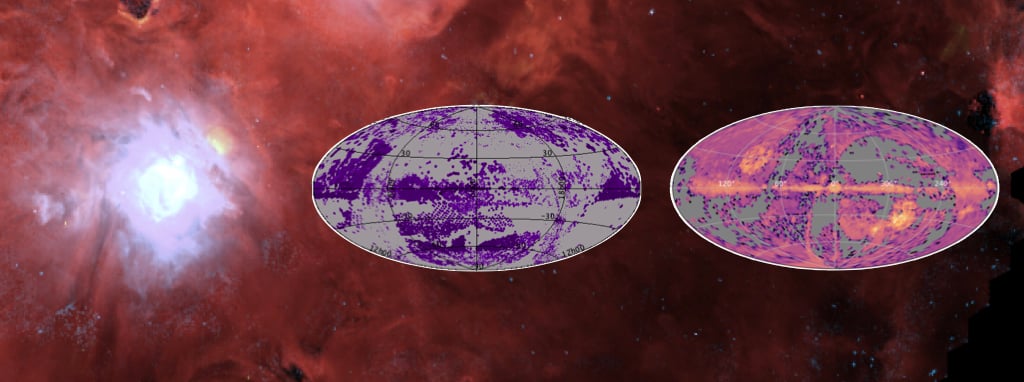
One of the most significant aspects of DR 20 is the inclusion of the first optical spectra from the Southern Hemisphere. This was achieved through the integration of the du Pont Telescope at the Las Campanas Observatory in Chile into the SDSS infrastructure. By mirroring the capabilities of the Apache Point Observatory in the South, the SDSS-V project has achieved its goal of all-sky panoptic spectroscopy.
The data release is categorized into several primary catalogs, including:
- Black Hole Mapper (BHM): This project focuses on the growth and evolution of black holes. DR 20 includes spectra for approximately 500,000 black holes, ranging from stellar-mass remnants to the supermassive giants residing at the centers of galaxies.
- Milky Way Mapper (MWM): Aimed at understanding the formation and history of our own galaxy, this catalog features over 3 million spectra of 1.5 million stars. It provides detailed information on stellar chemistry, temperature, and motion.
- Local Volume Mapper (LVM): This program investigates the interstellar medium (ISM) and the physics of star formation in nearby galaxies. DR 20 includes spectra of hydrogen clouds and planetary nebulae, offering insights into the lifecycle of matter within the "local" cosmic neighborhood.
Synergy with the eROSITA X-ray All-Sky Survey
A standout feature of DR 20 is its coordination with the second data release of the eROSITA X-ray All-Sky Survey (eRASS DR2). Through the SPectroscopic IDentification of ERosita Sources (SPIDERS) program, SDSS-V has provided optical counterparts to hundreds of thousands of X-ray-emitting sources.
This multi-wavelength approach is critical for identifying active galactic nuclei (AGN)—the luminous regions fueled by supermassive black holes—as well as galaxy clusters and active stars. By combining X-ray data (which identifies high-energy processes) with optical spectra (which provides distance and chemical composition), astronomers can construct a more holistic view of the most energetic phenomena in the universe. This synergy allows for the study of how black holes influence their host galaxies, a process known as "AGN feedback," which is a central question in modern astrophysics.
Expert Perspectives and Public Accessibility
The leadership of the SDSS-V collaboration has emphasized that the value of DR 20 lies not only in its volume but also in its accessibility. Dr. Anne-Marie Weijmans, the SDSS Data Products Coordinator from the University of St Andrews, noted that the survey is designed to be "publicly usable" rather than just "publicly available." The project provides numerous platforms, tutorials, and examples to ensure that the data can be utilized by professional researchers, educators, and amateur astronomers alike.
Dr. Emily Griffith, an NSF Postdoctoral Fellow at the University of Colorado Boulder and spokesperson for the SDSS-V collaboration, highlighted the collaborative effort required to reach this milestone. She described DR 20 as an "enormous leap" in the scale of SDSS data products, attributing the success to years of work by a dedicated international team.
Looking toward the future, Dr. Juna Kollmeier, Director of SDSS-V and a Staff Scientist at Carnegie Science, indicated that the momentum of the survey is only increasing. She noted that discussions are already underway for DR 21 and DR 22, suggesting that the influx of data will eventually require even more advanced computing infrastructure to process.
Broader Scientific Implications and Value-Added Catalogs
Beyond the raw spectroscopic data, DR 20 introduces eighteen new or updated Value-Added Catalogs (VACs). These catalogs are specialized datasets where researchers have applied additional processing or modeling to the primary SDSS data to facilitate specific scientific inquiries. For example, some VACs focus on the identification of binary star systems, while others provide refined measurements of galactic rotation curves or the properties of the circumgalactic medium.
The implications of DR 20 extend into several key areas of cosmology and astrophysics:
- Galactic Archaeology: By analyzing the chemical "fingerprints" of millions of stars in the Milky Way Mapper, researchers can reconstruct the history of our galaxy’s assembly, identifying ancient star clusters that were absorbed by the Milky Way billions of years ago.
- Dark Energy and Expansion: The continued accumulation of BOSS data helps refine the measurement of baryon acoustic oscillations. These measurements are vital for understanding the nature of dark energy and whether the expansion of the universe is changing in ways not predicted by current models.
- The Lifecycle of Galaxies: The Local Volume Mapper provides high-resolution data on how gas and dust are transformed into stars. This helps explain why some galaxies remain "active" with star formation while others become "quiescent."
- Black Hole Demographics: The Black Hole Mapper’s vast dataset allows for a census of black holes across different cosmic epochs. This is essential for understanding how the first supermassive black holes formed in the early universe and how they grew to billions of solar masses.
Conclusion and Future Outlook
The release of DR 20 is a testament to the enduring legacy of the Sloan Digital Sky Survey. By expanding into the Southern Hemisphere and adopting robotic automation, the survey has ensured its relevance in an era of "Big Data" astronomy. The transition to SDSS-V marks a move toward a more dynamic, all-sky approach that treats the universe as a changing, evolving entity rather than a static map.
As the scientific community begins to digest the three million spectra and eighteen value-added catalogs provided in this release, the discoveries generated by DR 20 are expected to populate the pages of astrophysical journals for years to come. With DR 21 and DR 22 already on the horizon, the SDSS remains the cornerstone of our efforts to map the final frontier and understand the physical laws that govern the existence of the cosmos. The data release stands as a monumental achievement in international scientific cooperation, proving that when the global community looks upward together, the mysteries of the universe become increasingly within reach.