Sisilia Frederika
The DESI Legacy Imaging Surveys has officially announced its eleventh data release (DR 11), unveiling the most extensive and detailed two-dimensional map of the cosmos ever produced. This monumental achievement, a culmination of over a decade of international collaboration and observation, encompasses a staggering 5.6 trillion pixels and catalogs nearly four billion celestial objects. The data release represents a critical milestone for the Dark Energy Spectroscopic Instrument (DESI) project, providing the foundational imagery required to explore the fundamental mysteries of the universe, specifically the nature of dark energy and the history of cosmic expansion.
A New Frontier in Extragalactic Mapping
The DR 11 release is not merely a collection of images but a comprehensive digital atlas of the extragalactic universe. Covering approximately 75% of the sky, the survey captures the heavens in both visible and near-infrared light. This dual-spectrum approach allows astronomers to peer through cosmic dust and observe objects at vast distances, ranging from nearby asteroids within our own solar system to ancient quasars located over 11 billion light-years away.
The sheer scale of the map is difficult to fathom. With nearly four billion distinct entries, the catalog includes stars within the Milky Way, distant galaxies, supermassive black holes, and transient phenomena. The map serves as the primary "target list" for the Dark Energy Spectroscopic Instrument, which uses these 2D coordinates to position its fiber-optic cables and capture the light of millions of individual galaxies. By measuring the spectra of these objects, scientists can determine their precise distance from Earth, effectively turning the 2D map into a high-resolution 3D model of the cosmos.
David Schlegel, a co-lead of the Legacy Surveys and a senior scientist at the Lawrence Berkeley National Laboratory (Berkeley Lab), emphasized the survey’s utility for the global scientific community. He noted that the Legacy Imaging Viewer has become an essential tool for modern astronomers, serving as the starting point for almost any investigation into specific celestial coordinates. The public accessibility of this data ensures that the survey’s impact extends beyond professional research, inviting citizen scientists and educators to explore the universe with the same tools as the world’s leading astrophysicists.
The Technological Backbone: Telescopes and Collaboration
The creation of a map this expansive required a sophisticated network of ground-based and space-based observatories. The project integrated data from three major imaging programs: the Dark Energy Camera Legacy Survey (DECaLS), the Mayall z-band Legacy Survey (MzLS), and the Beijing-Arizona Sky Survey (BASS).
At the heart of the southern sky observations was the Dark Energy Camera (DECam), mounted on the Victor M. Blanco 4-meter Telescope at the Cerro Tololo Inter-American Observatory in Chile. In the northern hemisphere, the Nicholas U. Mayall 4-meter Telescope at the Kitt Peak National Observatory (KPNO) played a central role, supported by the University of Arizona’s UA Bok 2.3-meter Telescope. These ground-based efforts were significantly enhanced by data from NASA’s Wide-field Infrared Survey Explorer (WISE), which provided the infrared depth necessary to identify the oldest and most distant galaxies.
More than 160 scientists from across the globe contributed to the data processing and analysis required for DR 11. This collective effort involved managing petabytes of raw data, correcting for atmospheric interference, and stitching together millions of individual exposures into a seamless, multi-layered mosaic of the night sky.
A Chronology of Cosmic Discovery
The journey toward DR 11 began in 2012 when DESI was first commissioned to investigate the accelerating expansion of the universe. The project was born out of a need to solve the greatest mystery in modern physics: dark energy. First theorized in the late 1990s following observations by the Hubble Space Telescope, dark energy is the invisible force that appears to be pushing the universe apart at an increasing rate.
From 2014 to 2019, the various imaging surveys (DECaLS, MzLS, and BASS) conducted their primary observation runs. These surveys were designed to provide the "scouting report" for the DESI spectroscopic mission, which officially began its five-year survey in 2021. By the start of 2024, the imaging team had completed its originally planned mission, having successfully mapped tens of millions of galaxies and quasars.
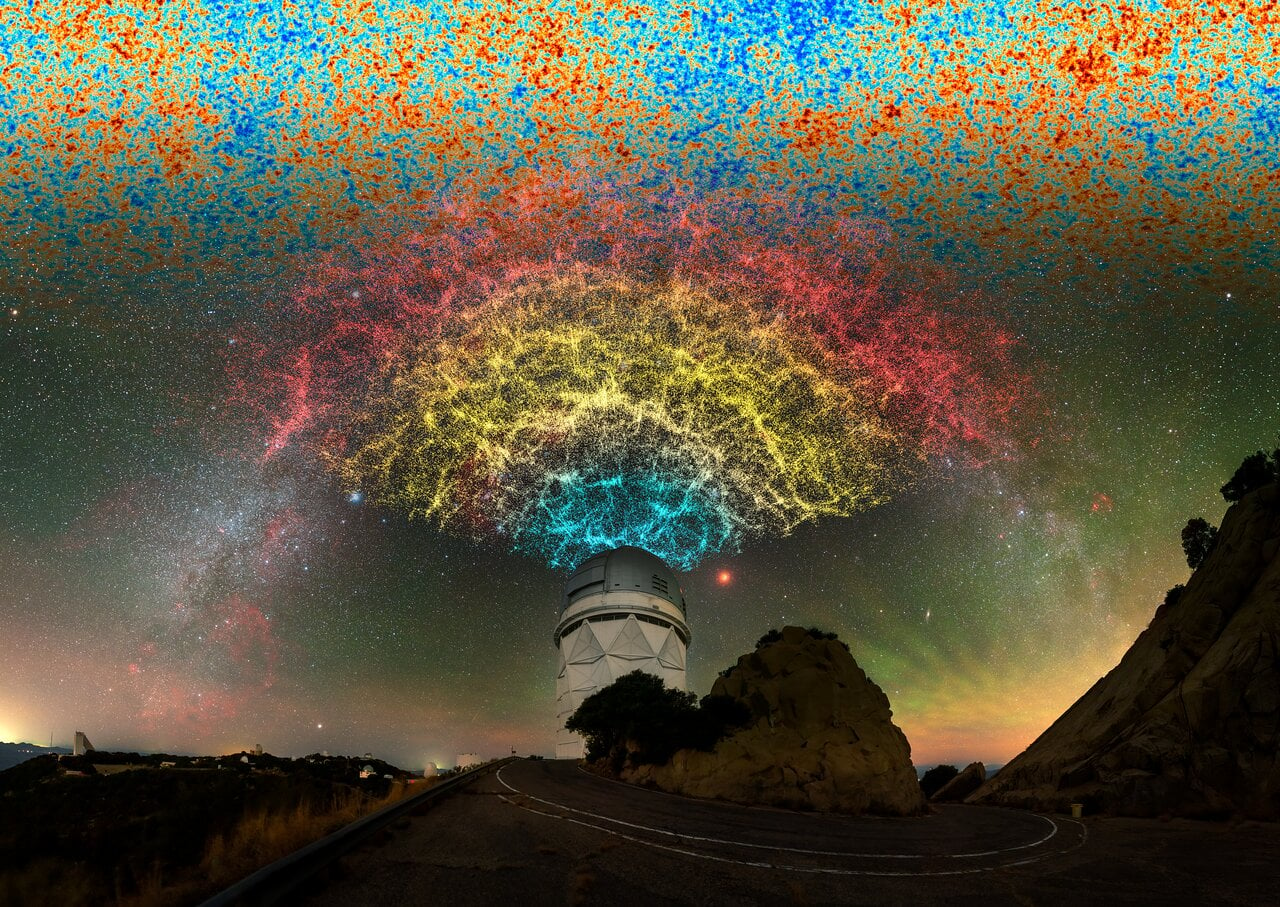
The release of DR 11 marks the transition from data collection to deep analysis. While previous releases provided the groundwork, DR 11 offers the most refined and complete version of the 2D sky, incorporating improved calibration techniques and a more comprehensive set of objects. This data will be used to finalize the targets for the remaining years of the DESI spectroscopic survey, which is scheduled to continue observations through 2028.
Challenging the Standard Model of Cosmology
Perhaps the most provocative aspect of the DESI project’s recent findings is the suggestion that our current understanding of dark energy may be incomplete. Early analysis of the data gathered via these surveys hints that the influence of dark energy might not be constant, as previously assumed in the "Lambda CDM" model—the standard model of cosmology.
If dark energy is indeed weakening over cosmic time, as some DESI results suggest, the implications for the future of the universe are profound. The standard model predicts a "Big Freeze," where the universe continues to expand until galaxies are so far apart that they become invisible to one another, eventually leading to the thermal death of the cosmos. However, a weakening dark energy force could mean the expansion might eventually slow down or reach a state of equilibrium.
This potential paradigm shift has sparked intense debate within the scientific community. Arjun Dey, an astronomer at NSF NOIRLab and co-lead of the Legacy Surveys, remarked that while these data are fundamental to investigating the expansion history of the universe, they also serve a broader human purpose. He noted that the skies belong to everyone, and the survey provides a bridge between rigorous mathematical investigation and the ancient human tradition of staring at the stars in wonder.
Beyond Dark Energy: Broad Scientific Impact
While the primary mission of DESI is to study dark energy, the DR 11 dataset is a goldmine for other fields of astronomy. The high-resolution map is already being used to identify gravitational lenses—rare alignments where the gravity of a massive foreground galaxy bends the light of a more distant object, acting as a natural telescope.
Furthermore, the survey is instrumental in the study of transient events. Supernovae, fast radio bursts (FRBs), and gamma-ray bursts (GRBs) often occur in distant galaxies; by having a detailed "before" image of those galaxies, astronomers can more easily identify and analyze these sudden cosmic explosions. The data also aids in the hunt for dark matter, the mysterious substance that provides the gravitational scaffolding for galaxies but does not emit light. By studying the clustering patterns of the four billion objects in the DESI map, scientists can infer the distribution of dark matter across the cosmos.
The map is also serving as a training ground for the next generation of astronomical tools. The sheer volume of data—measured in petabytes—is being used to train machine learning algorithms and artificial intelligence models. These tools are essential for the upcoming operations of the Vera C. Rubin Observatory and the Nancy Grace Roman Space Telescope. The Rubin Observatory’s Legacy Survey of Space and Time (LSST) is expected to generate 10 terabytes of data every night, while the Roman telescope will produce roughly 20 petabytes over its primary mission. The techniques developed to process and navigate the DESI DR 11 dataset are providing the blueprint for handling these future "big data" challenges in astronomy.
Future Outlook and Data Accessibility
The DESI collaboration is far from finished. Following the success of DR 11, the team is working toward a comprehensive publication of results from the first five years of spectroscopic operations, expected in 2027. These results will likely provide the most definitive measurements to date regarding the "equation of state" of dark energy.
In the meantime, the DR 11 catalog remains a public resource. It is available through the Legacy Survey Sky Viewer, an interactive interface that allows users to zoom from a wide-angle view of the Milky Way down to the individual spiral arms of a galaxy millions of light-years away. For professional researchers, the full searchable database is hosted by the Astro Data Lab at the Community Science and Data Center (CSDC), a program of NSF’s NOIRLab.
As the scientific community begins to digest the vast quantities of information contained within the eleventh data release, the map stands as a testament to human curiosity and technological prowess. By charting nearly four billion objects across 75% of the sky, the DESI Legacy Imaging Surveys has not only provided a roadmap for understanding the fate of the universe but has also ensured that the wonders of the deep cosmos are accessible to all.