Vera Intan Clara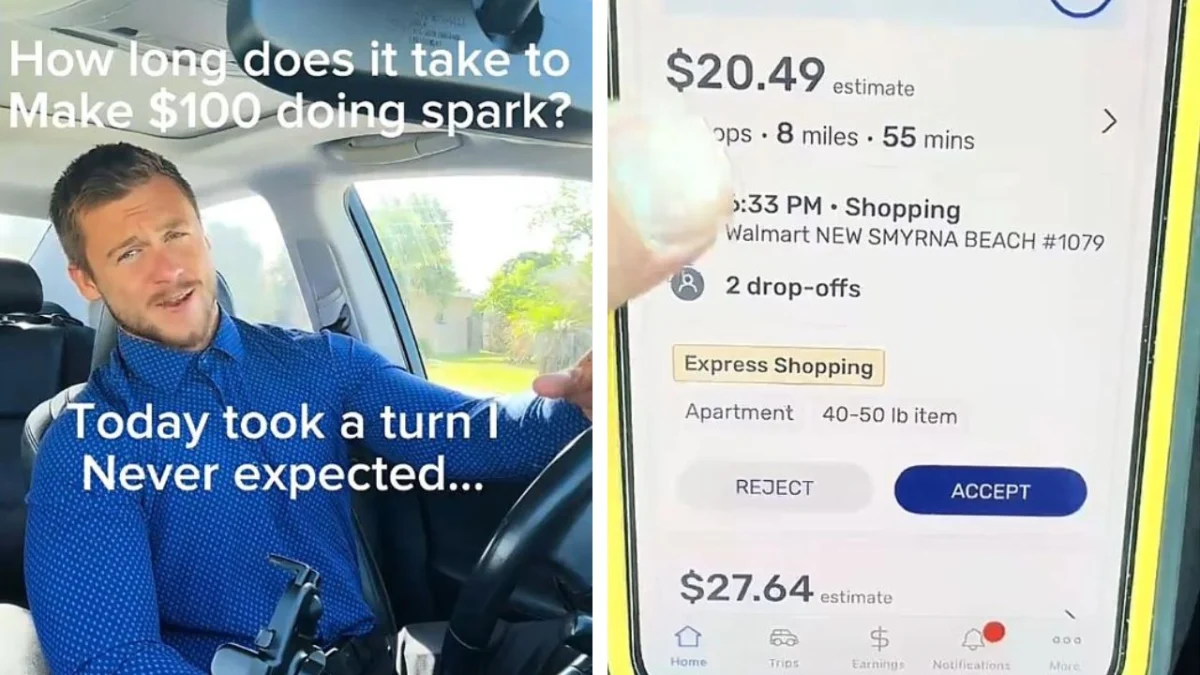
A recent TikTok video from creator @joelhustle, documenting his attempt to earn $100 through Walmart’s Spark Driver delivery application, garnered significant attention before an unforeseen family emergency abruptly concluded the challenge. The video, which detailed the intricacies and frustrations of navigating the gig economy platform, ended with the creator receiving a call from his wife reporting that their daughter may have broken her arm, prompting him to abandon his pursuit of the financial goal and head home immediately. This personal incident, while singular, served to underscore a broader spectrum of operational challenges, economic realities, and human elements inherent in the burgeoning last-mile delivery sector.
The chronicle of Joel Hustle’s day began with a clear objective: to track the time and effort required to accumulate $100 via Spark deliveries. His initial endeavors were met with a series of less-than-ideal offers, a common experience reported by many independent contractors in the gig economy. The first notable rejection was an offer paying $21.99 for a substantial 26.5 miles, a proposition that, when factoring in fuel costs, vehicle wear and tear, and time, likely presented a marginal net profit. Subsequently, he declined a larger, more complex order comprising 10 stops spread across 27.7 miles for $46.93. While the latter offer presented a higher gross earning, the multi-stop nature and extensive mileage suggested a significant time commitment and potential logistical headaches, often a deterrent for drivers seeking efficient earnings.
His initial acceptance was for a $19.51 offer covering a more manageable 3.8 miles. However, this trip was unexpectedly canceled just as he arrived at the Walmart store, a scenario that wastes a driver’s time and fuel without compensation, further illustrating the inherent unpredictability of app-based work. Undeterred, Joel then inadvertently accepted a $28.11 order, which he decided to complete. This particular order, consisting of 25 items, notably included sparklers, a detail he observed was fitting given the filming took place the day before the Fourth of July, adding a seasonal context to his delivery experience.
Chronology of a Gig Driver’s Day
Joel Hustle’s journey through the Spark Driver app unfolded over several hours, offering a micro-narrative of the daily grind for many gig workers:
- Morning/Early Afternoon: Joel initiates his challenge, setting a target of $100.
- Offer Evaluation: He meticulously reviews incoming delivery requests, demonstrating a strategic approach to maximizing earnings by rejecting offers deemed uneconomical. This included a $21.99 offer for 26.5 miles and a $46.93 offer for 10 stops over 27.7 miles, both rejected due to unfavorable pay-to-distance ratios or complexity.
- First Acceptance and Cancellation: He accepts a $19.51 offer for 3.8 miles, indicating a preference for shorter, potentially more profitable trips. However, the order is canceled upon his arrival at the Walmart store, resulting in lost time and fuel.
- Second Acceptance and In-Store Fulfillment: An accidental acceptance leads him to take a $28.11 order for 25 items. This phase highlights the in-store challenges:
- Inventory Discrepancies: He discovers the requested water brand is out of stock and attempts a substitution, which is subsequently rejected by the customer via the app.
- Further Stock Issues: He notes that iceberg lettuce, another requested item, is also unavailable. He marks multiple items as "unavailable" in the app, a process that can impact customer satisfaction and potentially driver ratings.
- Checkout and Imminent Delivery: After navigating the store and managing substitutions/unavailabilities, Joel proceeds to checkout.
- Abrupt Interruption: Before completing the delivery, he receives a critical phone call from his wife, informing him of their daughter’s potential arm injury.
- Challenge Suspension: Joel immediately ceases filming and the delivery attempt, prioritizing the family emergency. He heads home to transport his daughter to a doctor, leaving his $100 earning goal unfulfilled for the day.
This sequence of events not only captures the operational mechanics of the Spark platform but also the human element, where personal life can unexpectedly intersect with professional commitments, particularly for independent contractors who lack the traditional protections of employment.
The Spark Driver Ecosystem: An Expanding Gig Frontier
Walmart’s Spark Driver program is a critical component of the retail giant’s expanding e-commerce and last-mile delivery strategy. Launched in select markets and steadily expanding nationwide, Spark leverages a network of independent contractors to fulfill online grocery orders, general merchandise, and other deliveries directly to customers’ homes. This initiative is Walmart’s direct response to growing consumer demand for convenience and rapid delivery, positioning it competitively against rivals like Amazon, Instacart, and other third-party logistics providers.
For Walmart, Spark offers several strategic advantages. It provides a flexible and scalable delivery workforce without the overhead costs associated with full-time employees, such as benefits, training, and fixed wages. It also allows Walmart to maintain greater control over its delivery operations compared to relying solely on external partners, ensuring brand consistency and customer service standards. The platform integrates seamlessly with Walmart’s online ordering systems, offering a streamlined experience for customers from order placement to doorstep delivery.
From the driver’s perspective, Spark, like other gig platforms, advertises flexibility and the opportunity to earn supplemental income. Drivers use their personal vehicles and smartphones to accept and manage delivery requests, essentially operating as micro-entrepreneurs. They are paid per delivery, with earnings influenced by factors such as distance, item count, demand, and customer tips. This model appeals to individuals seeking part-time work, students, retirees, or those looking to supplement income from other jobs.
The Broader Gig Economy Landscape: Promises and Pitfalls
Joel Hustle’s experience is a microcosm of the broader challenges and opportunities within the gig economy, a sector that has witnessed explosive growth over the past decade. Globally, the gig economy is valued in the hundreds of billions of dollars, with projections for continued expansion. Its allure for workers often centers on flexibility, autonomy, and the ability to set one’s own hours. For companies, it provides a dynamic workforce that can scale rapidly with demand.
However, the rapid growth has also brought significant scrutiny regarding worker compensation, benefits, and overall working conditions. Studies from organizations like the Economic Policy Institute and the JPMorgan Chase Institute have consistently highlighted the variability of gig worker incomes, often showing that after accounting for expenses like fuel, vehicle maintenance, and self-employment taxes, net earnings can sometimes fall below traditional minimum wage equivalents.
Key challenges for gig drivers include:
- Volatile Earnings: Pay per delivery can fluctuate significantly based on demand, time of day, and platform algorithms. Drivers often spend uncompensated time waiting for suitable offers.
- Operational Costs: Independent contractors bear all business expenses, including fuel, vehicle depreciation, insurance, and maintenance. These costs can significantly erode gross earnings.
- Lack of Benefits: Gig workers typically do not receive traditional employee benefits such as health insurance, paid time off, sick leave, or retirement plans, leaving them vulnerable to financial hardship in times of illness or emergency, as highlighted by Joel’s situation.
- Offer Optimization and Algorithm Dependency: Platforms use complex algorithms to assign orders, which drivers must learn to navigate. Rejecting "bad" offers is a strategic necessity, but can also lead to fewer offers or perceived penalties from the algorithm. The "batching" of orders, where multiple deliveries are combined into one trip, as a commenter noted, can increase gross pay but also exponentially increase complexity, time, and the potential for errors.
- Classification Debate: A persistent legal and ethical debate revolves around whether gig workers should be classified as independent contractors or employees. Reclassification could grant them access to minimum wage protections, overtime pay, and benefits, but platforms argue it would undermine the flexibility central to their business model.
Operational Hurdles: In-Store Logistics and Customer Experience
Beyond the earnings structure, Joel’s video vividly illustrated several operational hurdles that impact both drivers and customers. The issue of item availability at Walmart stores emerged as a significant point of contention. Joel’s experience of finding the requested water brand and iceberg lettuce out of stock is not uncommon. This discrepancy between the online inventory displayed to customers and the actual stock on shelves can stem from several factors: rapid inventory turnover, delays in updating digital stock numbers, or human error in stocking.
For drivers, these inventory discrepancies translate into lost time. They must search for items, attempt substitutions, communicate with customers for approval (which can be rejected, as in Joel’s case), or mark items as unavailable. This process adds minutes to each delivery, potentially reducing the number of deliveries they can complete in a given timeframe and thus their overall earnings. Furthermore, incomplete orders or unwanted substitutions can lead to customer dissatisfaction, potentially affecting tips and driver ratings.
One commenter on Joel’s video explicitly raised this operational concern: "I stopped using the 3 hour or less option because Spark drivers can’t find most items (arnt on shelves) while the Walmart employees have access to the back rooms." This comment highlights a critical operational asymmetry. While Walmart associates typically have access to store backrooms and real-time inventory systems to locate items, independent Spark drivers are generally limited to the public sales floor. This limitation can make fulfilling complex orders more challenging for drivers than for in-store personnel, leading to inefficiencies and potentially impacting the quality of service.
Another commenter’s query, "I’m confused, so some of these give you multiple orders at one time? Idk if I could keep them separate. No wonder some people’s orders are messed up," pointed to the complexities of batched orders. While batching allows platforms to optimize routes and potentially offer drivers higher aggregate pay for a single trip, it places a significant burden on drivers to accurately sort and deliver multiple orders, often for different customers, within their personal vehicles. Mislabeling, misdelivery, or confusing items between orders are genuine concerns, affecting customer satisfaction and platform reputation.
Community Reactions and Broader Implications
Reactions to Joel’s video on TikTok were largely focused on the structural issues within the Spark platform and the broader gig economy. The sentiment reflected a shared understanding among many drivers regarding the demanding nature of the work versus the often-meager compensation. One commenter’s observation that "That order with all them steps is disrespectful" encapsulated the frustration with low-paying, high-effort offers. This speaks to a common complaint among gig workers that platforms prioritize efficiency and low cost over fair compensation for the labor involved.
The suggestion for a "Next video: today we’re going to see how long it takes to do Spark to pay off a $50,000 medical bill. Let’s do it!" was a poignant and sarcastic commentary on the financial precarity faced by many gig workers. It starkly highlights the absence of employer-provided health benefits and the potential for catastrophic financial burdens resulting from medical emergencies, a risk that Joel’s own family situation tragically brought into sharp relief.
The implications of these operational and economic realities extend far beyond individual driver experiences. For platforms like Spark, maintaining a reliable and motivated driver base is crucial for sustained growth. If drivers consistently find earnings insufficient or working conditions too challenging, turnover rates can increase, leading to service degradation. For customers, inconsistent inventory, missed items, or delayed deliveries can erode trust and drive them to competing services.
Ultimately, Joel Hustle’s truncated $100 challenge on Spark Driver, while a personal narrative, inadvertently served as a highly visible case study. It exposed the intricate interplay of technological platforms, economic pressures, logistical complexities, and the very human realities of independent contractors navigating the modern gig economy. The Daily Dot was unable to independently verify the specific earnings, order details, or the family emergency described in this video. The details presented above reflect the account shared by @joelhustle on TikTok. The identity and current condition of the child referenced in the video have not been confirmed, underscoring the limitations of information presented via social media platforms. However, the themes and challenges articulated resonate deeply with widely reported issues across the gig economy, prompting continued discussion about fair labor practices, technological efficiency, and the future of work.