admin
admin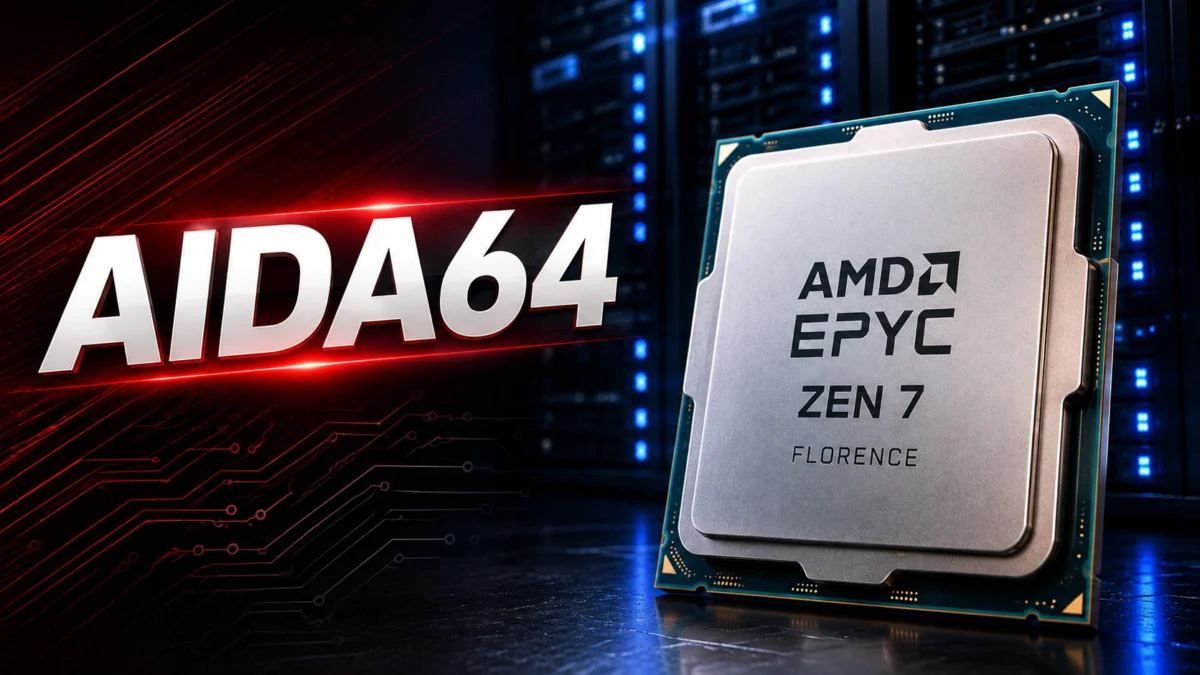
The update, specifically identified in the AIDA64 Extreme Beta version 8.35.8405, marks a pivotal moment in the hardware enthusiast and professional community. While it is common for monitoring tools like AIDA64, HWiNFO, and HWMonitor to add support for hardware months before release to ensure compatibility for early engineering samples, the addition of Zen 7—an architecture not expected to see a commercial release until approximately 2027 or 2028—highlights the long-term vision AMD has communicated to its partners and the software industry.
The AIDA64 Beta Update and Technical Scope
The latest beta release notes from FinalWire reveal a broad range of updates beyond the headline-grabbing Zen 7 support. The version 8.35.8405 update includes support for the Lenovo ThinkCentre M70t Gen 6 and M75q Gen 5 systems, as well as preliminary data for the AMD Radeon RX 9050 (Navi 44) graphics processors. However, the explicit mention of Zen 7 server processors is the most significant entry, as it confirms that the architectural definitions for AMD’s seventh-generation Zen cores have reached a stage where external software developers can begin the preliminary work of identification and monitoring.
For software like AIDA64, "early support" typically involves the ability to recognize specific CPUID signatures, instruction set extensions, and topology configurations. By incorporating these details now, the utility ensures that when early silicon—often referred to as Alpha or A0 stepping—reaches the hands of firmware developers and internal testers, the hardware can be accurately identified and its performance metrics can be tracked without software-level errors.
AMD’s Long-Term Roadmap: From Zen 5 to Zen 8
The disclosure of Zen 7 support follows AMD’s recent "Advancing AI" event, where the company provided a rare glimpse into its multi-year architectural roadmap. Currently, the market is seeing the rollout of the Zen 5 architecture, codenamed "Turin" for the EPYC server line. Zen 5 represents the current state-of-the-art for AMD, focusing on significant IPC (Instructions Per Clock) gains and enhanced efficiency for cloud and enterprise workloads.
According to the established roadmap, Zen 5 will be followed by Zen 6, codenamed "Venice." Zen 6 is expected to refine the chiplet interconnects and further expand the core counts available to data center clients. Zen 7, which AIDA64 has now added to its database, is the successor to Venice and is slated to power the seventh generation of EPYC processors, codenamed "Florence."
The progression of the Zen roadmap is as follows:

- Zen 5 (Turin): Launched 2024, focusing on 4nm and 3nm process nodes.
- Zen 6 (Venice): Anticipated 2025–2026, expected to introduce new packaging technologies and enhanced memory controllers.
- Zen 7 (Florence): Anticipated 2027–2028, confirmed to feature AI Compute Extensions and advanced memory support.
- Zen 8: Confirmed for a 2030 timeframe, representing the long-term evolution of the platform.
Architectural Innovations in Zen 7 "Florence"
While specific clock speeds and core counts for Zen 7 remain under wraps, AMD has been transparent about the high-level goals for the Florence family. One of the most significant additions to the Zen 7 architecture is the introduction of "AI Compute Extensions." As the global demand for Artificial Intelligence and Machine Learning (AI/ML) processing continues to skyrocket, AMD is looking to integrate specialized hardware acceleration directly into the general-purpose CPU cores.
These AI Compute Extensions are expected to function similarly to Intel’s Advanced Matrix Extensions (AMX), allowing the EPYC Florence processors to handle complex mathematical operations required for AI inference and training without solely relying on discrete GPU accelerators. This move positions AMD to capture a larger share of the "AI-at-the-edge" and "AI-in-the-cloud" markets, where versatility is as important as raw throughput.
Furthermore, Zen 7 is designed to leverage next-generation memory technologies. The architecture will support MRDIMM (Multiplexed Rank Dual In-line Memory Modules) and LPDDR (Low-Power Double Data Rate) memory. MRDIMMs are particularly crucial for the server market, as they allow for a significant increase in memory bandwidth by multiplexing two ranks of memory into a single high-speed interface. This is essential for feeding the high core counts expected in the 2028 era of server processors.
The Role of Zen 7c: Compute-Optimized Variants
Continuing a strategy that began with Zen 4, AMD will offer Zen 7 in two primary configurations: the standard Zen 7 core and a compute-optimized version known as Zen 7c. The "c" variants utilize a more compact physical layout, sacrificing some cache size and peak clock frequency in exchange for much higher core density.
In the Zen 7 generation, the 7c cores will be vital for cloud service providers (CSPs) who require maximum thread density for virtual machine (VM) hosting and containerized workloads. By offering both standard and "c" versions, AMD ensures that the Florence family can address everything from high-frequency financial modeling to ultra-dense cloud infrastructure.
Industry Implications and Competitive Landscape
The early appearance of Zen 7 in AIDA64’s database is a testament to the stability of AMD’s execution. In previous years, AMD struggled with roadmap consistency, but the "Zen era" has been marked by a disciplined cadence of releases. This predictability has allowed software partners like FinalWire to prepare their tools years in advance.
From a competitive standpoint, AMD is positioning Zen 7 to compete against Intel’s future Xeon architectures, likely including the successors to the Clearwater Forest and Diamond Rapids families. Intel has also been aggressive with its roadmap, aiming to regain leadership in the data center through its "five nodes in four years" strategy. However, AMD’s focus on chiplet innovation and the early integration of AI extensions suggests they intend to maintain the momentum that has seen their server market share grow from nearly zero to over 30% in less than a decade.

The support for Zen 7 also indicates that AMD is already deep into the design phase of its next-generation AI rack systems. These systems will integrate EPYC Florence CPUs with Instinct GPU accelerators, using high-speed Infinity Fabric interconnects to create a unified compute environment for the world’s most demanding supercomputers and AI training clusters.
Technical Analysis: Why 2028 Matters
The timeline for Zen 7 is strategically aligned with the expected maturation of several key technologies. By 2028, the industry expects to be utilizing sub-2nm process nodes, possibly involving Gate-All-Around (GAA) transistor architectures. AMD’s ability to design Zen 7 with these advanced manufacturing processes in mind will be critical for maintaining efficiency.
Moreover, the inclusion of LPDDR support in a server-centric architecture like Zen 7 points toward a growing trend of "memory-on-package" or highly efficient edge-computing servers. LPDDR, while traditionally reserved for mobile devices, offers a compelling bandwidth-per-watt profile that is becoming increasingly attractive for specialized server deployments where power density is a limiting factor.
Reaction from the Developer Community
While AMD has not issued an official statement regarding the AIDA64 update, the move is viewed by industry analysts as a routine but essential step in the hardware development lifecycle. Developers of monitoring tools often receive early documentation under non-disclosure agreements (NDAs) to ensure that their software is ready when the first engineering samples begin circulating among motherboard manufacturers and OEM partners.
"Adding support for an architecture four years out might seem premature to the average user," noted one hardware analyst. "But for the engineers building the next generation of liquid-cooled data centers and AI clusters, having these software hooks in place now is vital for the simulation and early testing phases."
Conclusion
The addition of AMD Zen 7 support to AIDA64 is more than just a line item in a beta release note; it is a signal of the long-term trajectory of the semiconductor industry. As AMD prepares for the "Florence" era, the focus is clearly shifting toward a fusion of traditional high-performance computing and specialized AI acceleration.
With the support of next-gen memory like MRDIMM and the expansion of the compute-optimized "c" core strategy, Zen 7 appears poised to continue the legacy of the Zen family. While consumers and enterprise clients still have several years to wait before Zen 7 hits the shelves, the software ecosystem is already preparing for its arrival, ensuring that when 2028 comes, the industry will be ready to harness the full potential of AMD’s seventh-generation architecture.