Sisilia Frederika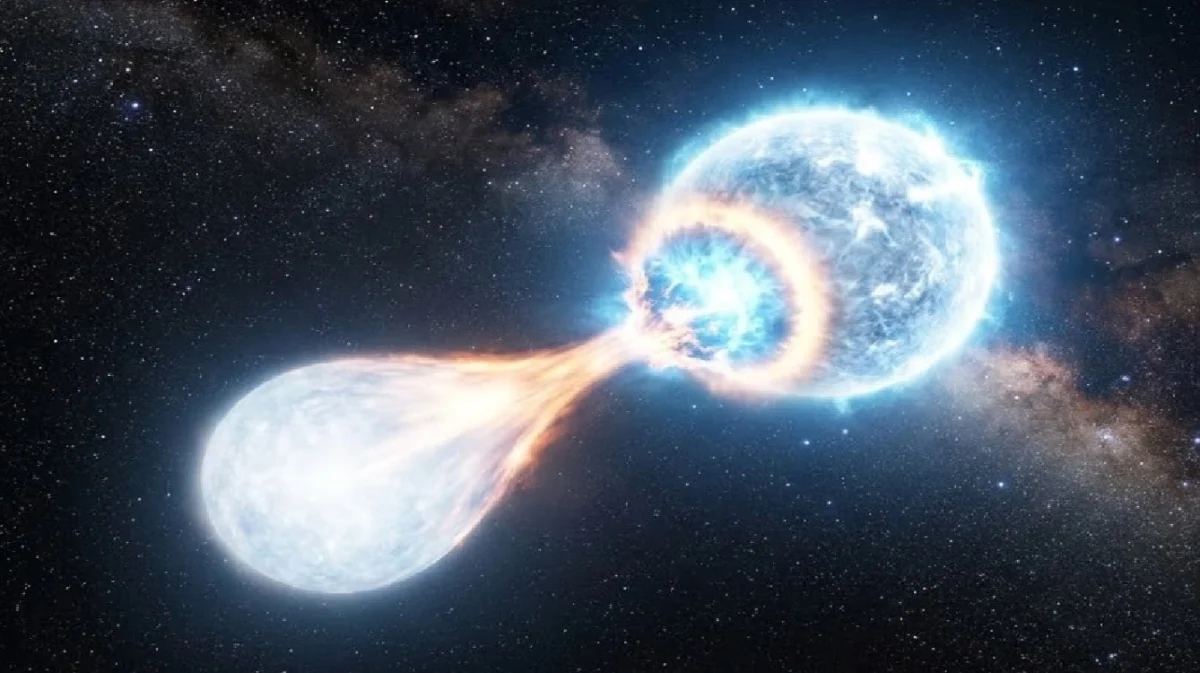
The landscape of modern astrophysics is currently undergoing a transformative shift, moving from traditional light-based observations to the nascent field of gravitational wave astronomy. While existing ground-based facilities like the Laser Interferometer Gravitational-Wave Observatory (LIGO) and Virgo have successfully detected the violent mergers of black holes and neutron stars, they remain deaf to the subtler, continuous hum of binary star systems. This observational gap is expected to close with the next generation of space-borne detectors. In a significant step toward this goal, an international team of researchers has identified an ultracompact binary white dwarf system, designated eRASSU J060839.5–704014 (eRASSU J0608), which exhibits one of the most rapid orbital decays ever recorded, marking it as a critical target for future gravitational wave missions.
The Discovery of an Ultracompact Engine
The system eRASSU J0608 was initially flagged as a notable X-ray source. Observations revealed a highly regular and remarkably short periodicity: the system emits a bright pulse of X-rays every 374 seconds, or approximately 6.2 minutes. In the realm of stellar dynamics, such rapid periodicity is almost always indicative of extreme physical conditions. Traditionally, repeating signals in the X-ray spectrum are associated with the rapid rotation of neutron stars (pulsars) or the geometric alignment of eclipsing binary systems. However, the specific characteristics of the eRASSU J0608 signal suggested something more exotic.
To unravel the nature of this source, astronomers utilized a multi-observatory approach, combining data from the Neutron star Interior Composition Explorer (NICER), an instrument situated on the International Space Station, and the Einstein Probe, a recently launched X-ray observatory designed to monitor the sky for transient events. The synthesis of this data allowed the team to confirm that eRASSU J0608 is a "double-degenerate" binary system—a pair of white dwarfs orbiting each other at an incredibly close distance.
White dwarfs are the dense, remnant cores of stars like our Sun that have exhausted their nuclear fuel. When two such objects are locked in a tight orbital embrace, they form a laboratory for testing the limits of General Relativity. In the case of eRASSU J0608, the proximity is so extreme that the stars complete an entire orbit in less time than it takes to soft-boil an egg.
Mechanics of Direct Capture Accretion
One of the most distinctive features of eRASSU J0608 is the method by which it generates X-rays. In most binary systems where mass is transferred from one star to another, the material forms an accretion disk—a swirling vortex of gas that heats up as it spirals inward. However, the stars in eRASSU J0608 are so close that there is no room for a stable disk to form. Instead, the system operates via "direct capture."
In this scenario, material ejected from the donor white dwarf is pulled directly onto the surface of the primary white dwarf. This process creates localized hotspots of super-heated plasma. As the stars rotate and orbit, these hotspots move into and out of the line of sight of Earth-based observers, resulting in the regular 374-second X-ray bursts. The absence of a constant glow from an accretion disk explains the pulsed nature of the emissions, providing a clear "clock" that astronomers can use to measure the system’s orbital evolution with high precision.
A Three-Year Chronology of Orbital Decay
To determine how the system is changing over time, the research team compared their recent findings with archival data from the X-ray Multi-Mirror Mission (XMM-Newton), a cornerstone of European X-ray astronomy that has been in operation since 1999. By analyzing observations spanning more than three years, the researchers were able to track the timing of the X-ray pulses with microsecond accuracy.
The results were definitive: the 374-second orbital period is shrinking. The stars are drawing closer together at a rate that places eRASSU J0608 among the fastest-decaying binary systems known to science. This orbital tightening is not a random fluctuation but a steady, relentless process. In the vacuum of space, such a rapid loss of orbital energy can only be explained by the emission of gravitational waves—ripples in the fabric of spacetime predicted by Albert Einstein over a century ago.
As the two white dwarfs orbit their common center of mass, they stir the local gravitational field, carrying energy away from the system in the form of radiation. As energy is lost, the stars must move closer together to maintain orbital stability, which in turn causes them to orbit faster. This feedback loop will eventually lead to a merger, though that event remains thousands of years in the future.
Quantifying the Gravitational Signal
The researchers calculated the "chirp mass" of the system—a mathematical combination of the masses of the two components that determines the strength and evolution of the gravitational wave signal. For eRASSU J0608, the chirp mass is estimated at 0.43 solar masses. While this is significantly lower than the masses involved in the black hole mergers detected by LIGO, it is substantial for a white dwarf binary.
The significance of eRASSU J0608 lies in its frequency. Ground-based detectors like LIGO are sensitive to high-frequency gravitational waves (tens to hundreds of Hertz), which are produced in the final milliseconds of a merger. In contrast, ultracompact binaries like eRASSU J0608 emit low-frequency waves (millihertz range). These waves are continuous and stable, representing a "background hum" of the universe that ground-based lasers cannot detect due to seismic noise and the limited length of their interferometer arms.
The LISA Mission and Verification Binaries
The discovery of eRASSU J0608 comes at a pivotal time for the Laser Interferometer Space Antenna (LISA) mission, a joint venture between ESA and NASA scheduled for launch in the mid-2030s. LISA will consist of three spacecraft flying in a triangular formation millions of kilometers apart, trailing the Earth in its orbit around the Sun. This vast scale will allow LISA to detect the low-frequency gravitational waves emitted by systems exactly like eRASSU J0608.
In the community of gravitational wave researchers, systems like this are known as "verification binaries." Because they can be seen through electromagnetic telescopes (in this case, X-ray observatories), their positions, periods, and orbital decays are already known. When LISA begins its mission, these systems will serve as calibration targets. If LISA detects the gravitational waves from eRASSU J0608 at the exact frequency and strength predicted by the X-ray data, it will confirm that the instrument is functioning correctly, allowing scientists to then hunt for "dark" sources that have no electromagnetic counterpart.
The Search for Distance and the Third Companion
Despite the wealth of data gathered, one critical piece of the puzzle remains missing: the distance to eRASSU J0608. Gravitational waves, like light, follow the inverse-square law. A source that is twice as far away will appear four times weaker. To accurately predict the amplitude of the gravitational waves LISA should detect, astronomers must know exactly how far away the system is from Earth.
Current X-ray observations are excellent at measuring temperature and timing but are poor at determining absolute distance. To solve this, the research team is looking for evidence of a third stellar companion in the system. If a third star is orbiting the white dwarf pair at a greater distance, its gravitational influence might cause subtle, long-term shifts in the timing of the X-ray pulses (the Light-Travel Time effect). Furthermore, if this third star can be identified and characterized using optical telescopes, it could provide a reliable distance measurement for the entire system.
Implications for Multi-Messenger Astronomy
The study of eRASSU J0608 is a prime example of "multi-messenger astronomy," a discipline where information from different "messengers"—light (X-rays) and gravity (waves)—is combined to provide a complete picture of a celestial object. By studying the orbital decay today via X-rays, scientists are essentially "pre-registering" a discovery for the gravitational wave observatories of the next decade.
The implications of this research extend beyond just calibration. Systems like eRASSU J0608 help theorists understand the population of compact objects in our galaxy. They provide data on how common these tight binaries are and what happens to the matter being transferred between them. If the mass transfer remains stable, the system may evolve into an AM Canum Venaticorum (AM CVn) star—a rare type of cataclysmic variable. If the transfer becomes unstable, the system could culminate in a Type Ia supernova, the "standard candles" used by astronomers to measure the expansion of the universe.
As the astronomical community prepares for the era of space-based gravitational wave detection, eRASSU J0608 stands as a beacon. It is a reminder that the universe is filled with silent, invisible ripples, and that we are finally developing the tools to hear them. The rapid decay of its six-minute orbit is not just a curiosity of stellar mechanics; it is a ticking clock that marks the countdown to a new age of discovery. Through the continued monitoring of such ultracompact binaries, researchers are ensuring that when LISA finally opens its "ears" to the cosmos, it will know exactly what to listen for.