Sisilia Frederika
The New Horizons spacecraft, a flagship of deep-space exploration that famously provided the first close-up images of Pluto, is currently facing a critical funding shortfall that threatens to halt its ongoing study of the outer solar system. Despite the spacecraft’s excellent mechanical health and its unique position in the Kuiper Belt, a budgetary gap within NASA’s Heliophysics Division may force the mission to deactivate its primary space-environment sensors as early as October 2024. This potential suspension comes at a pivotal moment, as the spacecraft approaches the outer boundaries of the Sun’s influence, a region of space that has not been surveyed with modern instrumentation since the Voyager missions of the 1970s.
The financial crisis centers on a relatively modest $2 million annual requirement for the operation of two specific instruments: the Solar Wind at Pluto (SWAP) and the Pluto Energetic Particle Spectrometer Science Investigation (PEPSSI). While the mission’s planetary science objectives continue to receive support, the heliophysics component—which tracks the interaction between solar wind and the interstellar medium—has seen its funding lapse. According to mission leadership, without an immediate restoration of these funds, the spacecraft will be forced to stop collecting data that is vital to understanding the heliosphere’s structure and the transition into interstellar space.
A Legacy of Deep Space Discovery
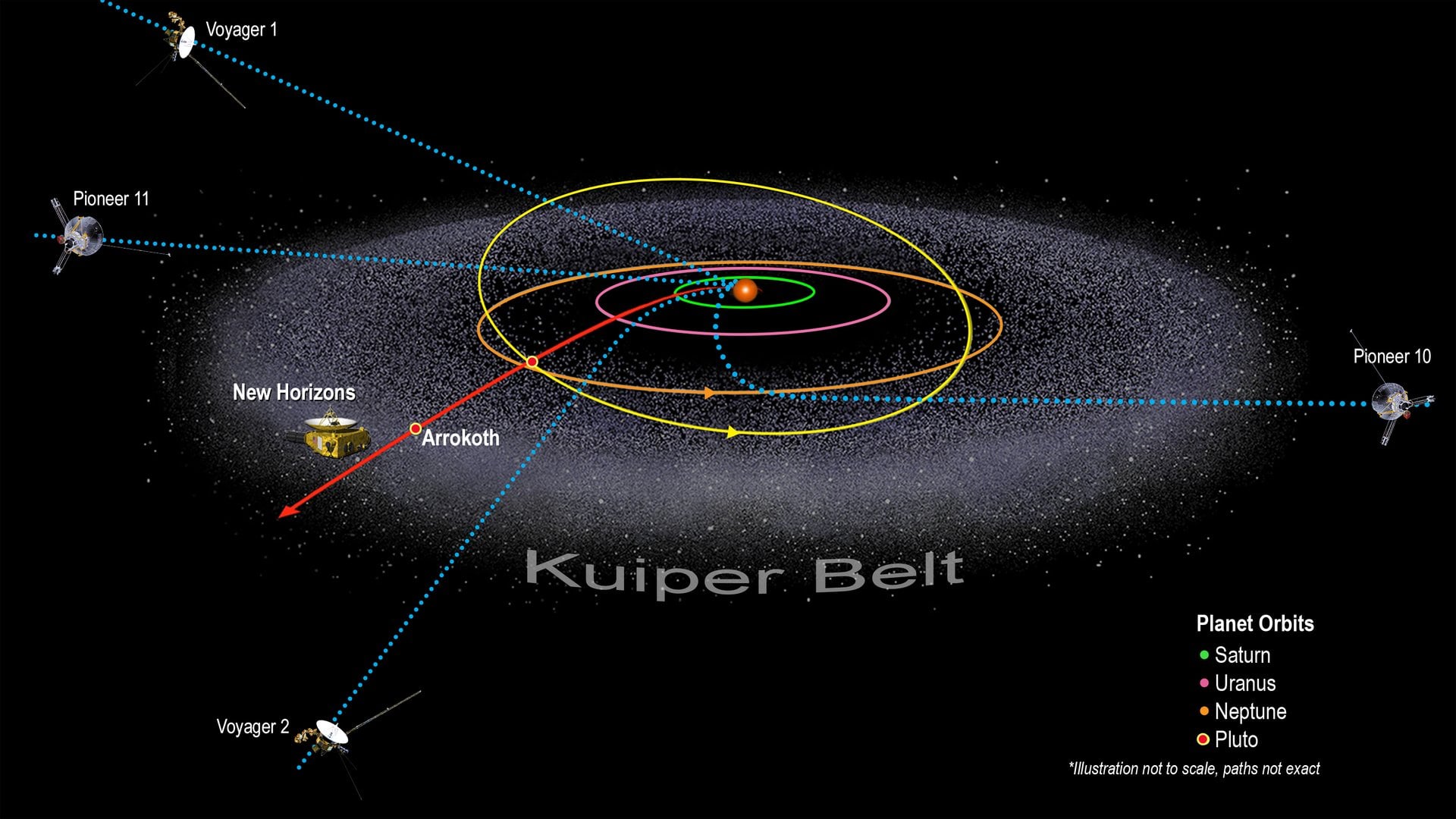
Launched in January 2006, New Horizons was designed to be the fastest spacecraft ever to leave Earth’s orbit. Its primary mission was to explore the Pluto system, a goal it achieved with spectacular success in July 2015. Following the Pluto flyby, the mission was extended to explore the Kuiper Belt, leading to the 2019 encounter with Arrokoth, the most distant and primitive object ever visited by a spacecraft.
Throughout its nearly two-decade journey, New Horizons has functioned as more than just a planetary scout. It has served as a moving laboratory, measuring the environment of the solar system across a vast trajectory. The spacecraft utilized a gravity assist from Jupiter in 2007, which not only accelerated its path toward Pluto but also allowed for detailed observations of the Jovian magnetosphere. Since then, the mission has been granted two major extensions, in 2016 and 2023, reflecting its continued relevance to both planetary science and heliophysics.
Currently, New Horizons is traversing the Kuiper Belt, a region of icy bodies and remnants from the early solar system. While it continues to look for new flyby targets and conduct remote observations of other Kuiper Belt Objects (KBOs), its "space weather" instruments have been providing a continuous stream of data on the Sun’s reach. This data is unique because it offers a modern perspective on the outer heliosphere, utilizing sensors that are significantly more advanced than those carried by Voyager 1 and Voyager 2.
The Technical Stakes: SWAP and PEPSSI
The two instruments currently at risk, SWAP and PEPSSI, are designed to measure different aspects of the solar environment. SWAP is optimized to measure the properties of the solar wind—the stream of charged particles flowing from the Sun—at low energies. PEPSSI, conversely, is designed to detect high-energy particles, such as those accelerated by solar flares or galactic cosmic rays.
Together, these instruments provide a comprehensive map of how the Sun’s influence wanes as a spacecraft moves further into deep space. Principal Investigator Alan Stern has emphasized that these instruments have provided an almost unbroken record of data from Earth’s orbit out to the spacecraft’s current position, which is more than 58 astronomical units (AU) from the Sun.
The importance of these measurements increases as New Horizons approaches the "termination shock"—the boundary where the solar wind slows down to subsonic speeds due to the pressure of the interstellar medium. The mission team estimates the spacecraft will cross this boundary within the next two years and reach the "heliopause" (the official edge of the solar system) within the next decade. Because the Voyager probes are now operating with extremely limited power and aging sensors, New Horizons represents the only opportunity for humanity to observe these milestones with 21st-century technology.
The Budgetary Divide and Mission Hibernation
The funding crisis is not a result of technical failure or a lack of scientific interest, but rather a structural and fiscal challenge within NASA. The New Horizons mission is cross-divisional, receiving support from both the Planetary Science Division and the Heliophysics Division. While the Planetary Science budget has maintained its $10 million annual commitment to the mission, the Heliophysics Division’s $2 million contribution has ceased for the 2024 fiscal year.
This $2 million shortfall covers the specialized staffing required at mission control to manage the SWAP and PEPSSI instruments, as well as the costs associated with "downlinking" the data—the process of transmitting stored information from the spacecraft’s recorders to NASA’s Deep Space Network (DSN) on Earth.
To cope with these constraints, the mission team has already begun placing the spacecraft into periodic hibernation. During these phases, the spacecraft’s non-essential systems are powered down to save money on mission operations. However, while planetary data can often be gathered in snapshots, heliophysics requires continuous monitoring to capture the fluctuating nature of solar wind and particle flux. As the spacecraft moves further away, the communication lag increases, and the "bit rate" (the speed of data transfer) drops, leading to a massive backlog of data stored on the spacecraft’s internal hard drives. Without the funds to pay for the "waking" hours of mission control, this data may never be retrieved.
Expert Reactions and Scientific Implications
The potential loss of data has sparked concern across the scientific community. Fran Bagenal, a planetary scientist and New Horizons team member, noted that while NASA’s Heliophysics Division is under immense pressure to fund missions closer to Earth, such as those at the L1 Lagrange point, the unique position of New Horizons makes it irreplaceable.
"It’s extremely important to know and understand the environment around the planets and out through the Kuiper Belt into the interstellar medium," Bagenal stated. She argued that the relatively small cost of $2 million is a bargain for the "frontier science" being conducted.
James Green, the former NASA Chief Scientist and a veteran heliophysicist, has also weighed in, highlighting the broader astrophysical implications of the mission. Green pointed out that every star possesses a "magnetic bubble" or astrosphere, similar to our Sun’s heliosphere. By studying the boundary of our own solar system, scientists can better understand how other stars interact with their environments, which has direct implications for the habitability of exoplanets.
"By understanding the physics going on with ours, we can help see how astrospheres of other stars are affecting the habitability of those planets," Green explained. "It’s heliophysics, but it’s also astrophysics."
In response to the funding gap, Green has helped circulate a public petition addressed to NASA leadership, including Administrator Bill Nelson and Associate Administrator for Science Nicola Fox. The petition argues that the cessation of these measurements would be a "tragic waste" of a healthy, multi-billion-dollar asset. As of mid-2024, the petition has garnered hundreds of signatures from researchers in both the planetary and heliophysics communities.
Chronology of the New Horizons Mission
- January 19, 2006: New Horizons launches from Cape Canaveral, Florida.
- February 28, 2007: Jupiter flyby; gravity assist provides a speed boost and allows for magnetospheric study.
- July 14, 2015: Historic Pluto flyby reveals a complex world with nitrogen ice glaciers and a thin atmosphere.
- 2016: NASA grants the first mission extension (KEM1) to explore the Kuiper Belt.
- January 1, 2019: Flyby of Arrokoth (2014 MU69), providing insights into planetesimal formation.
- 2023: NASA grants a second mission extension (KEM2), expanding the focus to include more heliophysics and astrophysics.
- Late 2023: Funding from the Heliophysics Division is reduced/stalled due to agency-wide budget cuts.
- October 2024: Projected deadline for the suspension of SWAP and PEPSSI instrument operations if funding is not restored.
- 2026–2027 (Projected): Expected crossing of the heliospheric termination shock.
- 2030s (Projected): Expected crossing of the heliopause into interstellar space.
- 2050: Estimated end of spacecraft life based on RTG (radioisotope thermoelectric generator) power decay.
Analysis: The Cost of Scientific Continuity
The struggle to fund New Horizons highlights a growing tension in modern space exploration: the difficulty of maintaining "legacy" missions while launching new ones. NASA’s budget for fiscal year 2024 and 2025 has been impacted by the Fiscal Responsibility Act of 2023, which capped non-defense discretionary spending. This has forced NASA to make difficult choices, leading to the "descoping" or cancellation of various projects.
However, critics of the New Horizons cut argue that the "cost-to-benefit" ratio of the mission is heavily skewed toward continued operation. The spacecraft is already built, launched, and positioned in a region of space that costs billions of dollars and decades of time to reach. To save $2 million—roughly 0.008% of NASA’s total annual budget—the agency risks losing a once-in-a-generation data set.
If the instruments are turned off in October, the gap in the data record will be permanent. The solar wind is dynamic; once a "gust" or a shockwave passes the spacecraft, it cannot be measured again. For scientists trying to model the long-term behavior of the Sun’s protective bubble, these gaps represent a significant loss of fidelity.
Future Outlook for New Horizons
The spacecraft itself remains in peak condition. It has sufficient fuel for maneuvers and enough power to continue operations until approximately 2050. This longevity means that New Horizons could potentially outlast the Voyager probes, which are expected to lose the ability to power even a single instrument by the end of the 2020s.
The mission team remains hopeful that the public and scientific outcry will lead to a budgetary shift. If the $2 million can be identified—either through a reallocation within the Heliophysics Division or through a direct intervention by NASA Headquarters—New Horizons will continue to serve as humanity’s most advanced outpost.
For now, the spacecraft continues its trek through the dark, cold reaches of the Kuiper Belt, its recorders filling with data that scientists on Earth are desperate to receive. Whether that data ever reaches the ground, or remains locked in the spacecraft’s memory as it drifts into the interstellar void, depends on a financial decision that must be made in the coming weeks. The scientific community continues to watch closely, hoping that the "frontier of our solar system" will not be abandoned for the sake of a relatively minor line item in a federal budget.