Evan Lee Salim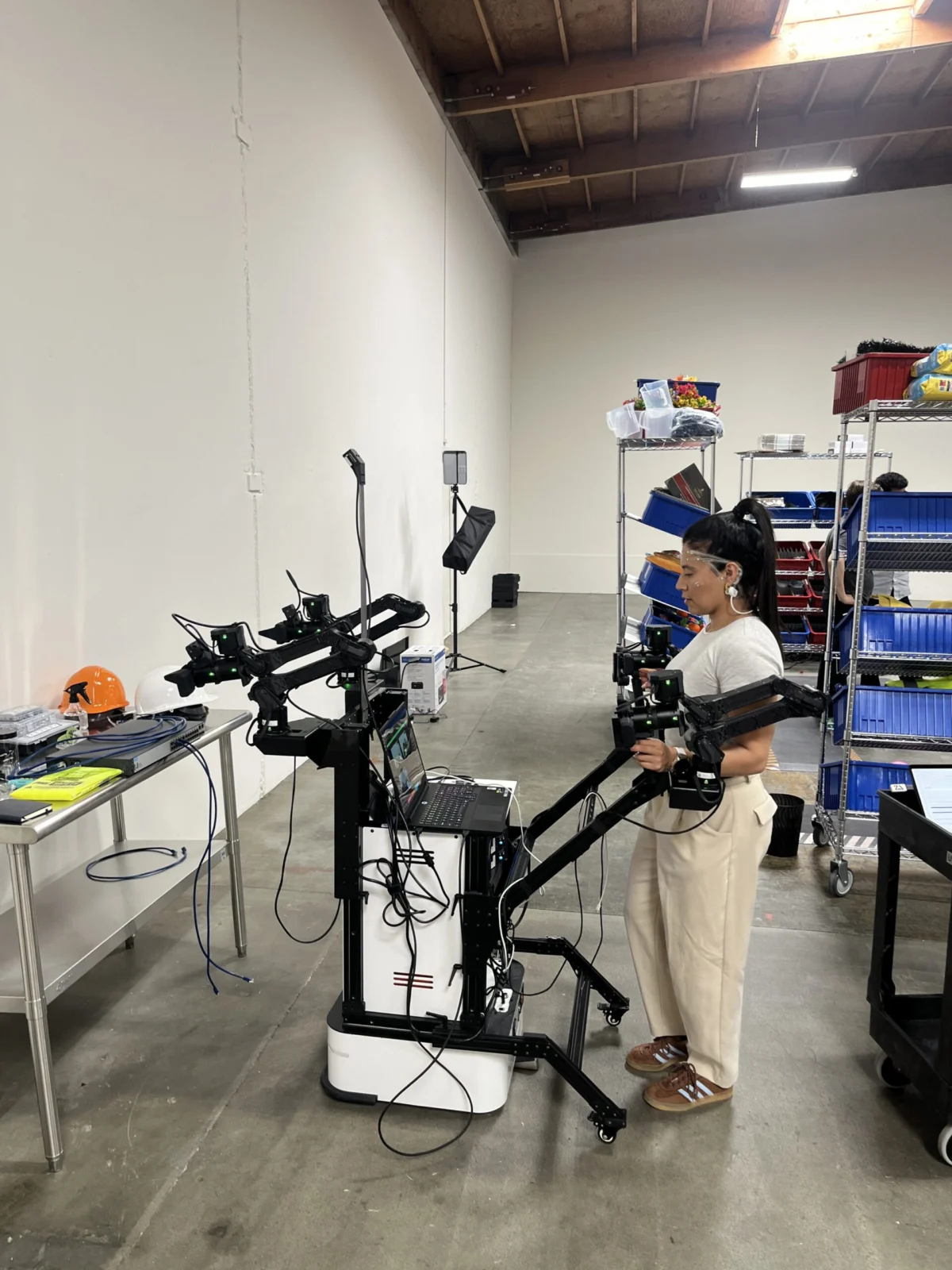
The cutting edge of physical artificial intelligence is currently being defined by a delicate Jenga game, meticulously orchestrated within a bustling warehouse in San Leandro, California. This facility, operated by Encord, a company traditionally known for its AI model training data tooling, has become a pivotal battleground in the race to overcome one of robotics’ most formidable challenges: the acute scarcity of high-fidelity, real-world physical training data. This challenge is not merely about collecting existing data; it’s about the laborious and innovative process of manufacturing it, piece by intricate piece.
At the heart of this endeavor is Andrew Ceja, one of Encord’s "pilots"—the company’s designation for its human robotic trainers. Ceja is engaged in the precise task of extracting wooden blocks from a precarious Jenga tower. His movements are captured by a specialized headset, which includes not only a camera tracking his visual field, a common method for robot training data collection, but also advanced sensors designed to measure his brain waves. This integration of electroencephalography (EEG) data marks a significant leap, aiming to imbue AI models with an understanding of human mental states such as error, intent, and surprise, derived directly from the source of human action.
The Unseen Bottleneck: Data Scarcity in Physical AI
The ambition to replicate the success of large language models (LLMs) in the realm of physical robotics has repeatedly encountered a fundamental obstacle: data. While LLMs were trained on the vast, readily accessible textual corpus of the internet, the physical world presents a far more complex and costly data acquisition landscape. Training neural networks to understand and execute physical manipulation tasks requires data that captures the nuances of real-world physics, varied environments, and the subtle dexterity of human interaction. Traditional methods, such as data collected by self-driving car companies, are difficult to scale across diverse robotic applications, and training solely from video often lacks the granular fidelity required for robust physical intelligence.
Encord, alongside a burgeoning number of innovative startups, is operating on the premise that the next significant constraint on the development of humanoid and warehouse robotics will not be the architectural sophistication of AI models, but rather the sheer dearth of relevant, high-quality physical training data. The company, which initially focused on helping clients annotate data and evaluate models for machine vision applications, recognized a critical gap as its customers, many of them leading robotics firms, began applying end-to-end learning to complex robotic manipulation tasks. Vineeth Velmurugan, Encord’s head of robot learning and a veteran of OpenAI’s robot lab and warehouse automation firm Berkshire Grey, emphatically states, "The data simply does not exist." This realization spurred Encord to pivot, building a dedicated internal team focused not just on managing data, but on actively manufacturing the specific datasets that the industry desperately needs.
Chronology of an Emerging Field
The journey towards sophisticated physical AI has been marked by several key developments:
- Early 2010s: The resurgence of deep learning, fueled by vast datasets like ImageNet and increased computational power, primarily focused on perception tasks (image recognition, natural language processing). Physical robotics, while advancing, largely relied on traditional control theory and specialized programming.
- Mid-2010s: Interest in "imitation learning" and "reinforcement learning" for robotics grows, recognizing the need for robots to learn from human demonstrations or trial-and-error in simulated or real environments. However, the data collection methods remained rudimentary and unscalable for general-purpose manipulation.
- Late 2010s: The success of large neural networks in other AI domains highlights the potential of data-driven approaches for robotics. Pioneering labs like OpenAI begin exploring "robot learning," emphasizing the need for diverse, high-volume interaction data.
- Early 2020s: The "data bottleneck" for physical AI becomes acutely apparent. Companies like Encord, initially serving as data tooling providers, identify the market need for generating specialized datasets rather than merely processing existing ones. This period also sees the rise of "egocentric" data collection methods.
- Present Day: The integration of advanced physiological sensors, such as Zander Labs’ brainwave headsets and Encord’s muscle activity sensors, represents the "bleeding edge" of this effort, aiming to create richer, more contextually aware datasets for training the next generation of dexterous and intelligent robots. The San Leandro warehouse is a testament to this ongoing evolution, continuously experimenting with novel modalities to push the boundaries of what’s possible.
Augmenting Reality: Brainwaves and Bio-Signals
The collaboration between Encord and Zander Labs epitomizes the innovative approaches required to solve the robotics data bottleneck. Zander Labs, a German neuroscience startup, has developed the brainwave headset worn by Encord’s pilots. This technology is designed to measure brain activity, providing insights into the user’s mental states—crucially, identifying moments of error, intent, and surprise. Lucas Gehrke, a Zander neuroscientist overseeing the project, explains that the varying levels of brain activity during a task can offer vital clues for model builders, indicating when and where their highest-effort models might need to be deployed for optimal performance.
This partnership is currently a trial run, with a clear objective: to build an initial brainwave-tagged dataset, test its efficacy by running it through customer robotics models, and then rigorously evaluate whether it genuinely improves robotic performance before any decision to scale up the technology. The implications, if successful, are profound. By understanding human cognitive states during task execution, robots could potentially learn to anticipate human actions, correct errors more intuitively, and adapt to unforeseen circumstances with greater agility—moving beyond mere imitation to a deeper comprehension of the underlying purpose and challenges of a task. Experts in neuro-robotics suggest that integrating bio-signals like EEG could lead to robots that are not only more capable but also more intuitive to interact with, as they might better infer human desires and frustrations.
Multi-Modal Data Generation: A Holistic Approach
Encord’s San Leandro facility serves as a vibrant laboratory for exploring and manufacturing a diverse array of data modalities. Beyond the pioneering brainwave integration, the company employs several other sophisticated methods to capture the complexity of human manipulation:
-
Egocentric Video Data: Collected by workers wearing cameras, often augmented with additional external camera angles and other metrics, this "first-person" perspective is invaluable. It provides robots with a direct view of how humans perceive and interact with their immediate environment during tasks. Encord sources this egocentric data from various factories worldwide, ensuring a broad and diverse dataset covering different operational contexts and object types. This allows robots to develop a more empathetic understanding of human interaction, crucial for collaborative tasks.
-
Leader-Follower Robotic Rigs: These setups involve paired robotic arms where one arm is directly controlled by a human operator, while the other precisely mimics its movements. This ingenious method allows for the generation of high-fidelity data on complex manipulation tasks. During a recent visit, pilots were observed using these rigs for tasks such as pouring coffee from a pot into mugs—a surprisingly challenging task due to the fluid dynamics and the need for careful balance—and stacking poker chips, which demands exceptional fine motor control and spatial reasoning. Velmurugan notes, "Every humanoid company has asked us for these pieces," underscoring the universal demand for data on such intricate, human-centric actions.
-
Forearm Muscle Sensors: Another novel data modality under development involves strapping sensors to a human forearm to detect electrical signals in muscles (electromyography or EMG). While video captures visual information, it often fails to fully depict the intricate movements and forces exerted by the entire hand. By correlating muscle activity with observed movements, Encord hopes to build a robust 3D depiction of the hand’s position and orientation at any given time. This richer understanding of human dexterity, force, and grip can then be transferred to robotic models, allowing them to replicate fine motor skills with unprecedented accuracy.
The warehouse itself is a physical manifestation of this data generation effort, stocked with a diverse array of everyday objects: cartons of fake flowers, books, plastic vegetables, kitty litter trays and scoops, bags, and bundles of wires. These mundane items are the "stock in trade" for training robotic manipulators for household chores and warehouse tasks, reflecting the varied and often unpredictable nature of real-world environments.
The Precision of Annotation: Bridging the Semantic Gap
Beyond raw data collection, Encord places a premium on detailed annotation. Each video segment in their datasets is meticulously tagged with precise physical descriptions, such as "right hand tightens bolt." This dense annotation is crucial for LLM-based models, providing them with the semantic context necessary to understand what is happening and why. Velmurugan estimates that this kind of detailed annotation is worth 100 times as much as "junky ego data" (unprocessed egocentric video) for training specific tasks. While it costs approximately 20 times more to produce, this trade-off is considered highly beneficial, dramatically increasing the efficiency and quality of the training process.
The economics of this specialized data generation stand in stark contrast to the data acquisition methods employed for LLMs. While LLM makers could scrape vast quantities of text from the internet, incurring minimal direct costs, manufacturing physical training data is inherently expensive. It requires specialized equipment, dedicated facilities, skilled human operators ("pilots"), and intensive annotation efforts. This fundamental difference underscores the limit of the "physical-AI-as-LLM" comparison; physical AI data must be deliberately engineered, not simply harvested, which fundamentally alters the economic model for building these advanced robotic systems. The need for a dataset perhaps five times the size of YouTube’s entire video corpus, as Velmurugan suggests, further explains why data generation itself has evolved from a research problem into a standalone, critical industry.
The Human Element: Pilots of the AI Frontier
The "pilots" at Encord’s facility, like Andrew Ceja and Sofia Infante, represent a burgeoning new workforce at the intersection of human skill and artificial intelligence. Infante, for instance, meticulously maneuvers robotic arms to plug and unplug ethernet cables from the back of a server rack—a task that data center operators would eagerly automate, provided robots could achieve the required precision and dexterity. Taking a turn behind the controls reveals the immense challenge: robotic pincers currently lack the fine motor control and the degrees of freedom inherent in human fingers and arms, making such tasks formidable.
These individuals are not merely data collectors; they are integral to developing the foundational building blocks for future neural networks. Both Infante and Ceja previously honed their skills at Scale, another prominent AI data annotation firm, before joining Encord. Ceja, whose earlier career included managing a robotic trash sorter at a waste management company, finds immense satisfaction in his current role. As the Jenga tower inevitably topples, he expresses the dynamic nature of his work: "It’s something new every day!" Their collective experience, combined with their hands-on interaction with the robotic systems, provides invaluable feedback loops that refine both the data collection methodologies and the eventual AI models.
Broader Implications and Encord’s Strategic Advantage
Encord’s unique position, operating at the nexus of numerous leading robotics companies, provides it with an unparalleled vantage point into the industry’s evolving landscape. Velmurugan notes that this visibility allows Encord to identify which data techniques and modalities are gaining traction and proving effective across various applications, often before any single customer can. This strategic insight enables Encord to proactively develop and offer the most impactful data solutions, cementing its role as a critical enabler for the advancement of physical AI.
The push for more dexterous and intelligent robots extends beyond industrial automation. The global robotics market, projected to reach hundreds of billions of dollars in the coming decade, is increasingly looking towards applications in healthcare, logistics, consumer services, and even domestic environments. The ability to perform complex manipulation tasks is central to unlocking these new frontiers. From assisting in surgical procedures to fulfilling e-commerce orders or even performing household chores, robots require an intuitive understanding of the physical world that can only come from rich, varied, and high-fidelity training data.
The meticulous, often unglamorous work being done in Encord’s San Leandro warehouse—whether it’s collecting brainwave data from a Jenga player or teaching a robot to pour coffee—is laying the groundwork for a future where robots are not just automated tools, but intelligent, adaptable collaborators. While the journey to truly autonomous, dexterous robots is long, the innovative approaches to data manufacturing, including the integration of bio-signals, are charting a clearer path forward, promising a future where physical AI can finally realize its full potential. The transformation of data generation into a specialized industry underscores its critical importance, signifying a paradigm shift in how we build and train the intelligent machines of tomorrow.