Sisilia Frederika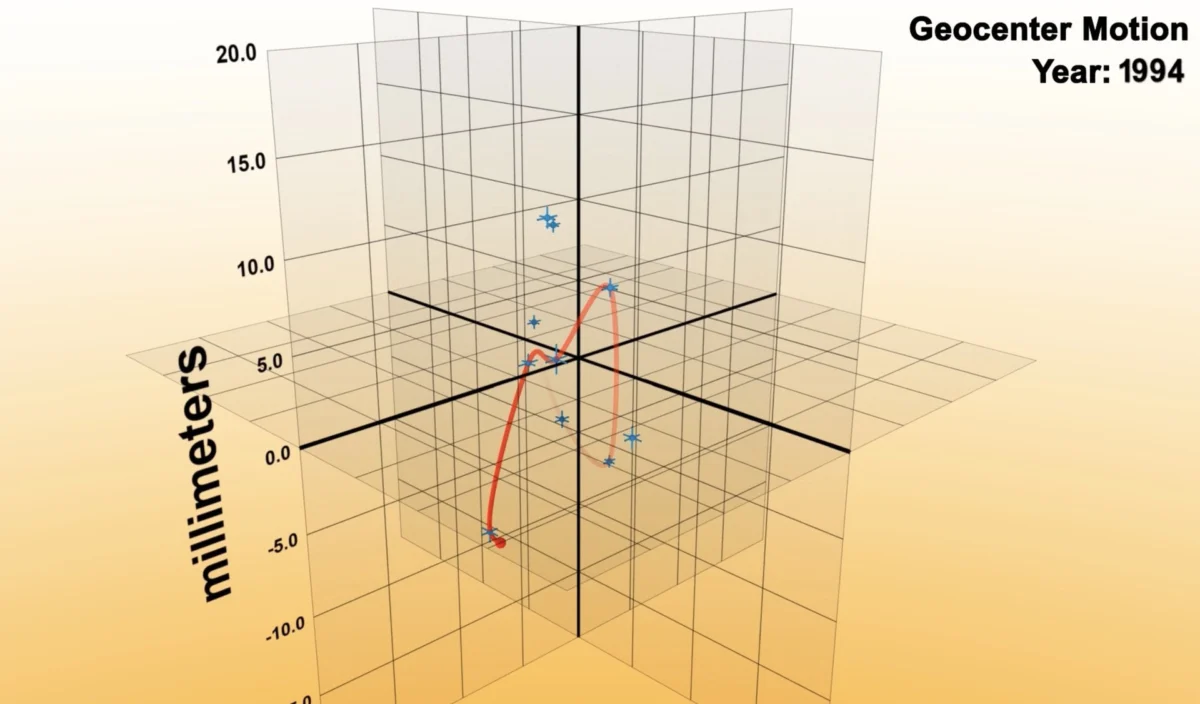
The determination of Earth’s exact center of mass is a fundamental challenge in the field of geodesy, carrying profound implications for our understanding of planetary dynamics, global navigation systems, and climate change monitoring. While the concept of a "center" might seem intuitive—a fixed point at the heart of the globe—the reality is far more complex. Earth is a dynamic, shifting entity, and its center of mass (CM) is in a state of constant, minute flux. A landmark study published in the Geophysical Journal International, led by Donald F. Argus and a team of researchers, has achieved a new level of precision in measuring this movement, revealing that the seasonal oscillation of the Earth’s center of mass is significantly smaller than previously estimated. This discovery challenges long-held assumptions about how mass, particularly water and air, moves between the Northern and Southern Hemispheres.
The Science of Geocenter Motion
To understand the significance of this research, one must first distinguish between the Center of Mass (CM) and the Center of Figure (CF). The Center of Mass is the point around which the planet’s total mass is balanced; it is the focal point for the orbits of all satellites. The Center of Figure, conversely, is the geometric center of the Earth’s surface. Because the Earth’s mass is not distributed uniformly and is constantly redistributed by natural processes—such as the melting of glaciers, the movement of atmospheric high-pressure systems, and the shifting of ocean currents—the CM moves relative to the CF. This phenomenon is known as "geocenter motion."
For decades, geophysicists have sought to measure this motion with millimeter-level accuracy. The geocenter serves as the origin point for the International Terrestrial Reference Frame (ITRF), the coordinate system used for all global positioning and mapping. If the origin point is inaccurately defined, every GPS coordinate on the planet is technically "off." The new study by Argus et al. utilizes advanced satellite data to reduce the uncertainty of this measurement to less than a millimeter, providing the most stable reference frame to date.
A Chronology of Precision: From LAGEOS to GPS
The quest to pinpoint the Earth’s center of mass has evolved alongside space-age technology. The timeline of this scientific endeavor reflects a steady progression toward higher resolution and lower margins of error.
The Era of Satellite Laser Ranging (1980s–1990s)
In the late 20th century, the primary tool for measuring geocenter motion was Satellite Laser Ranging (SLR). This involved the use of LAGEOS (Laser Geodynamics Satellites), which were essentially dense, spherical "disco balls" orbiting the Earth. These satellites were covered in retroreflectors designed to bounce laser pulses back to ground-based observatories. By measuring the time it took for a laser to travel to the satellite and back, scientists could calculate the satellite’s position—and by extension, the Earth’s center of mass—with an accuracy of approximately one to two centimeters.
The Integration of GRACE and GNSS (2000s–2010s)
The launch of the Gravity Recovery and Climate Experiment (GRACE) mission in 2002 revolutionized the field. GRACE consisted of two satellites that measured changes in Earth’s gravity field by tracking the distance between each other. This allowed scientists to see how mass was moving on the surface (such as ice loss in Greenland). When combined with Global Navigation Satellite System (GNSS) data, researchers began to realize that the CM was more volatile than the LAGEOS data alone suggested.
The Modern Breakthrough (2020s)
The latest study represents the pinnacle of this technological evolution. By integrating high-precision GPS data from thousands of ground stations with data from a diverse fleet of low-Earth orbit (LEO) satellites, the researchers were able to account for the "wobble" of the ground stations themselves. Earthquakes, volcanic activity, and even the "rebound" of the Earth’s crust following the last Ice Age (post-glacial rebound) can move ground-based observatories. By correcting for these tiny shifts, the team achieved sub-millimeter accuracy in defining the relationship between the CM and CF.
The Mechanics of Seasonal Drift
The Earth’s center of mass does not drift randomly; it follows a predictable seasonal cycle driven by the redistribution of fluids on the planet’s surface. The study identifies several primary drivers of this oscillation:
- The Cryospheric Cycle: During the Northern Hemisphere’s winter, massive amounts of water are sequestered as snow and ice across Siberia, Canada, and the Arctic. This accumulation of mass in the north pulls the Earth’s center of mass toward the North Pole.
- Hydrological Shifting: The rainy seasons in tropical regions, most notably the Amazon Basin, move trillions of tons of water. As water moves from the oceans to river deltas and floodplains, the local mass increases, causing a corresponding shift in the geocenter.
- Oceanic Density Changes: The warming and cooling of the oceans alter water density. Thermal expansion (steric changes) and the movement of saline currents change the distribution of mass within the basins of the Atlantic, Pacific, and Indian Oceans.
- Atmospheric Pressure: While air is light, the total mass of the atmosphere is significant. Seasonal shifts in high- and low-pressure systems, particularly the Siberian High, contribute to the tug-of-war on the planet’s center.
Challenging Previous Estimates: The "Half-Scale" Discovery
The most surprising finding of the Argus et al. study is that the seasonal drift of the center of mass is roughly 50% smaller than previous models suggested. Earlier estimates posited a more dramatic "sloshing" of mass between the hemispheres. The refined data indicates that the Earth’s hemispheres are less "interconnected" in terms of mass exchange than previously assumed.
This suggests that the movement of water and air across the equator is more constrained. For climate scientists, this is a pivotal piece of data. It implies that mass variations in the Northern Hemisphere—such as the rapid melting of Arctic sea ice—may have a more localized gravitational impact than a global one. The "half-scale" discovery forces a re-evaluation of global hydrological models and how we calculate the total volume of water moving through the global water cycle.
Implications for Global Infrastructure and Navigation
Precision in geocenter measurement is not merely an academic exercise; it has tangible consequences for modern civilization. The stability of the International Terrestrial Reference Frame (ITRF) is essential for several critical sectors:
Autonomous Systems and Transportation
As the world moves toward autonomous shipping, aviation, and self-driving vehicles, the requirement for precision increases. A centimeter-level error in the global coordinate system could lead to significant navigation failures over long distances. Sub-millimeter accuracy ensures that the digital maps used by these systems remain perfectly aligned with the physical world.
Satellite Constellation Management
Modern life relies on satellite constellations for everything from telecommunications to weather forecasting. These satellites must constantly adjust their orbits to account for the Earth’s gravitational pull. Knowing the exact center of that pull allows for more efficient fuel usage and longer lifespans for multi-billion-dollar satellite networks.
Sea-Level Rise Monitoring
To measure sea-level rise accurately, scientists must know if the sea is rising or if the land is sinking. This requires a fixed "zero point." If the center of mass is not correctly identified, the "vertical datum" (the baseline for height) is flawed. The new, more accurate measurements allow climate scientists to distinguish between actual increases in ocean volume and the vertical movement of the Earth’s crust.
Geological Events and Rotational Velocity
Beyond seasonal changes, the study also tracked long-term shifts in the center of mass caused by "solid Earth" events. Large-scale geological phenomena, such as the 2011 Tōhoku earthquake in Japan or major volcanic eruptions, redistribute mass within the Earth’s crust and mantle.
The researchers noted that these shifts, while permanent, also influence the Earth’s rotational speed. This is known as the "figure skater effect"—just as a skater spins faster when pulling their arms in, the Earth’s rotation speeds up or slows down when mass moves closer to or further from its axis. While these changes only affect the length of a day by microseconds, they are critical for the synchronization of atomic clocks and the maintenance of Universal Coordinated Time (UTC).
Future Outlook: A More Stable Earth Model
The findings published in the Geophysical Journal International provide a new benchmark for geophysics. By proving that the seasonal oscillation is smaller than expected, the research opens new questions about the viscosity of the Earth’s mantle and the efficiency of global atmospheric circulation.
As sensor technology continues to improve, the next step for researchers will be to monitor these shifts in real-time. Future missions, such as the planned successors to the GRACE-FO (Follow-On) satellites, will likely incorporate the findings of Argus et al. to further refine our planetary model.
In a world increasingly dependent on precise data, the ability to pinpoint the "middle of the Earth" to within a fraction of a millimeter is more than a feat of engineering; it is a vital necessity for understanding the past, present, and future of our changing planet. The Earth is a restless body, but thanks to this new level of precision, we are closer than ever to understanding the rhythm of its heart.