Sisilia Frederika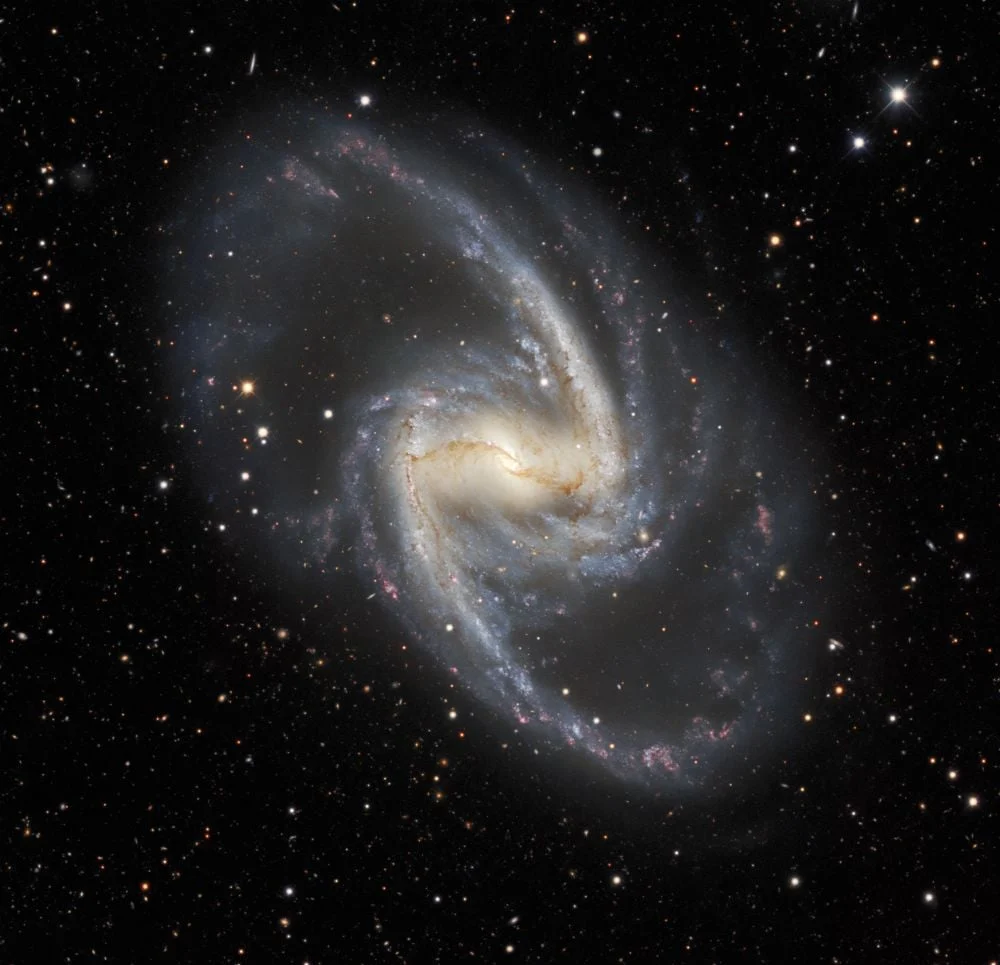
A team of international researchers led by the Center for Astrophysics | Harvard & Smithsonian (CfA) has successfully reconstructed the multi-billion-year evolutionary history of a distant spiral galaxy using a technique known as "galactic archaeology." By analyzing the chemical fingerprints left behind by ancient generations of stars, scientists have mapped the growth of NGC 1365, a massive barred spiral galaxy located approximately 56 million light-years from Earth. This study, published in the journal Nature Astronomy under the title "The assembly history of NGC 1365 through chemical archaeology," represents a significant milestone in extragalactic research, as it marks the first time such a high-resolution chemical analysis has been applied to a galaxy outside our own Milky Way.
The research, led by Professor Lisa Kewley, Director of the CfA and a prominent Australian astrophysicist, utilizes oxygen abundances as "archaeological tracers" to determine how and when different parts of the galaxy formed. By combining observational data from the TYPHOON survey with sophisticated magnetohydrodynamical simulations from the Illustris TNG project, the team identified three distinct phases of growth that shaped NGC 1365 into the "Great Barred Spiral" seen today.
The Science of Galactic Archaeology and Oxygen Tracers
Galactic archaeology is founded on the principle that stars are celestial time capsules. When a star forms from a collapsing cloud of interstellar gas, it preserves the chemical composition of that gas at that specific moment in time. By measuring the "metallicity"—the abundance of elements heavier than hydrogen and helium—astronomers can deduce the conditions of the galaxy during various epochs.
Oxygen serves as a particularly effective tracer for tracking rapid star formation. In the cosmic lifecycle, oxygen is synthesized primarily within massive stars, specifically those with more than eight times the mass of our Sun. These "stellar giants" live fast and die young, exhausting their nuclear fuel in just a few million years before exploding as Type II supernovae. These explosions blast oxygen and other heavy elements back into the interstellar medium at high velocities. Because the lifespan of these stars is negligible on a galactic timescale, the buildup of oxygen acts as a real-time indicator of where stars were forming most intensely.
In a theoretically "undisturbed" galaxy—one that grows solely through internal processes without external interference—astronomers expect to see a clear radial gradient. Oxygen levels should be highest at the dense galactic center, where star formation is most frequent, and decline steadily toward the sparser outer edges. When this gradient is disrupted, flattened, or inverted, it serves as a "smoking gun" for external events, such as mergers with other galaxies or the massive infall of primordial gas from the intergalactic medium.
Observing the Great Barred Spiral: The TYPHOON Survey
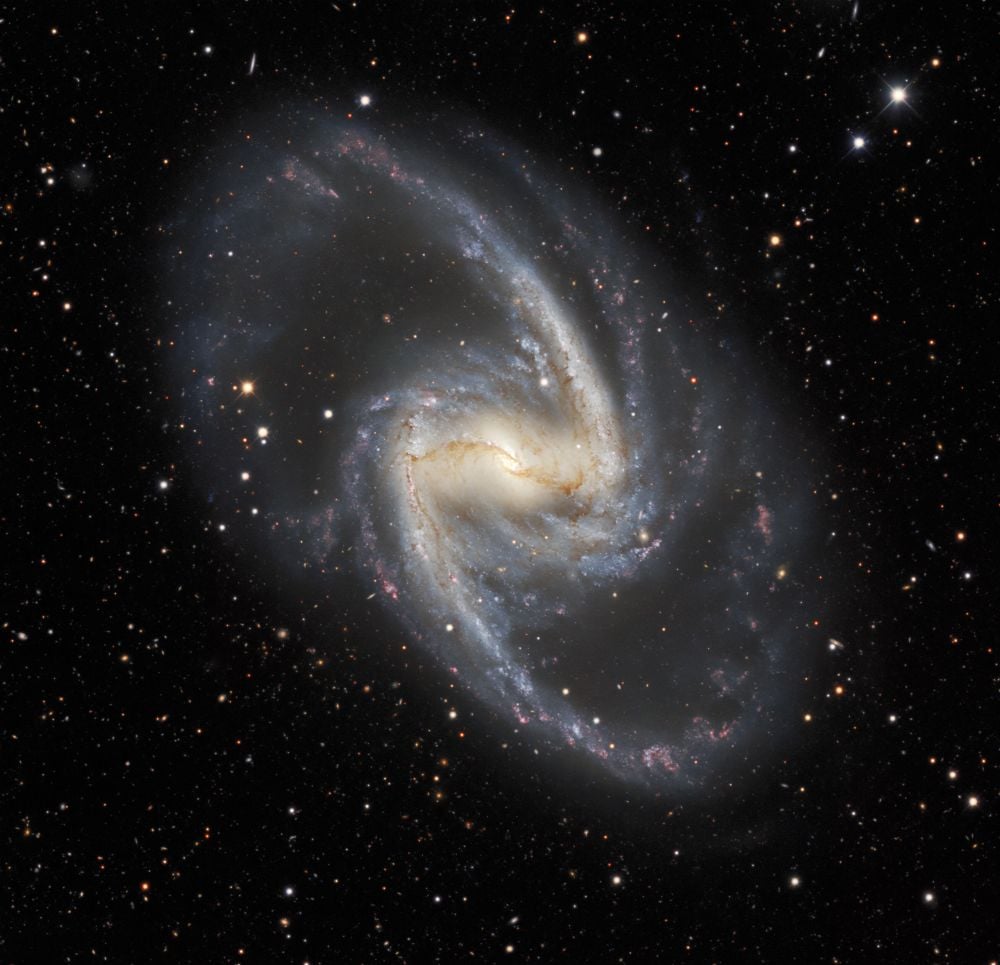
NGC 1365, situated in the Fornax Cluster, is a premier subject for such a study. Known as the Great Barred Spiral Galaxy, its prominent central bar and sweeping spiral arms provide a complex structural canvas for archaeologists to investigate. However, at a distance of 56 million light-years, resolving individual stars is currently beyond the capabilities of even the most advanced telescopes.
To overcome this hurdle, the research team utilized data from the TYPHOON survey, a collaborative effort involving the Carnegie Institute of Science, the Institute for Basic Science in Korea, and the Australian National University. TYPHOON uses a technique called "spaxel" (spatial pixel) analysis, which allows astronomers to capture spectroscopic data across the entire face of a galaxy. Rather than looking at a single point, the team derived gas-phase oxygen abundances for 4,546 individual spaxels across NGC 1365.
This approach provided a spatial resolution of approximately 175 parsecs—a level of detail that allows scientists to see how chemistry varies across the galaxy’s disk, bar, and spiral arms without needing to see every individual star. This "resolved" view of star formation history provides a chemical fossil record that is among the most detailed ever obtained for an extragalactic object.
A Three-Act History of Galactic Assembly
By comparing the TYPHOON observational data with more than 20,000 simulations from the Illustris TNG project—a large-scale cosmological simulation suite—the researchers identified a specific model (TNG0053) that closely mirrored the physical and chemical properties of NGC 1365. This comparison allowed them to reconstruct a timeline of the galaxy’s assembly spanning over 12 billion years.
Phase I: The Primordial Disk (11.9 to 12.5 Billion Years Ago)
The earliest era of NGC 1365 was defined by violent consolidation. Between 11.9 and 12.5 billion years ago, the main galactic disk began to take shape. This was not a peaceful process of gradual gas accumulation; instead, the simulations suggest the disk was formed through a series of mergers with multiple dwarf galaxies. These early collisions provided the raw material and gravitational turbulence necessary to establish the foundation of the spiral structure.
Phase II: The Rise of the Central Bar (Last 12 Billion Years)
Following the initial disk formation, the galaxy entered a long period of internal reorganization. Over the last 12 billion years, a steep oxygen gradient began to develop in the inner regions. This was driven by the formation of the galaxy’s massive central bar. The bar acts as a gravitational funnel, drawing gas from the outer reaches of the galaxy toward the center. This influx of fuel triggered intense bursts of star formation in the core, leading to a rapid buildup of oxygen and creating the "steep" chemical profile observed by the TYPHOON survey.
Phase III: The Minor Merger and the Extended Disk (5.9 to 8.6 Billion Years Ago)
The final major chapter in the galaxy’s history occurred more recently, between 5.9 and 8.6 billion years ago. The research indicates that a minor merger—a collision with a smaller but significant satellite galaxy—disrupted the outer regions of NGC 1365. This event led to the assembly of an "extended ionized gas disk." Unlike the central regions, this outer disk exhibits "flat" oxygen abundances, a characteristic sign that the gas was mixed or deposited by an external source rather than forming through the galaxy’s internal star-formation cycles.
The Intersection of Theory and Observation
The success of this study highlights a shifting paradigm in modern astrophysics: the total interdependence of observational data and theoretical modeling. As lead author Lisa Kewley noted, the project was split equally between theory and observation. Without the TYPHOON data, the simulations would have no real-world anchor; without the Illustris TNG simulations, the oxygen maps of NGC 1365 would be a "snapshot" without a clear narrative of how they came to be.
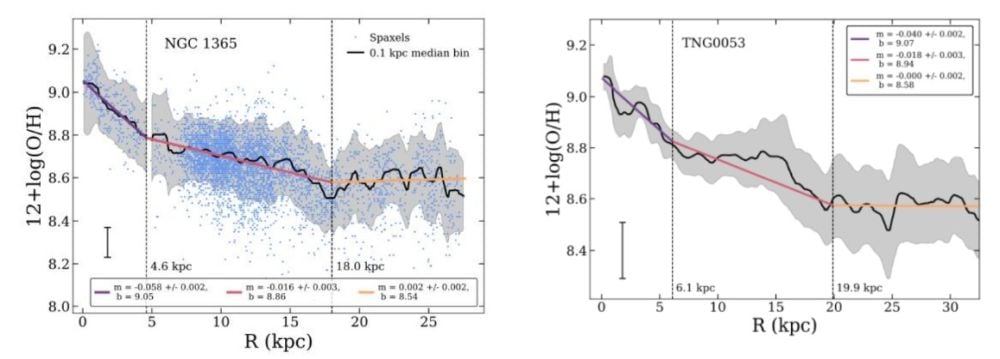
"Tracking the dynamical history of a galaxy from a single snapshot in time is notoriously difficult," the authors wrote in their paper. The simulations provide the necessary context to rule out alternative histories. For instance, while a flat oxygen gradient could theoretically be caused by internal gas churning, the Illustris TNG models allowed the team to confirm that a minor merger was the most statistically and physically plausible explanation for the specific patterns observed in NGC 1365.
Lars Hernquist, a Professor of Astrophysics at Harvard and a pioneer in galactic simulations, emphasized the importance of this validation. "It’s very exciting to see our simulations matched so closely by data from another galaxy," Hernquist said. "This study shows that the astronomical processes we model on computers are shaping galaxies like NGC 1365 over billions of years."
Implications for the Milky Way and Future Research
The implications of this work extend far beyond the Fornax Cluster. For decades, the Milky Way has been our primary laboratory for galactic archaeology because we can resolve its individual stars. However, studying our own galaxy is akin to trying to map a forest while standing in the middle of the trees—our perspective is limited and often obscured by cosmic dust.
By proving that chemical archaeology can be performed on distant galaxies with "fine detail," Kewley and her team have opened a new window into "Near-Field Cosmology." This field seeks to answer fundamental questions about the universe’s evolution by looking at the detailed structures of nearby galaxies.
The research raises vital questions about the "typicality" of our own home. "Do all spiral galaxies form in a similar way?" Kewley asked. "Are there differences between their formation? Where is their oxygen distributed now? Is our Milky Way different or unique in any way?"
If the Milky Way followed a similar three-stage path—early dwarf mergers, bar-driven growth, and later minor accretions—it would suggest a universal blueprint for spiral galaxy evolution. If not, it suggests that the environment of a galaxy, such as its membership in a cluster like Fornax versus a smaller group like our Local Group, plays a decisive role in its chemical destiny.
As telescopes like the James Webb Space Telescope (JWST) and the upcoming Extremely Large Telescopes (ELTs) continue to push the boundaries of resolution, the methods pioneered in this study will likely be applied to hundreds of other galaxies. This will allow astronomers to move from studying "individual cases" to building a comprehensive statistical history of the universe’s most beautiful structures. For now, the Great Barred Spiral stands as a testament to the power of combining ancient chemical fingerprints with modern supercomputing to tell a story 12 billion years in the making.