Sisilia Frederika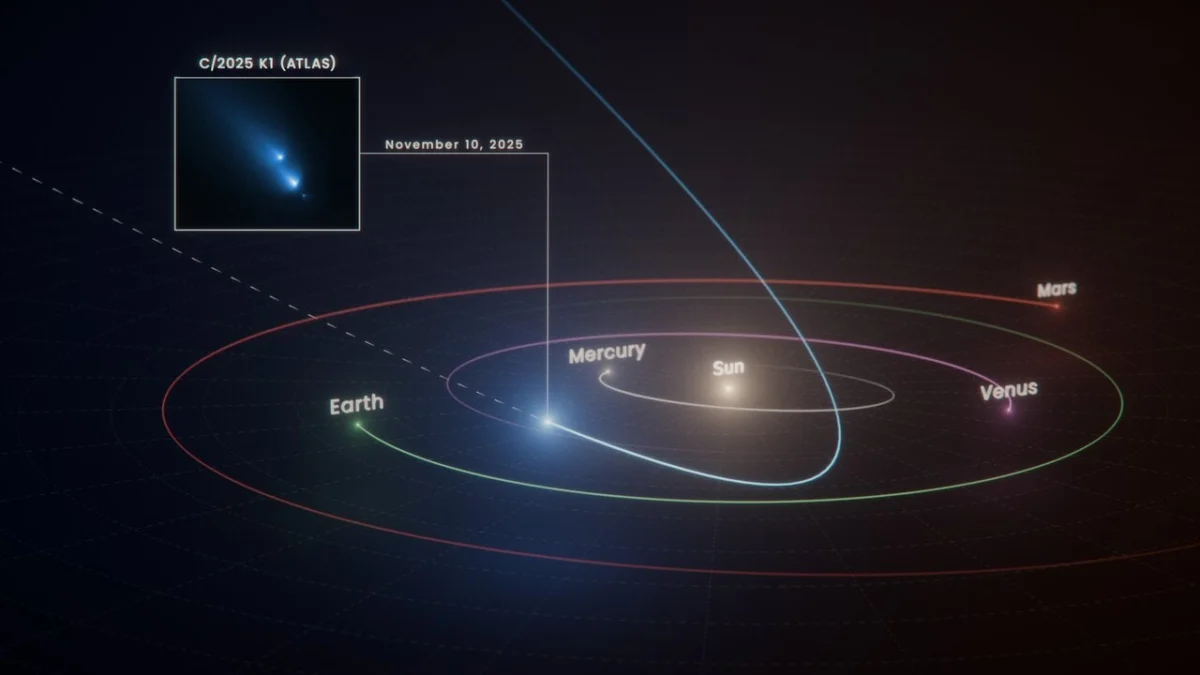
In the rigorous world of professional astronomy, discoveries are typically the culmination of decades of theoretical modeling, international lobbying for telescope time, and precision engineering. However, the history of science is also punctuated by moments of pure, unadulterated luck. Such was the case with the recent observation of Comet C/2025 K1 (ATLAS), a celestial wanderer from the furthest reaches of our solar system that decided to disintegrate precisely when one of humanity’s most powerful orbital observatories was pointed toward it.
The observation, detailed in a new study published in the journal Icarus, represents a significant milestone in cometary science. Led by Dennis Bodewits, a professor in Auburn University’s Department of Physics, a team of researchers captured high-resolution images of Comet K1 as it fractured into multiple distinct pieces. The event has provided a rare, unobstructed view into the internal structure of a "dynamically new" comet—an object making its first-ever foray into the inner solar system from the Oort Cloud.
A Serendipitous Scientific Breakthrough
The path to this discovery began not with a plan to observe a fragmentation event, but with a technical failure. The research team had originally secured highly competitive observing time on the Hubble Space Telescope (HST) to study a completely different comet. However, as the scheduled observation window approached, unforeseen technical constraints rendered the original target unviewable. Facing the loss of precious telescope time, the team was forced to scramble for an alternative.
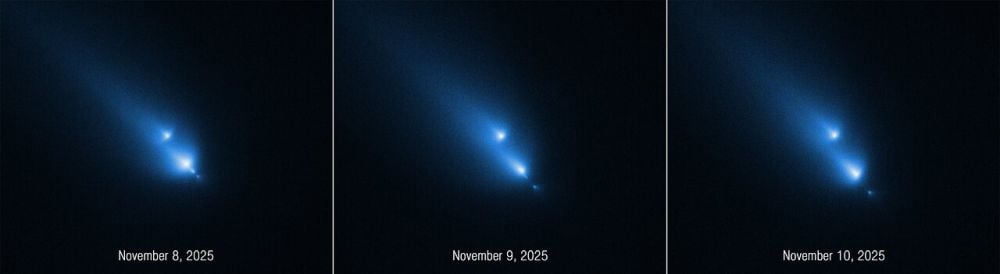
They settled on C/2025 K1 (ATLAS), a comet that had recently passed its closest point to the Sun. What happened next was described by co-author John Noonan, also a professor at Auburn University, as the "slimmest of slim chances." As the Hubble’s Space Telescope Imaging Spectrograph (STIS) focused on the object between November 8 and 10, 2025, the comet began to break apart.
When Noonan reviewed the data the following day, he realized they had captured something extraordinary. Instead of the single nucleus they expected to see, the images revealed four distinct fragments—later confirmed to be five—drifting apart in a slow-motion cosmic explosion. The timing was impeccable; the team had caught the comet just days after the initial disruption began, providing a "high-resolution view of a nucleus in the process of disruption" that is rarely, if ever, seen so early in the process.
The Journey from the Oort Cloud
Comet C/2025 K1 (ATLAS) is classified as a non-periodic comet, meaning it does not follow a regular, repeating orbit like the famous Halley’s Comet. Instead, it originated in the Oort Cloud, a theoretical, spherical shell of icy debris located between 2,000 and 100,000 astronomical units (AU) from the Sun. For context, 1 AU is the distance between the Earth and the Sun.
Objects in the Oort Cloud are considered the "refrigerators" of the solar system. They are composed of primordial material—ice, dust, and frozen gases—that has remained largely unchanged since the solar system’s formation approximately 4.5 billion years ago. When a gravitational nudge from a passing star or the galactic tide sends one of these objects tumbling toward the Sun, it becomes a "dynamically new" comet.
As these objects enter the inner solar system, they undergo a violent transformation. The Sun’s heat causes volatile ices to sublimate (turn directly from solid to gas), creating the characteristic coma and tail. However, this process also alters the comet’s surface. Decades of exposure to cosmic rays and the sudden onset of solar heating create a weathered "crust" that hides the pristine material inside. This creates a fundamental challenge for astronomers: it is difficult to determine which properties of a comet are original and which are the result of recent environmental processing.
The Mechanics of Fragmentation
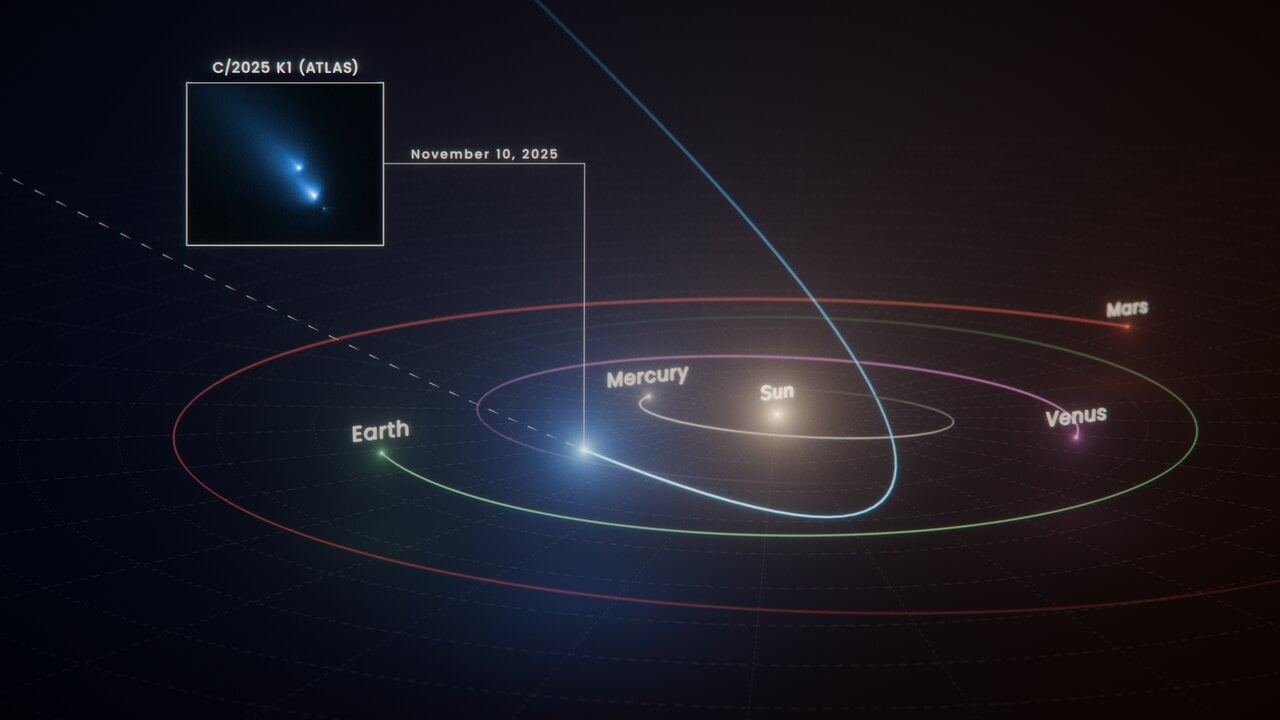
Fragmentation is often the "evolutionary end state" for many long-period comets. As Comet K1 approached its perihelion—its closest approach to the Sun—on October 8, 2025, it was subjected to immense physical stress. At a distance of just 0.33 AU (roughly the orbit of Mercury), the thermal gradient across the nucleus became extreme.
The researchers estimate that prior to its breakup, Comet K1 was approximately 8 kilometers in diameter. While smaller than giants like Comet Hale-Bopp (60 km), it was still a substantial body. The breakup was likely driven by several factors:
- Thermal Stress: The rapid heating of the exterior caused expansion and cracking.
- Internal Pressure: Sublimating ices trapped beneath the surface crust can build up pressure until the nucleus structurally fails.
- Rotational Spin-up: As a comet outgasses, the jets of vapor can act like small thrusters. If these jets are asymmetric, they can cause the comet to spin faster and faster until centrifugal forces literally pull it apart.
The authors of the research paper describe the event as a "nucleus-wide mechanical failure." The fact that the comet shattered into multiple pieces suggests that its interior was not a monolithic block of ice but rather a "heterogeneously mixed" collection of ices and dust. The fragments showed varying levels of activity, indicating that water ice and carbon dioxide were not evenly distributed throughout the body.
Chronology of the Event
The observation of Comet K1’s demise was a multi-observatory effort. While the Hubble provided the high-resolution "close-ups," ground-based assets provided the necessary context and early warnings.
- October 8, 2025: Comet K1 reaches perihelion at 0.33 AU.
- November 2–4, 2025: The Las Cumbres Observatory (LCO) Outbursting Objects Key Project detects a massive increase in the comet’s activity. Monitoring reveals rapid changes in the shape and brightness of the coma, signaling the beginning of a major structural event.
- November 8, 2025: The Hubble Space Telescope begins its serendipitous observation. The first images show Fragment I intact.
- November 9, 2025: Hubble captures Fragment I splitting into two smaller pieces, labeled IIa and IIb.
- November 10, 2025: Further imaging shows Fragment IIb brightening and developing its own coma, while other fragments, such as Fragment III, begin to dim as they deplete their volatile reserves.
This timeline is crucial because Hubble caught the fragmentation within a 1-to-3-day window of the event. Most previous observations of fragmenting comets have occurred weeks or months after the fact, by which time the "fresh" evidence has already been obscured by new dust and gas.
The Mystery of the Delayed Dust Activation
One of the most intriguing findings from the Bodewits team involves the timing of the comet’s brightness. Conventionally, scientists expected that as a comet breaks apart, the exposure of fresh, "clean" ice would cause an immediate and dramatic increase in brightness. However, with Comet K1, there was a puzzling delay between the physical breakup and the subsequent bright outbursts.
The researchers propose two possible explanations for this lag. First, it may be a matter of "dust physics." It is possible that it takes several days for a substantial layer of light-reflecting dust to form on the newly exposed surfaces before it can be ejected by escaping gas. Second, it may be a "thermal lag" issue. It takes time for solar heat to penetrate the newly exposed interior surfaces deeply enough to trigger the sublimation of buried volatile reservoirs.
"We may be seeing the timescale it takes to form a substantial dust layer that can then be ejected by the gas," Noonan explained. Understanding this delay is vital for interpreting the light curves of other comets and for planning future "intercept" missions to primitive bodies.
Chemical Anomalies and Interstellar Questions
Beyond the physical breakup, the chemical composition of Comet K1 has raised eyebrows in the astronomical community. Ground-based spectra taken before the perihelion revealed that the comet was extremely depleted in carbon-bearing species. Specifically, it showed one of the lowest ratios of cyanogen to hydroxyl (CN/OH) ever recorded.
Such chemical anomalies are rare and are usually only seen in "chemically anomalous" comets. Some researchers have suggested that such extreme carbon depletion could even be a sign of an extrasolar origin—meaning the comet might have formed around a different star before being captured by our Sun or passing through our system. While Comet K1 is currently considered a member of the Oort Cloud, its unique chemistry suggests it may have formed in a very different environment than most other comets in our solar system.
Broader Impact and Future Research
The fragmentation of Comet C/2025 K1 (ATLAS) is more than just a spectacular visual event; it is a "natural laboratory" for understanding the building blocks of planets. By watching the comet crumble, scientists are essentially performing a remote autopsy on a 4.5-billion-year-old specimen.
The study of these fragments allows researchers to probe the "volatile reservoirs" of the early solar system. If the different chunks of the comet behave differently—as they did in this case—it proves that the primordial disk from which the planets formed was a chaotic, poorly mixed environment.
The research team is not finished with Comet K1. While the current paper focuses on the imaging and the physical timeline of the breakup, data from Hubble’s Cosmic Origins Spectrograph (COS) is still being analyzed. This data is expected to provide a high-resolution chemical map of the fragments, potentially settling the debate over the comet’s unusual carbon levels and its ultimate origin.
As the fragments of Comet K1 continue to drift away and fade into the darkness of the outer solar system, they leave behind a wealth of data that will occupy researchers for years. This "happy accident" with the Hubble Space Telescope has once again proven that in the vastness of space, being in the right place at the right time is just as important as having the right equipment. For the team at Auburn University, a technical failure on one target led to a career-defining observation of another, reminding the scientific community that the universe often reveals its deepest secrets when we least expect it.