Sisilia Frederika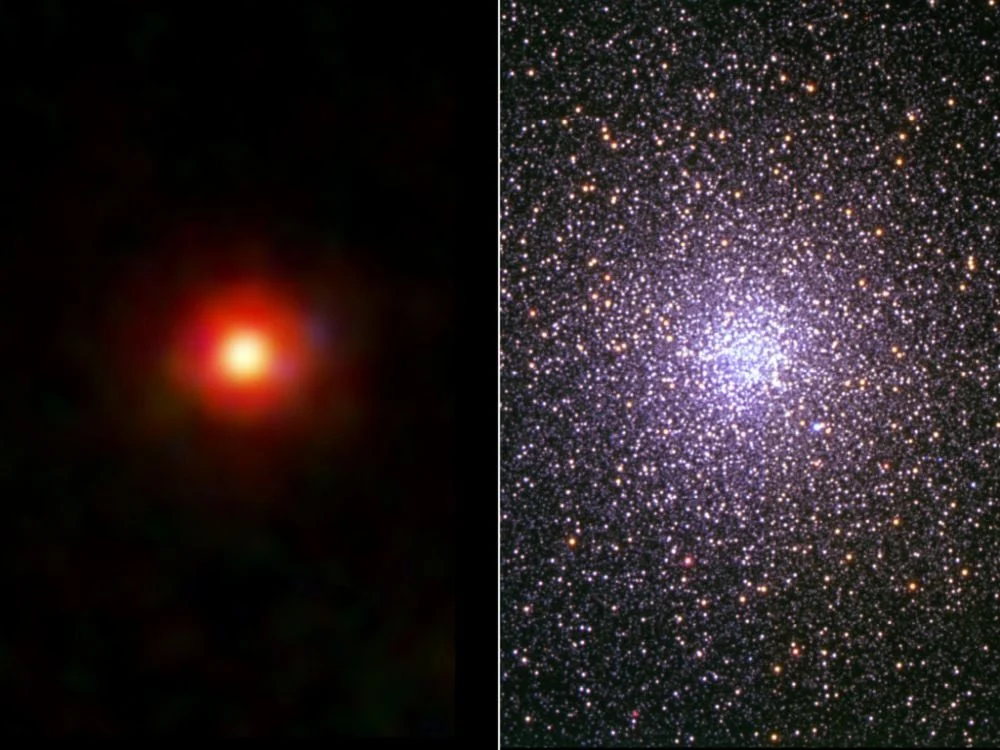
The age-old idiom of killing two birds with one stone describes the rare efficiency of a single solution resolving two distinct problems. In the realm of modern astrophysics, this concept has taken center stage as a team of researchers proposes a unified explanation for two of the most persistent mysteries in the study of the cosmos. By linking the "Little Red Dots" (LRDs) recently discovered by the James Webb Space Telescope (JWST) to the ancient globular clusters found in the peripheries of modern galaxies, astronomers may have found a missing link in the evolution of the universe.
The study, led by John Chisholm, an astronomer at the University of Texas at Austin, and published in The Astrophysical Journal Letters, suggests that the enigmatic, glowing red objects seen in the early universe are actually the chaotic, high-energy birthplaces of the globular clusters we observe today. This hypothesis not only provides a source for the LRDs but also solves a decades-old puzzle regarding the strange chemical compositions found within globular clusters.
The Discovery of Little Red Dots
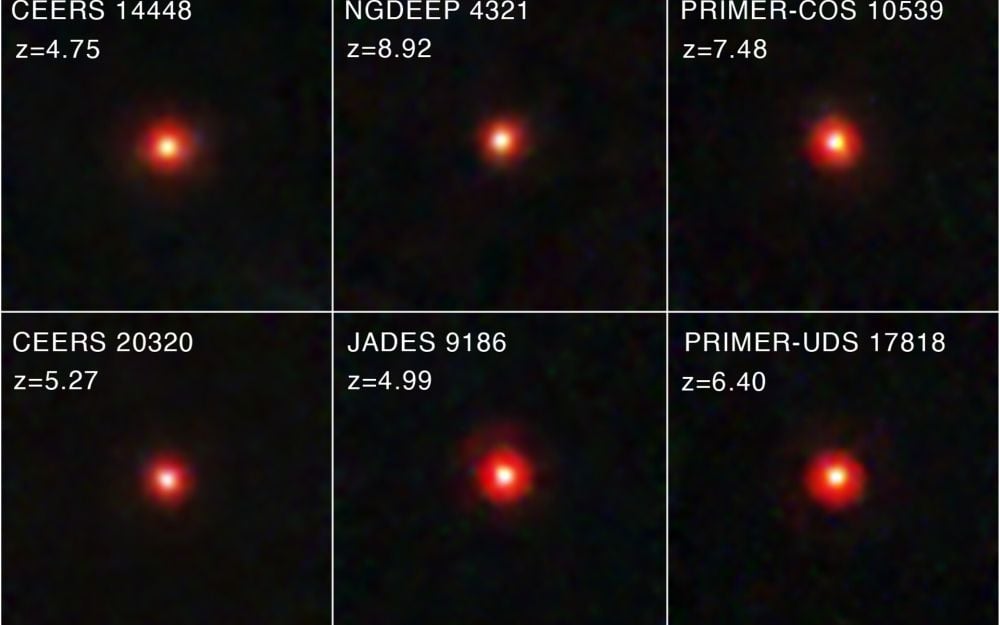
The James Webb Space Telescope, since its deployment and the subsequent release of its first deep-field images, has consistently challenged existing models of the early universe. Among its most surprising finds are the "Little Red Dots." These objects, first formally reported in early 2024, appeared in abundance in observations of the universe as it existed between 12.2 and 13.2 billion years ago—roughly 600 million to 1.5 billion years after the Big Bang.
LRDs are characterized by their extreme compactness and their distinct "V-shaped" spectral morphology. To the infrared eyes of the JWST, they appear as tiny, point-like sources with a deep red hue. Initially, astronomers speculated that these could be small, extremely dense galaxies, primordial supermassive black holes (active galactic nuclei), or perhaps even a previously unknown class of stellar objects. However, the sheer number of these dots and their rapid emergence and subsequent decline in the early cosmic timeline suggested a specific, temporary phase of galactic or stellar evolution.
The Enigma of Modern Globular Clusters
While LRDs represent a new mystery, globular clusters (GCs) are a long-standing one. These are spherical collections of hundreds of thousands to several million stars, gravitationally bound into a tight unit. They are found in the halos of almost every major galaxy; the Milky Way alone hosts at least 150 of them.
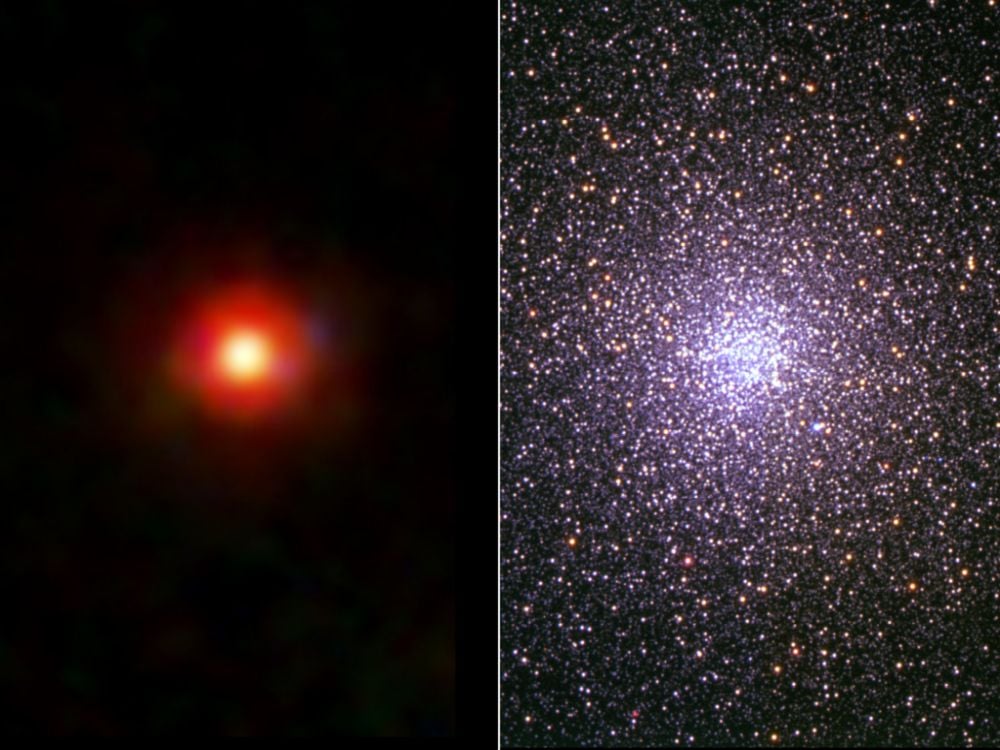
Globular clusters are among the oldest known structures in the universe. Their stars are characterized by low metallicity, meaning they contain very few elements heavier than hydrogen and helium, which suggests they formed in the very early stages of cosmic history. However, they present a chemical paradox known as the "Multiple Stellar Population" problem.
In a typical star cluster, one would expect all member stars to share a nearly identical chemical signature, as they presumably formed from the same cloud of gas at the same time. Instead, astronomers find that globular clusters contain stars with wildly varying amounts of certain elements. Specifically, they show an abundance of helium, nitrogen, sodium, and aluminum, while being depleted in carbon, oxygen, and magnesium. This specific "fingerprint" requires nuclear fusion at temperatures far exceeding those found in the cores of standard massive stars, leaving scientists to wonder what kind of environment could have produced such a result.
The Supermassive Star Hypothesis
The research conducted by Chisholm and his colleagues, including co-authors Danielle Berg and Mike Boylan-Kolchin, posits that the missing link is a "Supermassive Star" (SMS). According to their model, during the formation of a globular cluster, the environment was so dense that stars frequently collided and merged. This process could result in the creation of a single, titanic star at the center of the cluster, possessing a mass thousands of times greater than that of our Sun.
"A supermassive star is precisely the kind of environment that could produce this combination [of chemicals]," noted Mike Boylan-Kolchin. These stars would be hot enough to synthesize the specific elements—like sodium and aluminum—that have puzzled astronomers for decades.
However, these behemoths would be inherently unstable and short-lived. A supermassive star would burn through its nuclear fuel at an incredible rate, likely lasting only a few million years before collapsing or exploding. "When they die, they would blow that material back out, seeding the next generation of stars with the chemical fingerprints we still see in globular clusters today," explained Danielle Berg.
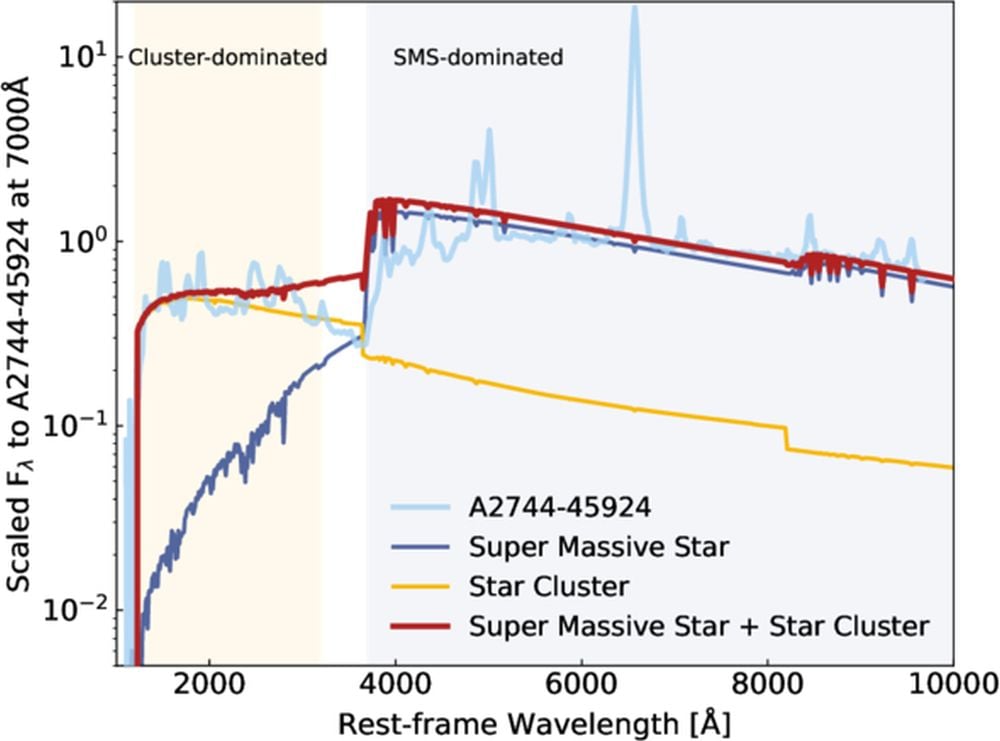
The UT Austin team suggests that it is these supermassive stars, situated within a dense, forming cluster, that give the LRDs their unique appearance. The intense radiation from the SMS, combined with the surrounding stellar population and potentially thick shrouds of dust, would produce the specific "V-shaped" light spectrum observed by the JWST.
Quantitative Evidence: Mass Functions and Spectral Matching
To move beyond theoretical plausibility, the researchers employed rigorous mathematical modeling to compare the LRDs with local globular clusters. Their primary evidence rests on two pillars: spectral profiles and mass density.
Spectral Profiles
The researchers compared the light signature of a particularly bright LRD, known as A2744-45924, with their models. They found that neither a standard star cluster nor a supermassive star alone could replicate the LRD’s light. However, when they combined the two—a massive star cluster with a supermassive star at its heart—the resulting spectral line was a near-perfect match for the JWST observations. This "V-shape" is created by the hot, blue light of the SMS being absorbed and re-emitted by dust, or being balanced by the cooler, redder light of the surrounding cluster stars.
The Mass Function
The second piece of evidence involves a "census" of these objects. If LRDs are indeed the precursors to globular clusters, the number of LRDs in the early universe should correspond to the number of globular clusters we see in the local universe today.
The team analyzed the "mass function"—the distribution of objects based on their mass—of LRDs and then projected how those masses would change over 13 billion years. Over such vast timescales, clusters lose mass through stellar evolution (stars dying) and dynamical processes like "tidal stripping" (stars being pulled away by the gravity of a parent galaxy) and "evaporation" (stars escaping the cluster’s gravity).
After accounting for these losses, the researchers compared their results to the known populations of globular clusters in the Milky Way, the Andromeda Galaxy (M31), and the Virgo Cluster (a massive collection of galaxies). They estimated that the total number density of LRDs formed across history is approximately 0.3 per megaparsec cubed (Mpc⁻³). This figure aligns closely, within scientific uncertainties, with the observed density of globular clusters in our local cosmic neighborhood.
Chronology of Scientific Progress
The bridge between LRDs and GCs represents the culmination of several years of rapid advancement in infrared astronomy:
- December 2021: The James Webb Space Telescope is launched, equipped with the NIRCam and NIRSpec instruments capable of seeing the most distant, redshifted light in the universe.
- 2022–2023: Early Release Science (ERS) programs and deep-field surveys begin to detect peculiar, compact red objects that do not fit the standard profile of early galaxies.
- Early 2024: Multiple papers are published identifying these objects as "Little Red Dots" (LRDs). Debates ensue regarding whether they are powered by black holes or dense stellar populations.
- Late 2024/2025: The UT Austin team publishes "Little Red Dots as Globular Clusters in Formation," providing a comprehensive model that links these objects to the chemical anomalies of modern globular clusters.
Broader Implications and Future Research
If this hypothesis is confirmed, it would represent a paradigm shift in our understanding of how the first structures in the universe formed. It suggests that globular clusters are not just "old stars," but the fossilized remains of a violent and extreme era of stellar physics.
"There’s no single smoking gun at this point that says Little Red Dots are globular clusters, but it would explain a lot of diverse and surprising observations," said Boylan-Kolchin.
Confirming the link would allow astronomers to use LRDs as a laboratory for studying "extreme stellar astrophysics." The environments within these forming clusters would be characterized by radiation fields of such intensity that they are impossible to replicate or observe in the modern, "quieter" universe. Furthermore, because LRDs are so luminous, they could potentially be observed at even higher redshifts, offering a direct view of the very first generations of stars—the so-called Population III stars—that emerged shortly after the Big Bang.
The researchers have outlined several "stress tests" for their hypothesis. Future observations with the JWST will look for specific emission lines that would definitively prove the presence of supermassive stars. Additionally, more precise measurements of the sizes of LRDs will help determine if they are compact enough to be the progenitors of clusters or if they are larger, galaxy-sized objects.
For now, the "two birds, one stone" solution remains the most elegant explanation for why the early universe is so full of red dots and why our own galactic halo is filled with chemically strange clusters of stars. As Chisholm concluded, "Little Red Dots could be galaxies, they could involve black holes, or they could be something even more unexpected. Our work shows that forming globular clusters with supermassive stars should be part of that conversation."