Sisilia Frederika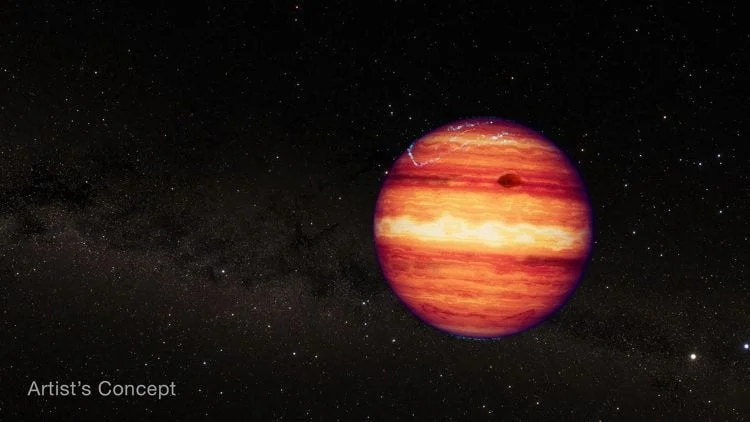
The search for celestial bodies beyond our solar system has entered a transformative era, shifting focus from the discovery of massive exoplanets to the far more elusive pursuit of exomoons. An international team of astrophysicists has recently introduced a groundbreaking methodology for identifying "exo-Ios"—volcanically active moons analogous to Jupiter’s moon Io—orbiting distant, massive worlds. By analyzing auroral data captured by the James Webb Space Telescope (JWST), researchers have identified a potential exomoon signature around the object SIMP 0136+0933, a planetary-mass body located approximately 20 light-years from Earth. The study, recently accepted for publication in The Astronomical Journal, suggests that the same electromagnetic interactions that illuminate Jupiter’s poles could serve as a beacon for discovering moons in distant star systems.
The Volcanic Blueprint: Learning from Jupiter’s Moon Io
To understand the significance of this new detection method, scientists point to the relationship between Jupiter and its innermost Galilean moon, Io. Io is recognized as the most geologically active object in the solar system, a distinction held due to the extreme gravitational forces it endures. As Io orbits Jupiter in a non-circular path, the massive gravity of the gas giant, combined with the gravitational tugs from neighboring moons Europa and Ganymede, creates a process known as tidal heating. This constant stretching and compressing generates immense internal friction, melting Io’s interior and fueling hundreds of active volcanoes that continuously spew molten lava and sulfurous gases into space.
A critical, though less frequently discussed, aspect of this volcanism is its impact on Jupiter’s magnetosphere. The volcanic gases ejected by Io become ionized, forming a "plasma torus" around Jupiter. These charged particles are then funneled along Jupiter’s magnetic field lines toward its poles. When they collide with the planet’s atmosphere, they trigger brilliant, permanent aurorae. These auroral "footprints" are distinct from the solar-wind-driven aurorae seen on Earth, providing a direct link between the moon’s volcanic activity and the planet’s electromagnetic display. The researchers behind the new study hypothesized that if this process occurs in our solar system, it likely occurs around "super-Jupiters" and brown dwarfs in other sectors of the galaxy.
SIMP 0136+0933: A Super-Jupiter on the Edge of Stellar Classification
The focal point of the recent study is SIMP J013656.5+093347, commonly referred to as SIMP 0136+0933. Discovered in 2006, this object has long fascinated astronomers due to its ambiguous nature. Initially classified as a brown dwarf—often called a "failed star" because it lacks the mass necessary to sustain hydrogen fusion—SIMP 0136+0933 was later re-evaluated. Detailed observations revealed it possesses a mass approximately 12.7 times that of Jupiter, placing it right at the "deuterium burning limit." This limit is the theoretical boundary separating the most massive planets from the smallest brown dwarfs.
SIMP 0136+0933 is a free-floating or "rogue" planetary-mass object, meaning it does not orbit a parent star but travels through the galaxy independently. Despite its lack of a host star, it remains part of a young moving group of stars known as Carina-Near, estimated to be about 200 million years old. One of its most striking characteristics is its rapid rotation; the object completes a full turn on its axis in just 2.4 hours. For comparison, Jupiter, the fastest-rotating planet in our solar system, takes nearly 10 hours. This rapid rotation, combined with its significant mass, generates a powerful magnetic field, making it an ideal candidate for auroral studies.
The Auroral Connection: Detecting Moons Through Magnetic Signatures
The research team utilized the high-precision infrared capabilities of the JWST to analyze the light curves of SIMP 0136+0933. Specifically, they looked for variations in brightness that could be attributed to auroral activity fueled by an external source—namely, an exomoon. Because SIMP 0136+0933 is a rogue planet, its aurorae cannot be powered by a stellar wind in the same way Earth’s are. Instead, the presence of intense aurorae strongly implies an internal mechanism or an interaction with a nearby satellite.
By monitoring the object as it "transited"—or as potential satellites passed in front of it relative to the telescope’s view—the researchers sought to identify specific patterns in the light data. The study suggests that an "exo-Io" orbiting SIMP 0136+0933 would inject plasma into the planet’s magnetosphere, creating a predictable auroral signature. The statistical analysis performed by the team was remarkably promising. According to their models, the current detection techniques have a 66 percent success rate for identifying an Io-like volcanic moon and a 93 percent success rate for identifying a Ganymede-like moon, which interacts with the magnetosphere through its own intrinsic magnetic field rather than volcanism.
The Historical Context of the Exomoon Search
The quest to find exomoons is one of the most difficult challenges in modern astronomy. While astronomers have confirmed the existence of over 5,000 exoplanets, the "exomoon" count remains at zero for definitive, 100-percent-confirmed discoveries. The difficulty lies in the scale; moons are significantly smaller than their host planets and are often lost in the overwhelming glare of the stars they orbit.
In recent years, several compelling candidates have emerged, though they remain unconfirmed. These include:
- WASP-49 b: Observations suggested a cloud of sodium gas surrounding this hot Jupiter, potentially originating from a volcanic moon.
- Kepler-1625 b and Kepler-1708 b: Transit data from the Kepler and Hubble telescopes indicated the presence of large, Neptune-sized moons, though these findings have been debated by other teams who suggest the signals may be instrumental noise.
- HD 206893 b: A massive companion to a star where dust disks suggest the presence of a complex satellite system.
The methodology applied to SIMP 0136+0933 represents a shift in strategy. Instead of looking for the physical shadow of a moon (transit photometry), researchers are looking for the electromagnetic "exhaust" of the moon’s existence.
Technical Challenges and the Precision of the James Webb Space Telescope
While the study provides a robust theoretical framework and encouraging initial data, the researchers emphasized that the current archival data is not yet sufficient to declare a confirmed discovery. The primary obstacle is the duration of the observations. To move from a "potential" detection to a "confirmed" existence, scientists require continuous monitoring over longer periods.
The study concludes that JWST light curves spanning approximately 1.5 days would be necessary to provide the statistical rigor required for confirmation. Currently, most archival observations are shorter, offering only a snapshot of the object’s behavior. Furthermore, the researchers noted that a larger sample size is needed. By observing 4 to 12 known aurorally active super-Jupiters over these extended periods, astronomers can determine whether Io-analogs are common in the universe or if our solar system’s configuration is a rarity.
The role of the JWST cannot be overstated. Its Near-Infrared Spectrograph (NIRSpec) and Mid-Infrared Instrument (MIRI) allow it to see through cosmic dust and capture the faint thermal signatures of cool objects like SIMP 0136+0933. The precision of JWST allows for the measurement of minute fluctuations in light—fractions of a percent—that were previously invisible to ground-based telescopes.
Future Directions: Establishing a Statistical Constraint on Exomoon Populations
The implications of this research extend beyond the discovery of a single moon. If the "auroral footprint" method proves successful, it will open a new window into the study of planetary formation. Moons are believed to be byproducts of the same processes that create planets, and their composition can reveal much about the chemical environment of a young star system.
Furthermore, volcanically active moons like Io are of high interest to astrobiologists. While Io itself is too hostile for life, the process of tidal heating is the same mechanism that keeps the subsurface oceans of Europa and Enceladus liquid. Detecting "exo-Ios" is a precursor to finding "exo-Europas"—moons that could potentially harbor life in hidden, warm oceans beneath icy crusts.
As the scientific community awaits further observation cycles with the JWST, the consensus is one of cautious optimism. The team’s work has successfully moved the search for exomoons from the realm of "what if" to a structured, data-driven methodology. The study of SIMP 0136+0933 has provided a roadmap; the next step is for the global astronomical community to follow it, peering into the magnetic storms of distant giants to find the tiny, volcanic worlds hiding in their shadows.
The exploration of these rogue worlds and their potential satellites continues to challenge our definitions of "planet" and "star." Whether SIMP 0136+0933 is a failed star or a super-planet, it is proving to be a vital laboratory for testing the limits of our technology and our understanding of the cosmos. As the researchers noted in their concluding remarks, the transition from detecting exoplanets to characterizing exomoon systems is the next great frontier in the age of space-based observatories.