Sisilia Frederika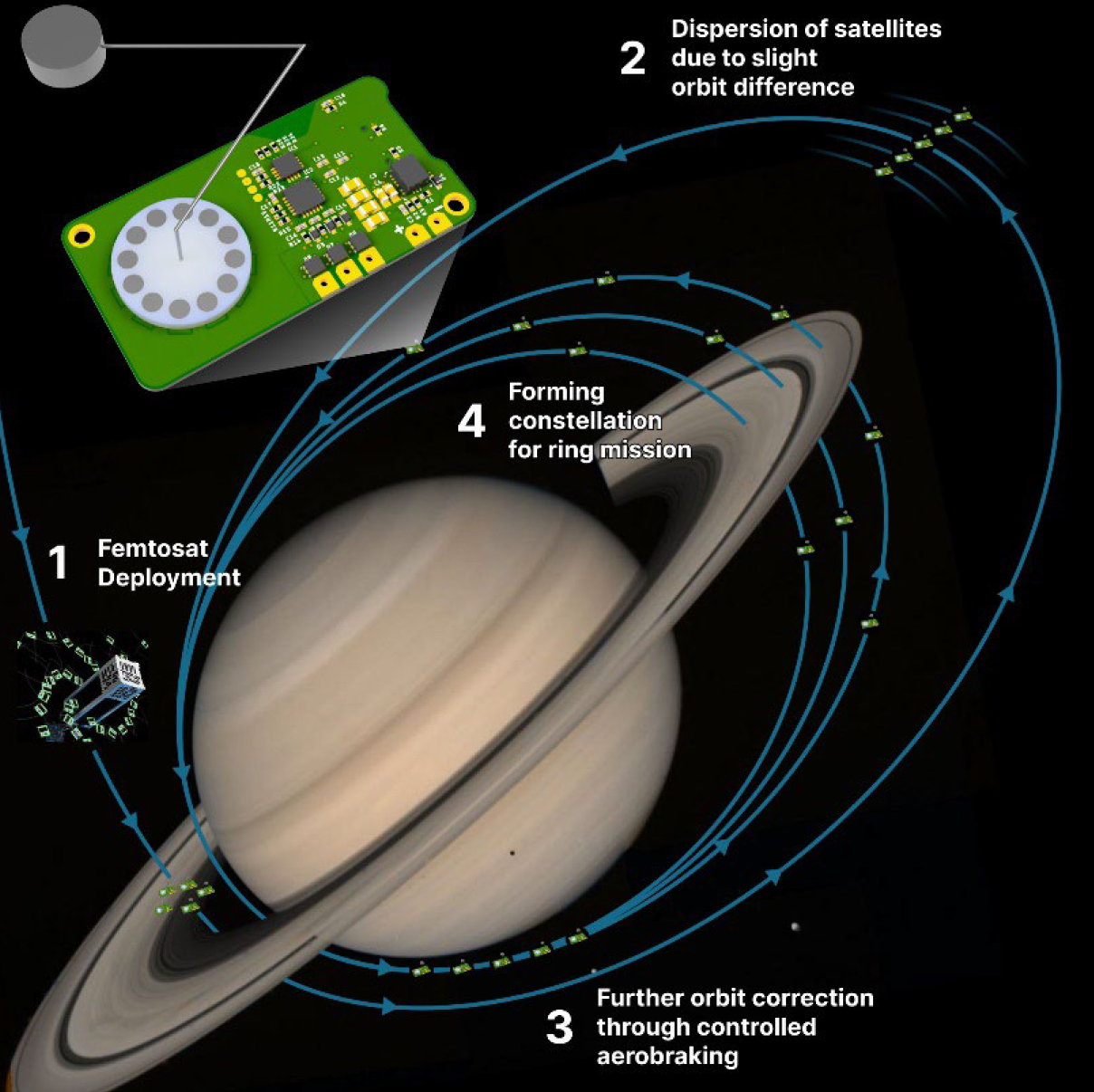
The National Aeronautics and Space Administration (NASA) has officially moved to address one of the most significant "blind spots" in planetary science by funding a revolutionary proposal to send a massive swarm of miniaturized spacecraft to Saturn. Under the NASA Institute for Advanced Concepts (NIAC) program, the agency has awarded a Phase I grant to a project titled “Actively Steerable Femtosat Constellations for In-Situ Exploration of Saturn’s Rings, Atmosphere, and Magnetosphere.” This initiative seeks to deploy approximately 10,000 "femtosatellites"—tiny, low-cost, and expendable sensors—directly into the hazardous environment of Saturn’s ring system, a region previously deemed too dangerous for traditional multi-billion-dollar flagship missions.
The project, led by Principal Investigator Dr. Michael Rubenstein of Northwestern University, represents a fundamental shift in space exploration strategy. Rather than relying on a single, highly shielded, and expensive orbiter, the mission concept utilizes the principles of swarm robotics to achieve high-resolution, multi-point data collection. By accepting the statistical certainty that many individual units will be destroyed by collisions, the mission ensures that the collective swarm survives to transmit unprecedented data back to Earth.
The Legacy and Limitations of the Cassini-Huygens Mission
To understand the necessity of a swarm-based approach, one must look at the conclusion of the Cassini-Huygens mission. For thirteen years, Cassini provided humanity with an intimate look at the Saturnian system, discovering geysers on Enceladus, liquid methane lakes on Titan, and complex hexagonal storms at Saturn’s poles. However, as the mission entered its "Grand Finale" in 2017, it faced a physical barrier that its design could not overcome: the rings themselves.
Saturn’s rings are a maelstrom of trillions of particles, ranging in size from microscopic dust grains to icy boulders the size of terrestrial mountains. While Cassini performed daring dives through the "gap" between the planet and the innermost rings, it never dared to enter the ring plane itself. The spacecraft, a school-bus-sized machine costing nearly $4 billion, would have been catastrophically damaged by an impact with even a relatively small piece of debris. Consequently, while Cassini could observe the rings from a distance and measure their gravitational influence, it could not provide in-situ measurements of particle dynamics, local magnetic fluctuations, or the precise composition of the ring material at a granular level.
The Architecture of the Femtosat Swarm
The proposed mission leverages the "femtosat" platform, a class of spacecraft significantly smaller than the now-common CubeSats. Often referred to as "chipsats" or "Sprites," these devices are the result of decades of miniaturization driven by the commercial smartphone and semiconductor industries. A typical femtosat weighs only a few grams and is roughly the size of a large postage stamp. Despite their diminutive size, they are equipped with solar cells for power, a microcontroller, various sensors (such as accelerometers or magnetometers), and a radio transmitter.
Dr. Rubenstein, a pioneer in swarm robotics known for the "Kilobot" project—which demonstrated how 1,000 small robots could autonomously coordinate to form complex shapes—aims to apply these terrestrial lessons to the vacuum of space. The 10,000 femtosatellites would be transported to Saturn via a "mothership." Upon arrival, the swarm would be deployed in a targeted cloud.
The "actively steerable" component of the proposal is its most ambitious technical hurdle. Unlike previous experiments like KickSat-2, which deployed 105 Sprites into Low Earth Orbit in 2019 without propulsion, the Saturnian swarm requires a method to navigate the complex gravitational and magnetic environment of the gas giant. Potential steering mechanisms being investigated in Phase I include micro-thrusters or the use of electromagnetic tethers that interact with Saturn’s powerful magnetosphere to generate propellant-less thrust.
Scientific Objectives: Solving the Age Paradox
The primary scientific driver for the mission is the ongoing debate regarding the age and origin of Saturn’s rings. For decades, the prevailing theory was that the rings formed alongside Saturn approximately 4.5 billion years ago. However, data from Cassini’s final orbits suggested the rings might be much younger—perhaps only 10 to 100 million years old—potentially the remnants of a destroyed moon or a captured comet that wandered too close to the planet’s Roche limit.
By sending thousands of sensors directly into the rings, scientists can observe the kinetic behavior of ice particles in real-time. This in-situ data will allow researchers to measure the rate of collisions, the transfer of angular momentum, and the "purity" of the water ice. If the rings are highly contaminated with silicate dust, it suggests they have been gathering "space grime" for billions of years; if they are pristine, it supports the "young ring" hypothesis.
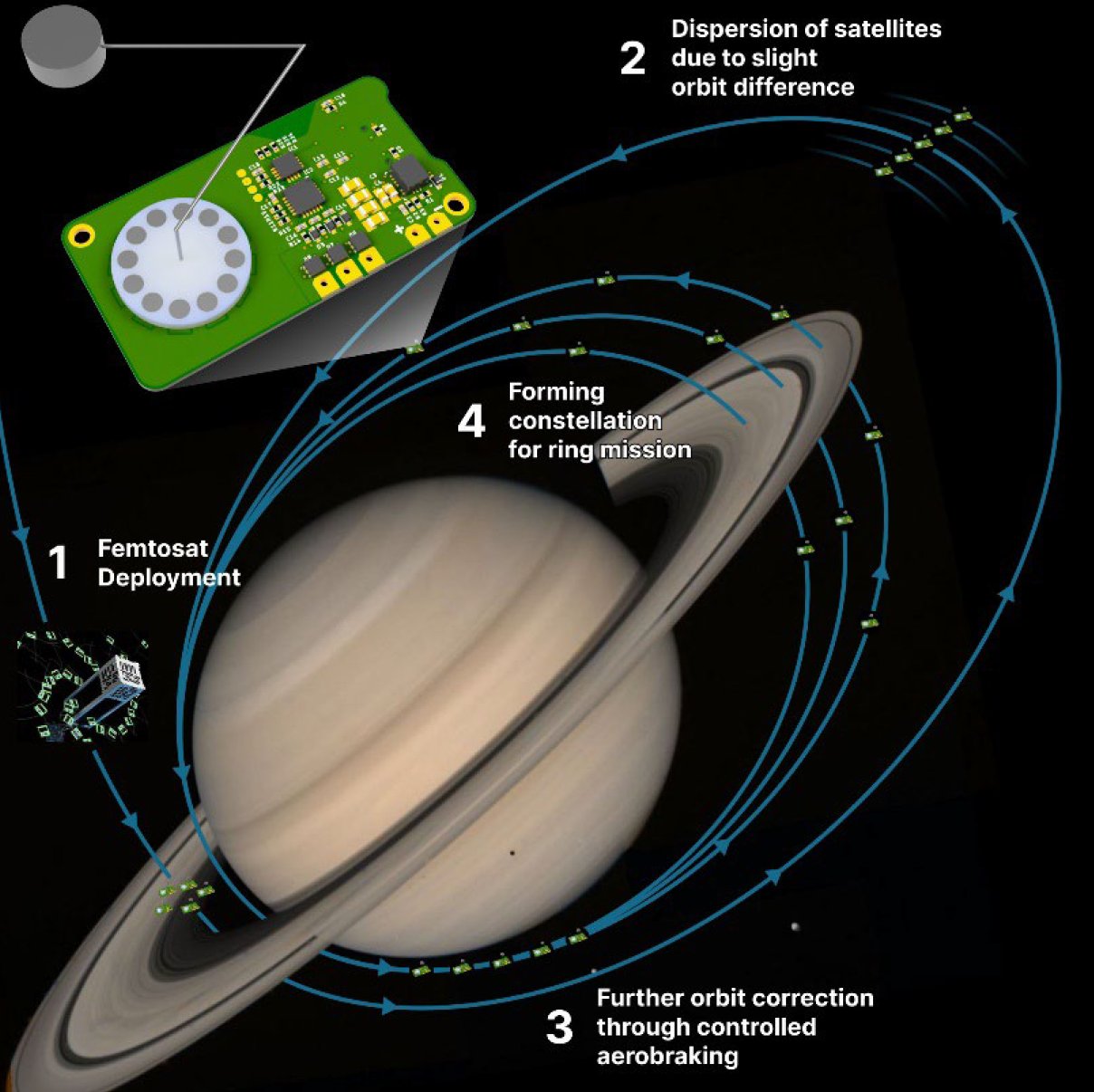
Beyond the rings, the swarm offers a unique advantage for atmospheric and magnetospheric study. Traditional orbiters provide a "single-point" measurement, capturing data only from the specific location of the spacecraft at a given time. A swarm of thousands of sensors can provide a "multi-point" map, measuring the global structure of Saturn’s magnetic field and its atmospheric dynamics simultaneously across different latitudes and altitudes. This would be akin to moving from a single weather station to a global network of sensors, allowing for a far more sophisticated understanding of Saturn’s internal structure and weather patterns.
Chronology of Development and Funding
The path from concept to launch is a multi-decade endeavor. The timeline for the femtosat swarm is currently in its earliest stages:
- July 2026: NASA announces the selection of 18 early-stage concept awards under the NIAC program. Dr. Rubenstein’s project is awarded a Phase I grant.
- 2026–2027: Phase I investigation. This nine-month study, funded with $175,000, focuses on the feasibility of the steering mechanisms and the communication architecture required to manage 10,000 distinct data streams.
- Late 2027 (Projected): Successful Phase I projects may apply for NIAC Phase II, which provides up to $600,000 for two additional years of development.
- 2030s: If the technology matures, it would transition from a "concept" to a "mission" within a specific NASA program (such as Discovery or New Frontiers). This would involve the construction of flight hardware and the selection of a launch vehicle.
- 2040s: Earliest potential launch and arrival at Saturn. Given the distance to the outer solar system, even a high-velocity transit would take 7 to 10 years.
Comparative Exploration Strategies: The PRAXIS Alternative
NASA’s interest in the rings is further evidenced by the simultaneous funding of a competing, though complementary, NIAC concept. The Planetary Rings Autonomous EXploration with In-Situ Sampling (PRAXIS) project, led by Marco Quadrelli at the Jet Propulsion Laboratory (JPL), proposes a different approach. Instead of a swarm, PRAXIS envisions a larger "mothership" that hovers above the ring plane, using an AI-guided, extendable boom to perform "touch-and-go" sampling of ring particles.
While the femtosat swarm offers breadth and redundancy, the PRAXIS concept offers precision and the potential for return-to-mothership analysis. The fact that NASA is funding both concepts highlights the agency’s commitment to breaking the "Cassini barrier" and finally interacting physically with the solar system’s most iconic feature.
Technical Challenges and Risk Mitigation
The mission faces several daunting engineering challenges. First is the "communication bottleneck." Managing the telemetry of 10,000 individual spacecraft across 1.2 billion kilometers of space requires an innovative relay system. The current plan involves using the mothership as a local hub, which aggregates data from the swarm and beams it back to the Deep Space Network on Earth.
Second is the radiation environment. Saturn possesses a formidable magnetosphere that traps high-energy electrons and protons. Femtosatellites, by their very nature, lack the heavy lead or aluminum shielding found on larger craft. The mission’s success depends on the "strength in numbers" philosophy—even if 50% of the swarm is fried by radiation or pulverized by ice, the remaining 5,000 units would still constitute the largest sensor array ever deployed in the outer solar system.
Broader Impact on Future Exploration
The implications of the Rubenstein proposal extend far beyond Saturn. If a swarm of 10,000 satellites can be successfully managed and navigated in deep space, it opens the door for similar missions to other hazardous or complex environments. Future swarms could be used to map the asteroid belt, explore the plumes of Europa, or provide a dense sensor web around Mars to support future human colonization efforts.
Furthermore, the project represents a democratization of space technology. By utilizing off-the-shelf electronics and focusing on small-scale manufacturing, the cost per unit is dramatically reduced. This could allow for more frequent "high-risk" missions that NASA’s traditional budget structure might otherwise forbid.
As the Phase I study progresses, the scientific community awaits the results with cautious optimism. While the 2040s may seem distant, the groundwork being laid today by Dr. Rubenstein and the NIAC program represents the next great leap in our attempt to touch the untouchable—the glittering, icy debris that defines the crown jewel of our solar system.