Clarissa Hana
OpenAI is embarking on a significant initiative to enhance transparency in the burgeoning field of artificial intelligence by implementing invisible watermarks on text generated by its advanced models, ChatGPT and Codex, specifically within the European Union. This groundbreaking move, slated for deployment over the coming weeks, aims to address growing concerns surrounding the proliferation of AI-generated content and its potential impact on information integrity. The watermarking system, dubbed "textGrain," operates by subtly altering word choices within the AI’s output. These modifications create a statistical pattern, imperceptible to the human eye during reading or copying, but detectable by specialized tools. While the EU will be the initial focus for this rollout, OpenAI has also made watermarking available for API developers globally on an opt-in basis, though it remains disabled by default. The company is simultaneously opening applications for its watermark detector, initially granting access to a select group of researchers and expert organizations to foster robust evaluation and refinement of the technology.
The Genesis of TextGrain: Addressing a Growing Need for Provenance
The decision to implement AI text watermarking stems from a broader societal and regulatory landscape grappling with the rapid advancement and widespread adoption of generative AI. As AI models become increasingly sophisticated, their ability to produce human-like text has raised questions about authorship, authenticity, and the potential for misuse, including the spread of misinformation, academic dishonesty, and sophisticated phishing attacks. The European Union, in particular, has been at the forefront of regulatory efforts concerning AI, with initiatives like the AI Act aiming to establish a comprehensive legal framework for AI development and deployment. OpenAI’s proactive step to introduce watermarking, especially in the EU, can be viewed as a response to these evolving regulatory pressures and a commitment to fostering responsible AI development.
The development of textGrain signifies a crucial step in OpenAI’s ongoing efforts to imbue its AI systems with a greater degree of transparency and accountability. While the exact timeline for the development of textGrain is not publicly detailed, its integration into ChatGPT and Codex suggests a significant investment in research and development over an extended period. The initial announcement by OpenAI regarding textGrain highlights their strategic approach to introducing such a sensitive technology, prioritizing a controlled rollout within a key regulatory jurisdiction before considering wider global implementation. This phased approach allows for thorough testing, feedback incorporation, and adaptation to diverse technological and societal contexts.
How TextGrain Works: A Statistical Fingerprint
Unlike traditional watermarking techniques that embed visible or easily removable marks, textGrain operates on a fundamentally different principle. It leverages the statistical properties of language generation within AI models. By making minute, almost imperceptible adjustments to word selection, the technology weaves a unique statistical pattern into the text. This pattern acts as a digital fingerprint, allowing detection software to identify whether a piece of text originated from a specific AI model.

"Over the coming weeks, we will add an invisible watermark to eligible ChatGPT and Codex text output in the European Union," OpenAI explained in a recent statement. This declaration underscores the deliberate and strategic nature of the rollout. The company emphasizes that the watermark is designed to be undetectable during normal interaction with the text. This means users can read, copy, and paste content generated by these models without noticing any alteration. The true purpose of the watermark is revealed only when subjected to OpenAI’s proprietary detection tools.
The decision to focus on the EU for the initial rollout is significant. The region has been a leader in digital regulation, with a strong emphasis on data privacy and consumer protection. The implementation of AI watermarking in the EU signals OpenAI’s commitment to aligning with the region’s evolving legal and ethical expectations surrounding AI technologies. This move could set a precedent for other jurisdictions and encourage broader adoption of similar transparency measures.
Limitations and Challenges: The Imperfect Nature of AI Detection
Despite the innovative approach of textGrain, OpenAI candidly acknowledges its limitations. The company’s own evaluations have revealed that the watermark’s detectability can be significantly compromised by common text editing practices. For instance, replacing just 10% of words with synonyms can reduce detection rates from approximately 92% to 66%. A more substantial edit, such as replacing 25% of words, plummets detection accuracy to a mere 17%. This highlights a critical challenge: the watermark’s efficacy is directly tied to the level of human intervention or modification applied to the AI-generated text.
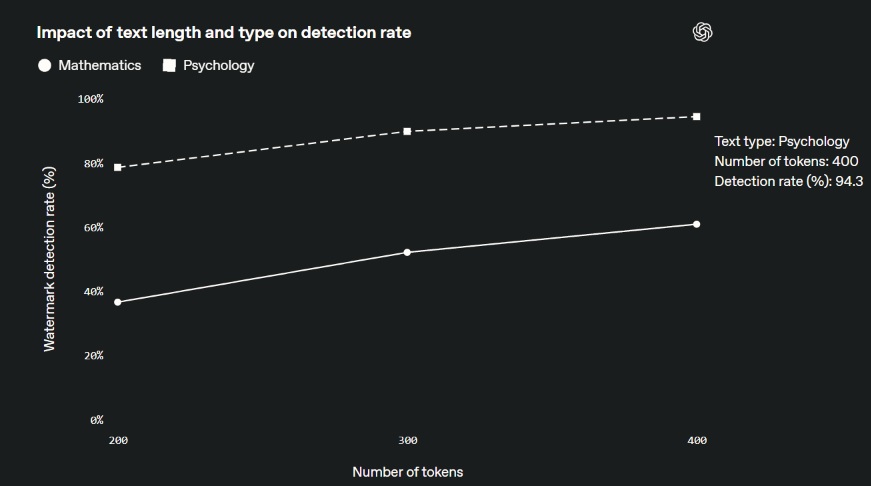
The effectiveness also varies depending on the length of the text and the subject matter. OpenAI’s tests indicated that at a 1% false-positive target, the watermark was detected in about 80% of 200-token psychology responses, increasing to roughly 95% for 400-token passages. However, for subjects with more constrained language, such as mathematics, where the AI has less lexical freedom, detection rates can be even lower.
This inherent fragility leads OpenAI to issue a crucial disclaimer: "The absence of a detected watermark does not prove human authorship." This warning is paramount for users and developers relying on the technology. It means that even if a watermark cannot be detected, it does not definitively confirm that a human authored the text. Conversely, a detected watermark offers no insight into the identity of the user, their specific prompt, or the conversation history that led to the generation of the text. Furthermore, the watermark cannot ascertain the proportion of human authorship or editing in a final piece of work.
Implications for Developers and Researchers
For API developers, the opt-in nature of watermarking presents an opportunity to integrate this transparency feature into their applications. This allows them to provide their users with a clearer indication of content origin, potentially enhancing trust and mitigating risks associated with AI-generated misinformation. However, developers must also be cognizant of the limitations and carefully manage user expectations regarding the watermark’s reliability.
The opening of applications for the watermark detector to approved researchers and expert organizations signifies a commitment to collaborative improvement. This approach allows for external validation of the technology and the identification of potential vulnerabilities or areas for enhancement. Such collaboration is vital in the rapidly evolving landscape of AI security and ethical deployment. By involving a broader community of experts, OpenAI can accelerate the refinement of textGrain and build a more robust and trustworthy AI ecosystem.
The Broader Impact: Navigating the Future of AI Content
The introduction of invisible watermarking by OpenAI is a significant development in the ongoing effort to balance the transformative potential of AI with the imperative to maintain information integrity. It represents a proactive step towards addressing societal concerns about AI-generated content, offering a technical solution to a complex problem.
However, the limitations of textGrain underscore that watermarking is not a silver bullet. It is a tool, albeit a sophisticated one, that can contribute to provenance tracking but cannot entirely solve the challenges of AI misuse. The effectiveness of such technologies will likely continue to evolve alongside AI capabilities. Future advancements may involve more resilient watermarking techniques or complementary methods for AI content verification.
The broader impact of this initiative extends beyond technical implementation. It signals a shift towards greater accountability in the AI industry and may encourage other AI developers to explore similar transparency measures. As AI becomes more integrated into our daily lives, the need for clear indicators of origin and authorship will only grow. OpenAI’s move, while imperfect, is a crucial step in that direction, fostering a more informed and responsible use of artificial intelligence. The ongoing dialogue between AI developers, regulators, and the public will be essential in shaping the future of AI content and ensuring its beneficial integration into society. The journey towards comprehensive AI provenance is complex and ongoing, with textGrain marking a significant waypoint in this critical endeavor.