Sisilia Frederika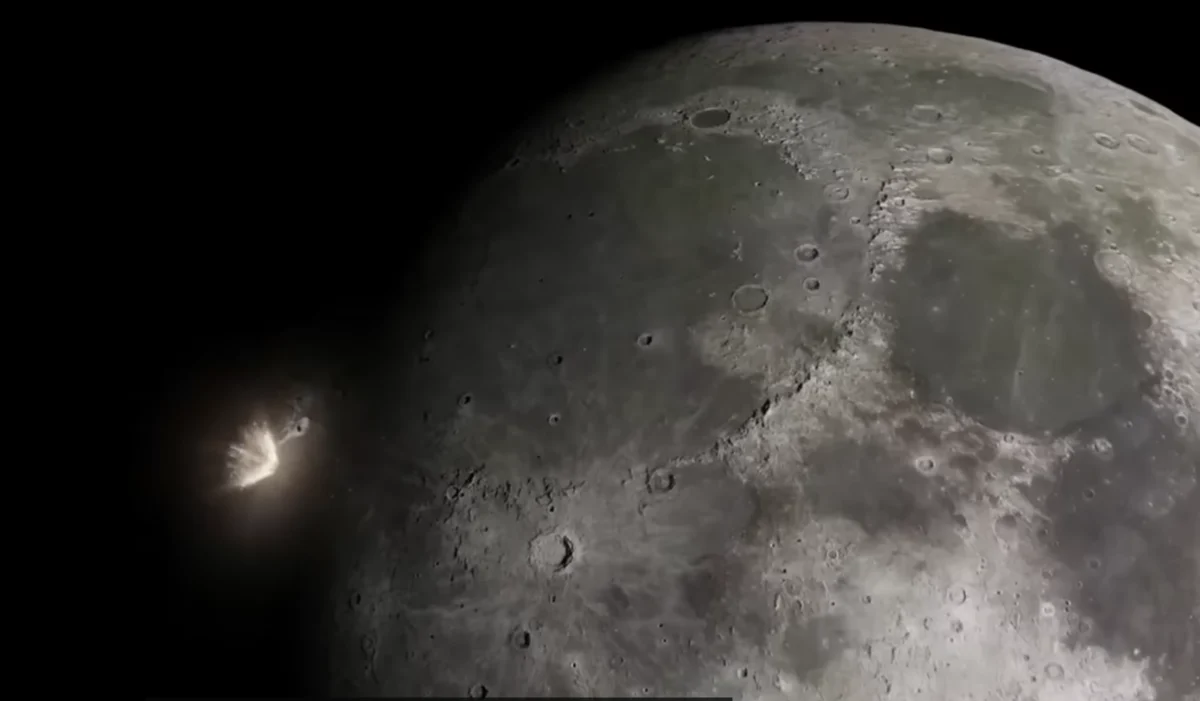
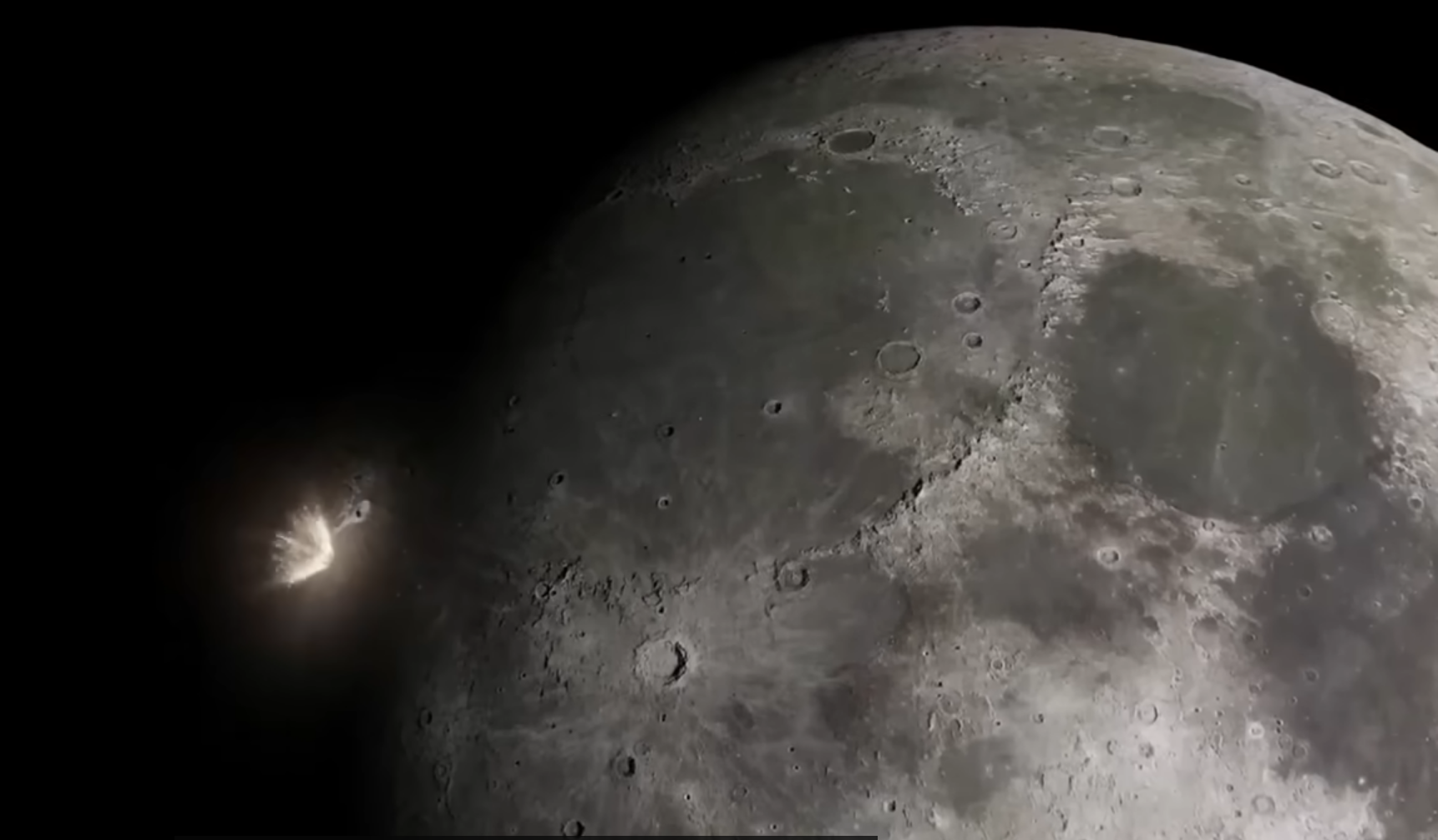
In a significant event for lunar ballistics and cislunar space management, a spent upper stage from a SpaceX Falcon 9 rocket successfully impacted the lunar surface on Wednesday, August 5, 2026. The collision occurred at 06:35 UTC (11:35 p.m. PDT on August 4; 2:35 a.m. EDT on August 5), marking a rare instance of a man-made object striking the Moon under observation from both orbital and ground-based assets. The impactor, a 13.8-meter (45-foot) long cylindrical structure weighing approximately 4,000 kilograms (9,000 lbs), struck the western "lunar limb" in the vicinity of the Einstein Crater. Traveling at a velocity of roughly 8,700 km/h (5,400 mph), the spent stage’s kinetic energy was sufficient to create a new permanent feature on the lunar landscape, providing scientists with a unique opportunity to study the Moon’s subsurface composition and the mechanics of high-velocity impacts.
Technical Specifications and the Mechanics of Impact
The object involved in the collision was the second stage of a Falcon 9 rocket, which originally served as the delivery vehicle for two high-profile lunar missions launched in January 2025: Firefly Aerospace’s Blue Ghost Mission 1 and ispace’s HAKUTO-R Mission 2, carrying the "Resilience" lander. While the landers were successfully deployed to their respective trajectories, the upper stage remained in a highly elliptical Earth orbit that eventually intersected with the Moon’s gravity well.
Physicists and astronomers had been tracking the object for months, refining their predictions as the impact date approached. Calculations indicated that the 4,000 kg mass hitting the surface at over 2,400 meters per second would generate a significant crater. Preliminary estimates suggested the resulting scar would measure between 20 and 27 meters (65 to 89 feet) in diameter, with a depth of approximately 4 meters (12 to 13 feet).
The impact site, located near the Einstein Crater on the Moon’s dayside, was chosen by celestial mechanics rather than intent. Einstein Crater is a large lunar impact crater located near the western limb of the Moon, a region that is often difficult to observe from Earth due to libration. However, the timing of the impact on the dayside allowed for spectroscopic analysis of the resulting plume, even though direct visual imaging of the flash was limited by the equipment available to most observers.
Observational Success and Spectroscopic Findings
Despite the lack of real-time video of the collision, the event was a triumph for multi-platform observation. The European Southern Observatory’s (ESO) Very Large Telescope (VLT) in Chile played a pivotal role in the scientific windfall. Using advanced spectroscopic instruments, astronomers at the VLT analyzed the light filtered through the debris cloud kicked up by the impact.
The spectroscopic data revealed the presence of lithium and sodium in the ejecta plume. While sodium is a known component of the thin lunar exosphere and is often found in the regolith, the detection of lithium provided a point of interest for researchers. Scientists are currently debating whether these elements were native to the impact site’s subsurface or if they originated from the Falcon 9’s own hardware, such as specialized alloys or battery components. The dust and gas from the impact dissipated within minutes, but the data gathered during those brief moments offers a "borehole" view into the lunar crust without the need for a physical drilling mission.
The Role of the Korean Pathfinder Lunar Orbiter (Danuri)
One of the most critical players in the post-impact analysis was the Korea Aerospace Research Institute (KARI). Their mission, the Korean Pathfinder Lunar Orbiter (KPLO)—popularly known as Danuri—was positioned to capture the aftermath. Officials from KARI confirmed that Danuri began its observation sequence approximately 30 minutes before the predicted collision time.
Through precise orbit control, the orbiter passed over the Einstein Crater region multiple times, conducting a total of eight imaging sessions. These high-resolution images allowed for a "before and after" comparison of the terrain. KARI officials stated on the morning of August 6th that the observations confirmed clear changes in the local topography and the presence of an ejecta blanket—a layer of debris spread across the surrounding area by the force of the blast.
This collaborative effort is expected to continue as NASA’s Lunar Reconnaissance Orbiter (LRO) coordinates with KARI for follow-up high-resolution mapping. NASA’s Meteoroid Environments Office at the Marshall Space Flight Center also contributed by using ground-based telescopes to monitor the event, ensuring that the impact was documented from both the lunar orbit and the Earth’s surface.
Chronology of the Falcon 9 Upper Stage
The path to the August 5th impact began over a year and a half prior. The following timeline outlines the lifecycle of the debris:
- January 2025: The Falcon 9 rocket launches from Cape Canaveral, carrying the Blue Ghost Mission 1 and HAKUTO-R M2. After deploying the payloads, the second stage enters a chaotic high-Earth orbit.
- February 2025 – June 2026: The spent stage is influenced by the gravitational "tug-of-war" between the Earth, Moon, and Sun. It is monitored by various space situational awareness (SSA) organizations.
- July 2026: Orbital analysts confirm a high-probability impact trajectory for early August. The target area is identified as the western limb of the Moon.
- August 5, 2026, 06:05 UTC: Danuri (KPLO) begins pre-impact imaging and enters its observation phase.
- August 5, 2026, 06:35 UTC: Impact occurs near Einstein Crater. Spectroscopic data is captured by the VLT in Chile.
- August 6, 2026: KARI releases initial reports confirming the creation of a new crater and the successful capture of post-impact imagery.
Official Responses and the "Isaacman" Perspective
The event has elicited reactions from top space officials, highlighting the shift in how the international community views lunar debris. NASA Administrator Jared Isaacman addressed the event in a post on the social media platform X, noting that while the Moon is frequently hit by natural meteoroids, the increase in man-made impacts is a direct consequence of the burgeoning "Lunar Economy."
Isaacman pointed out that while this specific impact posed no threat to existing missions—such as the various robotic landers or the Gateway station—it serves as a reminder of the need for better debris management. NASA planners are already tasked with safeguarding the upcoming crewed Artemis missions from natural micrometeoroids; however, the addition of massive spent rocket stages into the risk equation introduces a new variable for mission safety.
"The risk of impacts will increase as more launches are made," Isaacman indicated, echoing a sentiment shared by many in the space flight safety community. The concern is not just the impact itself, but the "ejecta" or debris cloud that can briefly orbit the Moon or interfere with sensitive optical instruments on other spacecraft.
Broader Implications for Cislunar Space Debris
The Falcon 9 impact is a practical illustration of a growing theoretical problem. A study recently published by the Chinese Academy of Sciences (CAS) warned that cislunar space—the region between Earth and the Moon—is becoming increasingly crowded with "zombie" satellites and spent rocket stages. The CAS study used simulations to show that as traffic to the Moon increases, the likelihood of uncontrolled collisions rises exponentially.
Unlike Earth orbit, where atmospheric drag eventually pulls many objects down to burn up, the lunar environment has no atmosphere to clear out debris. Objects in cislunar space can remain in unstable orbits for years before either being ejected into solar orbit or crashing into the Moon.
The August 5th impact serves as a bellwether for the international community. As more nations and private entities like Firefly, ispace, SpaceX, and Blue Origin target the Moon, the "pristine" lunar environment is rapidly becoming a zone of human industrial activity. This has led to calls for a more robust framework for tracking and potentially de-orbiting spent stages to prevent them from becoming hazards to future lunar bases or orbiting stations.
Scientific Value of Artificial Impacts
While the impact is technically a case of "space junk," it provides immense scientific value. Artificial impacts are "controlled" experiments where the mass, velocity, and composition of the impactor are known. This allows scientists to calibrate the data they receive from natural meteoroid impacts, where the properties of the impactor are usually unknown.
By studying the size and shape of the Falcon 9 crater, geologists can determine the density and strength of the lunar regolith at the Einstein Crater site. The spectroscopic detection of sodium and lithium also adds to the growing map of lunar resources, which will be vital for future "in-situ resource utilization" (ISRU)—the practice of living off the lunar land.
As the data from Danuri, the VLT, and the LRO continues to be processed, the SpaceX Falcon 9 impact will likely become one of the most well-documented lunar collisions in history. It stands as a testament to the current era of space exploration: a mix of commercial ambition, scientific curiosity, and the emerging necessity of environmental stewardship in the vacuum of space.