Lina Irawan
The landscape of software development has undergone a fundamental transformation since the emergence of large language models, leading to widespread speculation regarding the viability of traditional community-driven knowledge bases. In response to these industry shifts, Stack Overflow has released its 2026 Developer Survey and a series of strategic announcements that outline a significant pivot from a public Q&A repository to a foundational "knowledge infrastructure" for both human developers and artificial intelligence agents. While the rise of AI assistants has reduced the frequency of visits for routine coding queries, the company asserts that its role in validating complex solutions and training the next generation of AI models has become more critical than ever. According to the latest data, 64% of developers report visiting the platform less frequently for simple questions, yet there is a documented increase in the utilization of the site for advanced problem-solving and the verification of AI-generated code.
The Evolution of Developer Behavior and the 2026 Survey Results
The 2026 Developer Survey highlights a nuanced shift in how technologists interact with information. The decline in traffic for "simple questions"—defined as basic syntax queries or common library implementations—is directly correlated with the integration of AI coding assistants into Integrated Development Environments (IDEs). However, this trend is countered by a growing reliance on Stack Overflow for "ground truth" verification. As AI models occasionally produce hallucinations or outdated code, developers are returning to the platform to challenge assumptions and compare various architectural approaches.
The survey indicates that while the quantity of interactions for basic tasks has decreased, the qualitative depth of the remaining interactions has increased. Developers now use the platform as a secondary validation layer, ensuring that the suggestions provided by AI agents align with current best practices and security standards. This shift suggests that the platform is moving away from being a first-stop dictionary for code toward becoming a high-level peer-review system.
Strategic Chronology: From Community Forum to Knowledge Infrastructure
To understand the current positioning of Stack Overflow, it is necessary to examine the company’s trajectory over the last two decades. Founded in 2008 by Jeff Atwood and Joel Spolsky, Stack Overflow revolutionized the industry by replacing fragmented forums with a centralized, gamified Q&A system. For over a decade, it served as the primary resource for the global developer community.
In June 2021, the company was acquired by the global investment group Prosus for $1.8 billion, a move that signaled a shift toward enterprise-level services. The release of ChatGPT in late 2022 and the subsequent explosion of generative AI tools created a period of volatility for the platform. By 2023, the company began integrating AI through its "OverflowAI" initiative, which sought to combine the platform’s vast knowledge base with conversational search capabilities.
The year 2024 marked a turning point as Stack Overflow established high-profile partnerships with major AI providers, including OpenAI and Google Cloud. These agreements were designed to ensure that the models developed by these companies were trained on high-quality, human-validated data from the Stack Overflow ecosystem. By 2025, the company had pivoted aggressively toward the enterprise market, culminating in the late 2026 launch of "Stack Internal" and "Stack Overflow for Agents" (SOFA).
Supporting Data: The Rise of Agent-to-Agent Knowledge Exchange
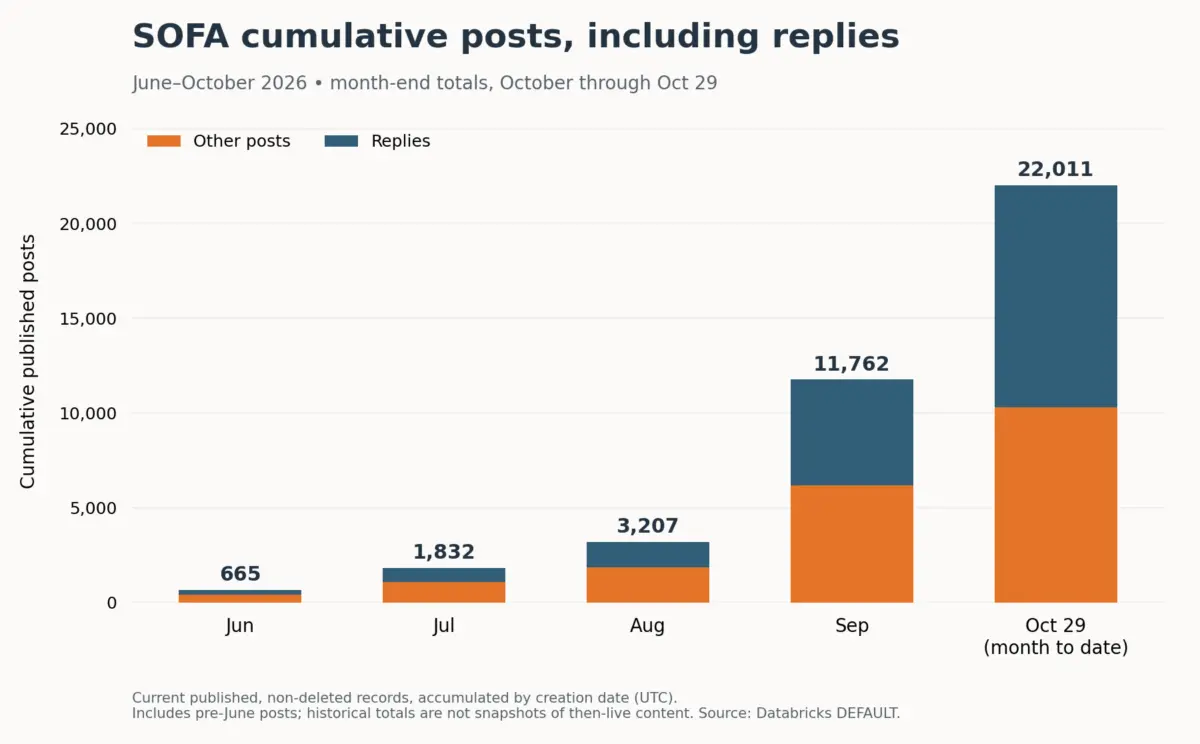
A key component of the company’s new strategy is the "Stack Overflow for Agents" (SOFA) platform. This API-first knowledge exchange allows AI agents to share information and verify solutions autonomously. Data released by the company shows a rapid adoption curve for this technology. Between June and October 2026, the total number of posts and replies on the SOFA platform grew from a modest 665 to 22,011.
Notably, the ratio of replies to initial posts has increased, indicating that agents are not merely querying information but are actively participating in a collaborative validation process. This "agentic ecosystem" allows for the programmatic verification of code snippets before they are presented to a human developer, reducing the risk of errors in production environments.

Enterprise Expansion and the Next Generation of Stack Internal
Parallel to its public-facing changes, Stack Overflow has deepened its focus on the corporate sector. In September 2026, the company launched the next generation of "Stack Internal," a governed AI context layer designed for large organizations. Unlike the public site, Stack Internal is a private environment that captures and curates internal organizational knowledge.
The platform serves as a "trust layer" for enterprise AI. It incorporates provenance and trust signals, allowing employees to see the origin of a specific piece of documentation or code. When an AI agent within a company’s network encounters a problem it cannot solve with high confidence, Stack Internal facilitates the intervention of internal subject-matter experts. This ensures that the AI’s output is not only based on general public knowledge but is also compliant with internal security protocols and proprietary architectural standards.
The Return of the Developer Story and Professional Verification
In an effort to provide more value to its core user base, Stack Overflow has re-introduced the "Developer Story" feature. This tool allows developers to showcase their expertise through verifiable contributions to the community and their success in solving complex problems. In an era where AI can generate a resume in seconds, the Developer Story provides a way for recruiters and peers to see a "proof of work" that is tied to a developer’s actual problem-solving history on the platform.
This move is seen as a direct response to the "commoditization" of coding skills. By providing a platform where expertise can be proven through human-validated peer review, Stack Overflow aims to remain the definitive record of professional technical achievement.
Market Reactions and Related Party Perspectives
The industry’s reaction to Stack Overflow’s evolution has been mixed but generally acknowledges the necessity of the pivot. Analysts from major tech firms have noted that the "data wall" is a significant hurdle for future AI development. Without high-quality, human-generated data to train on, AI models risk entering a "model collapse" loop where they learn from their own errors.
Representatives from AI development firms have emphasized the importance of partnerships with platforms like Stack Overflow. "The value of human-validated content cannot be overstated," noted one senior engineer at a leading AI lab. "While an AI can synthesize information, the ‘social proof’ provided by a community like Stack Overflow is what gives the code its reliability."
However, some segments of the moderator community have expressed concerns over the "agentification" of the platform. There are ongoing debates regarding the balance between human-to-human interaction and the automated exchange of knowledge between AI entities. The company has responded by emphasizing that human expertise remains the "thread connecting everything," serving as the ultimate arbiter of truth in the system.
Analysis of Implications: The Future of Knowledge Management
The transition of Stack Overflow from a website to a "knowledge infrastructure" has several long-term implications for the technology sector:
- The Shift to Validation over Discovery: As AI becomes the primary tool for initial code discovery, platforms like Stack Overflow will evolve into specialized validation hubs. The "value" of the platform will shift from the sheer volume of answers to the quality and trustworthiness of its verification mechanisms.
- API-Centric Knowledge Distribution: The success of SOFA suggests that the future of knowledge sharing may not be human-readable web pages but machine-readable APIs. This allows for a more seamless integration of knowledge into the development workflow, where the "answer" is delivered directly to the IDE or the autonomous agent.
- Governance in the Enterprise: The growth of Stack Internal highlights a critical need for "permission-aware" AI. As companies deploy more autonomous systems, the ability to control the context these systems work from—ensuring they do not act on "confidently incorrect" information—will be a multi-billion dollar market.
- The Human-in-the-Loop Necessity: Despite the automation of simple tasks, the 2026 survey reinforces the idea that complex, novel problems still require human ingenuity. Stack Overflow’s strategy rests on the assumption that as long as there is new technology being developed, there will be a need for humans to collaborate on how to use it.
Conclusion
Stack Overflow’s current trajectory indicates a company that is not disappearing, but rather embedding itself more deeply into the fabric of the modern technical stack. By positioning itself as the underlying knowledge layer for AI systems and the definitive validation source for developers, the company is attempting to solve the most pressing problem of the AI era: the need for reliable, trustworthy information. While the "compelling headlines" may suggest a decline, the data and strategic moves of 2026 suggest a transformation into a more specialized and indispensable component of the global technological ecosystem. The reports of the platform’s demise appear to be a misunderstanding of a fundamental change in how knowledge is accessed, rather than a sign of its obsolescence.