Sisilia Frederika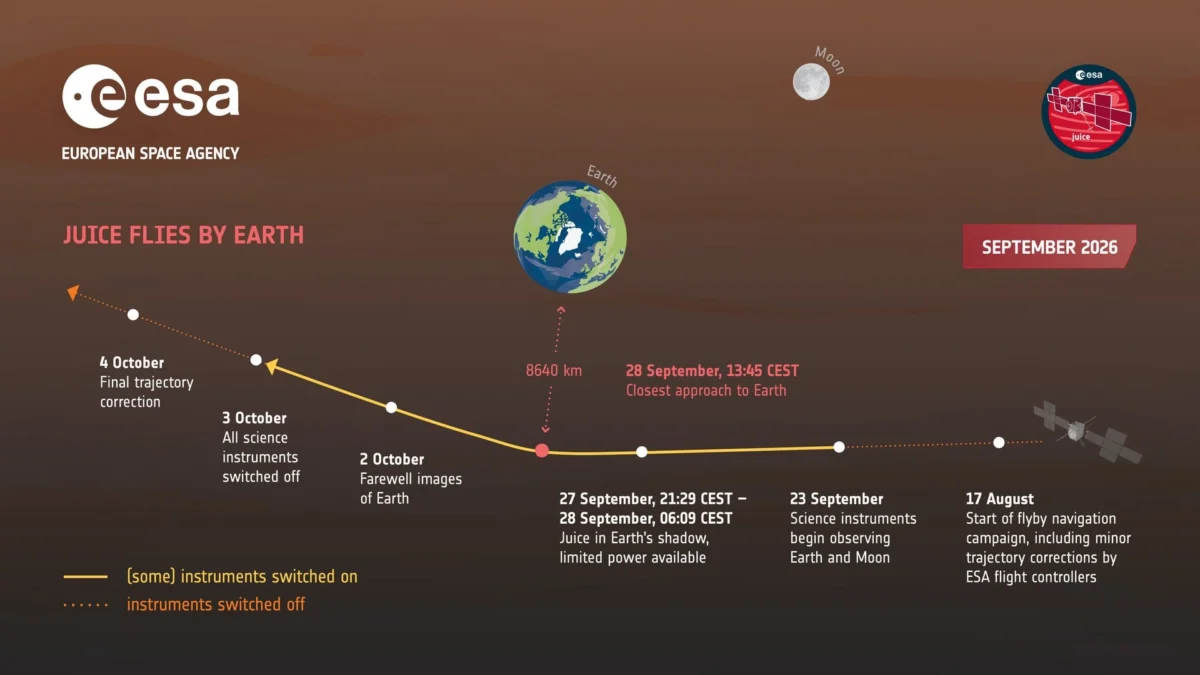
The JUpiter ICy moons Explorer (JUICE), a flagship mission of the European Space Agency (ESA), is currently navigating a complex series of celestial maneuvers designed to propel it toward the outer solar system. Launched on April 14, 2023, from Europe’s Spaceport in Kourou, French Guiana, the robotic explorer is tasked with investigating the potential habitability of Jupiter’s largest moons: Ganymede, Europa, and Callisto. As of late 2024, mission controllers at the European Space Operations Centre (ESOC) in Darmstadt, Germany, are preparing for a pivotal gravity assist maneuver (GAM) with Earth, scheduled to reach its closest point on Monday, September 28th. This encounter will see the spacecraft pass within approximately 8,640 kilometers (5,370 miles) of the Earth’s surface at 13:45 CEST (07:45 a.m. EST; 04:45 a.m. PST), marking a critical milestone in a journey that spans billions of kilometers and more than a decade of flight time.
The Mechanics of Celestial Billiards: Gravity Assist Maneuvers
Reaching the Jovian system requires a massive amount of energy, far more than any modern rocket can provide through a direct flight path. To overcome this limitation, mission planners employ "gravity assists," a technique often described as celestial billiards. By flying close to a planet or moon, a spacecraft can exchange orbital energy with the celestial body, either gaining or losing velocity and altering its trajectory without consuming significant amounts of onboard fuel.
For JUICE, these maneuvers are essential to ensure the spacecraft arrives at Jupiter in July 2031 with the correct velocity to enter orbit. Without these assists, the spacecraft would either overshoot its target or require a fuel tank so large that the mission would be impossible to launch. The upcoming September 28th flyby is the third in a series of such maneuvers. It follows a groundbreaking "world-first" lunar-Earth flyby conducted on August 19, 2024, where JUICE used the gravity of both the Moon and Earth in quick succession to perform a braking maneuver. This specific maneuver redirected the spacecraft toward Venus, setting the stage for a flyby of the second planet from the Sun in August 2025.
The complexity of these calculations cannot be overstated. Flight dynamics teams must account for the gravitational pull of multiple bodies, solar radiation pressure, and the precise alignment of the spacecraft’s thrusters. To ensure the September 28th flyby occurs at the optimum angle and speed, ESA established six distinct "time slots" for small course corrections. These minor adjustments, known as Trajectory Correction Maneuvers (TCMs), ensure that JUICE enters the Earth’s gravitational well at the exact coordinates required to sling it toward its next deep-space milestone.
Operational Challenges and the Shadow of Earth
While gravity assists provide "free" velocity, they come with significant operational risks and technical challenges. During the upcoming Earth flyby, JUICE will face a period of darkness as it passes through the Earth’s shadow. From approximately 03:29 p.m. EST on September 27th to 12:29 p.m. EST on September 28th, the spacecraft’s massive 85-square-meter solar arrays—the largest ever flown on a planetary mission—will be unable to generate power.
During this window, the mission will rely entirely on its internal battery systems. To conserve energy and ensure the health of the spacecraft’s primary systems, mission controllers will temporarily shut down non-essential instruments. This "low-power mode" is a standard but delicate procedure, requiring precise timing to ensure that heaters remain active to protect sensitive electronics from the extreme cold of space while preventing battery depletion.
Despite these power constraints, the flyby is not merely a navigational necessity; it is a prime opportunity for scientific observation. Between September 23rd and October 3rd, JUICE will activate several of its ten state-of-the-art scientific instruments to collect data on the Earth-Moon system. This period allows instrument teams to calibrate their sensors against known targets—Earth and the Moon—ensuring that the data collected years from now in the Jovian system will be accurate and reliable.
Scientific Calibration and Earth’s Magnetotail
The calibration phase is vital for the mission’s long-term success. JUICE carries a sophisticated suite of instruments, including the JANUS camera system, the MAJIS imaging spectrometer, and the RIME ice-penetrating radar. By observing the Earth and Moon, scientists can compare JUICE’s readings with data from Earth-orbiting satellites and ground-based observatories.
One of the unique scientific objectives for this specific flyby involves the study of Earth’s magnetotail. This is the portion of the Earth’s magnetic field that is stretched out like a windsock by the continuous stream of charged particles from the Sun, known as the solar wind. JUICE will spend several days traversing this complex magnetic structure, providing a rare opportunity to gather multi-point data on how the magnetosphere interacts with solar activity.
Additionally, the spacecraft’s navigation camera (NavCam) team will use the Moon’s horizon to test a new autonomous navigation technique. By training the camera on the lunar limb, the team aims to refine the software that will eventually help JUICE navigate between Jupiter’s moons with pinpoint accuracy. The mission’s two onboard monitoring cameras will also be active, capturing high-resolution images of Earth and the Moon that ESA intends to share with the public to document the spacecraft’s progress.
Official Perspectives on Mission Progress
The precision required for these maneuvers has drawn praise from ESA leadership. Angela Dietz, the Juice Spacecraft Operations Manager, highlighted the success of recent adjustments leading up to the September encounter. “Until now, only one maneuver at minus four weeks was needed,” Dietz noted. “It was of relatively small size, but extremely effective. It put Juice in the right spot for the flyby. Our Flight Dynamics Team did an amazing job to prepare it!”
The transition from the highly complex double-flyby of 2024 to the upcoming single-planet encounter also offers some operational breathing room. Claire Vallat, a Juice Project Scientist, explained that while all flybys carry inherent risks, the relative simplicity of the September 28th pass allows for more diverse scientific activity.
“All flybys are risky, requiring very careful planning and continuous monitoring,” Vallat stated. “But the upcoming Earth flyby is much simpler from an operational perspective than the 2024 lunar-Earth flyby, where a flyby of the Moon set Juice up for a flyby of Earth the next day. This is great news for science, because it means we will be able to turn Juice in all different directions to point its science instruments at different parts of Earth and the Moon.”
A Long-Term Chronology: The Road to 2034
The journey of JUICE is a marathon, not a sprint. The mission’s timeline is a testament to the vast distances involved in outer solar system exploration. Following the September 2024 Earth flyby, the spacecraft will follow a trajectory that includes:
- August 2025: A gravity assist from Venus, which will provide a significant boost in orbital energy.
- September 2026: A second flyby of Earth to further refine the path.
- January 2029: The fourth and final Earth flyby, which will provide the final "slingshot" needed to reach Jupiter.
- July 2031: Arrival at the Jupiter system. JUICE will perform a high-stakes orbital insertion maneuver to become a satellite of the gas giant.
- 2031–2034: A series of 35 flybys of the moons Europa, Ganymede, and Callisto, studying their composition, magnetic fields, and hidden oceans.
- December 2034: JUICE will make history by entering orbit around Ganymede, becoming the first spacecraft to orbit a moon other than Earth’s.
Broader Implications for Planetary Science
The JUICE mission represents a significant leap forward in our quest to understand the "habitable zone" of the solar system. While traditional searches for life focused on Mars or Earth-like planets, scientists now believe that the icy moons of gas giants may hold the key. Ganymede, Europa, and Callisto are all believed to harbor vast, liquid-water oceans beneath their thick icy crusts.
By studying these moons in unprecedented detail, JUICE will help answer fundamental questions about how planets and moons form and whether the conditions for life—liquid water, energy sources, and essential chemical building blocks—exist in the cold reaches of the outer solar system. The data gathered during the Earth flybys, while primarily for calibration, adds to our broader understanding of planetary environments and the complex interactions between magnetic fields and solar radiation.
As JUICE nears its September 28th encounter with Earth, it serves as a reminder of the international cooperation and technical ingenuity required to explore the cosmos. The successful execution of this flyby will not only keep the mission on schedule for its 2031 arrival but will also provide the scientific community with a sharpened set of tools to eventually peel back the icy layers of Jupiter’s mysterious moons. For now, the spacecraft remains a silent traveler in the dark, preparing for its brief homecoming before plunging back into the void toward the king of planets.