Sisilia Frederika
The prevailing scientific consensus regarding the early history of Mars describes a world defined by vast hydrological systems, including sprawling river networks, deep-seated groundwater aquifers, and a massive northern ocean. To maintain such liquid water on a planet further from the Sun than Earth, researchers have long posited that ancient Mars must have possessed a dense atmosphere rich in carbon dioxide (CO2) to provide the necessary greenhouse warming. However, a persistent geological discrepancy has haunted this narrative: if Mars once had a thick CO2 atmosphere and abundant surface water, the planet’s surface should be littered with carbonate rocks, such as limestone, formed through the interaction of water, rock, and atmospheric carbon. Instead, decades of orbital mapping and rover exploration have revealed only sparse, localized deposits of carbonates, creating a "missing carbon" paradox that challenges our understanding of Martian evolution.
A groundbreaking geochemical study led by researchers from the Japan Aerospace Exploration Agency (JAXA) and the Earth-Life Science Institute (ELSI) at the Institute of Science Tokyo has proposed a compelling resolution to this mystery. The study, published in the journal JGR Planets, suggests that the missing carbonates are not absent, but rather hidden. By utilizing advanced thermochemical simulations, the research team demonstrated that feldspar-rich rocks—long overlooked in favor of magnesium-heavy basalt—readily facilitate the formation of specific carbonate types. Furthermore, the study reveals that Martian groundwater dynamics likely acted as a "conveyor belt," dissolving surface carbonates and redepositing them deep within the planet’s crust.
The Carbonate Paradox and the Search for Early Mars
For decades, the search for carbonates on Mars was considered a "holy grail" for planetary scientists. On Earth, the carbon cycle is heavily mediated by biology and plate tectonics, resulting in massive carbonate platforms that sequester atmospheric CO2. On a prebiotic Mars, the process would have been purely geochemical: CO2 from the atmosphere would dissolve in water to form carbonic acid, which then reacts with silicate minerals in the crust to precipitate carbonate minerals.
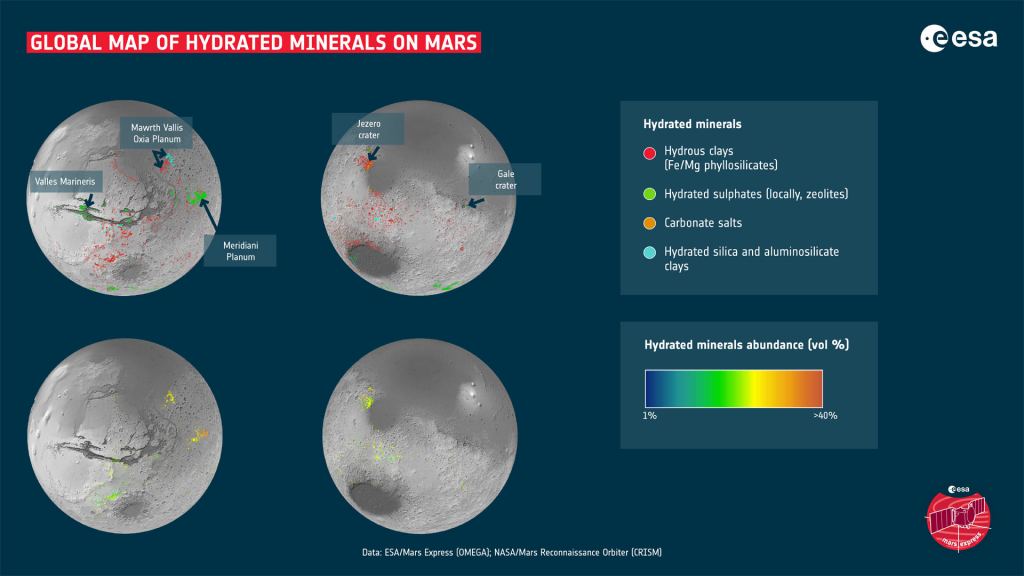
When the first high-resolution spectrometers reached Martian orbit, scientists expected to find vast swaths of carbonate-rich terrain. Instead, missions like the Mars Reconnaissance Orbiter (MRO) and the Mars Express found only trace amounts, often associated with impact craters or specific hydrothermal sites. This led to two primary theories: either the early Martian atmosphere was never as thick as believed, or the carbon had been stripped away by solar winds rather than being sequestered in the crust. The new findings from JAXA suggest a third, more complex possibility involving the specific mineralogy of the Martian crust and the behavior of its ancient subsurface plumbing.
Shifting Focus: The Importance of Feldspar-Rich Lithologies
Traditionally, models of Martian geochemistry have focused on "mafic" rocks—volcanic rocks rich in magnesium and iron, such as basalt. Basalt is the most common rock type on the Martian surface, and it was long assumed to be the primary reactant for carbonate formation. However, the study led by doctoral student Chang-Chin Wang and Professor Tomohiro Usui highlights a different class of minerals: feldspars.
Feldspars are aluminum-rich silicate minerals that constitute roughly 60% of the Earth’s crust. While once thought to be rare on Mars, recent data from the Curiosity and Perseverance rovers, along with orbital infrared spectroscopy, have confirmed that feldspar-rich rocks are far more prevalent on the Red Planet than previously estimated. These rocks are characterized by higher concentrations of calcium, sodium, and aluminum.
The JAXA-led team recognized a curious pattern in the carbonates that have been found on Mars. They generally fall into two categories: magnesium-rich carbonates and calcium/iron-rich carbonates. By modeling the interaction between water and feldspar-rich rocks, the researchers found that these specific minerals are highly efficient at producing the calcium/iron-rich carbonates observed in certain Martian regions. While mafic rocks tend to produce magnesium-rich carbonates, they only produce calcium/iron varieties during very brief windows of aqueous alteration. In contrast, feldspar-rich rocks consistently yield the types of carbonates that have puzzled scientists, providing a mineralogical link between the planet’s crustal composition and its missing carbon record.
Modeling Ancient Martian Geochemistry
To test their hypothesis, the research team employed PHREEQC Version 3, a sophisticated geochemical software package developed by the U.S. Geological Survey. This tool allowed the scientists to create one-dimensional thermochemical models that simulated how water moves through different types of rock under the atmospheric and thermal conditions of early Mars.
The simulations accounted for several variables, including:
- Time Scales: The models ran scenarios ranging from short-term "flash" alteration events lasting only a few years to sustained aqueous activity spanning 100,000 years.
- Hydrological Modes: The team compared two different ways water interacts with rock: "standing water" (diffusion) and "groundwater flow" (percolation).
- Mineral Composition: Simulations were run for both standard mafic (magnesium-iron) basalt and the more recently identified feldspar-rich (aluminum-calcium) rocks.
The results were definitive. In scenarios involving feldspar-rich lithologies, the chemical environment remained favorable for the precipitation of calcium and iron carbonates over long periods. More importantly, the simulations provided a breakthrough regarding the location of these minerals.
The Groundwater Sequestration Mechanism
One of the most significant findings of the study involves the vertical migration of minerals. The simulations showed that while carbonates might form at or near the surface, they are not stable there if groundwater continues to percolate through the soil.
According to the model, as CO2-rich water filters down from the surface, it initially forms carbonates in the upper layers of the regolith. However, as more water passes through, the chemistry of the water changes, often becoming capable of re-dissolving those same carbonates. This dissolved carbon is then carried deeper into the Martian crust, where it reprecipitates in higher concentrations at greater depths.
This "burial" process explains why orbital instruments, which can only "see" the top few microns or millimeters of the Martian surface, have failed to detect the massive carbonate deposits predicted by climate models. The carbon is not missing; it has been sequestered kilometers underground, shielded from the view of orbiting spectrometers and the shallow reach of current robotic arms. This parallels theories regarding Mars’ "missing water," which suggest that much of the planet’s ancient hydration is currently trapped in hydrated minerals or deep-seated permafrost rather than having been lost entirely to space.
Chronology of Martian Atmospheric Loss and Mineral Formation
The timeline of these processes is critical to understanding the transition of Mars from a habitable world to a frozen desert. The study suggests a specific chronological sequence:
- The Noachian Period (4.1 to 3.7 Billion Years Ago): Mars possesses a thick CO2 atmosphere and active precipitation. Water interacts with feldspar-rich and mafic crustal rocks, beginning the process of carbon sequestration.
- Carbonate Migration: Over hundreds of thousands of years, downward-percolating groundwater moves the majority of these carbonates into the deep subsurface.
- The Hesperian Transition (3.7 to 3.0 Billion Years Ago): Volcanic activity and a thinning atmosphere lead to a cooling climate. Surface water begins to freeze or evaporate, but groundwater remains active longer, continuing to bury carbon stores.
- The Amazonian Period (3.0 Billion Years Ago to Present): Mars becomes the hyper-arid environment we see today. The surface carbonates are eroded or covered by dust, leaving the bulk of the planet’s carbon history locked in the deep crust.
Implications for Future Exploration and the Search for Life
The findings of Wang, Usui, and Melwani Daswani have profound implications for the future of Martian exploration. If the planet’s carbon record and ancient water chemistry are preserved in deep carbonate reservoirs, current surface-level missions may only be scratching the surface of Martian history.
1. Targeting Drilling Sites:
Future missions, such as the European Space Agency’s Rosalind Franklin rover or proposed human missions, should prioritize regions with exposed feldspar-rich terrain. These areas are likely "windows" into the planet’s aqueous past. Furthermore, the study underscores the necessity of deep-drilling technology capable of reaching beyond the immediate surface layer.
2. Identifying Potential Bio-signatures:
Carbonates are excellent at preserving fossilized evidence of microbial life. On Earth, some of the oldest evidence of life is found in carbonate structures. If Mars has vast underground carbonate deposits, these could be the primary repositories for any biosignatures that formed during the planet’s habitable youth.
3. Understanding Atmospheric Evolution:
By quantifying how much carbon is stored underground, scientists can better calculate the original density of the Martian atmosphere. This will help resolve the debate over whether Mars lost its atmosphere primarily to space or to its own crust, providing vital data for models of planetary habitability across the galaxy.
Expert Analysis and Scientific Reaction
While the scientific community has yet to provide a universal consensus on the study, the initial reception from planetary geologists has been one of cautious optimism. The integration of feldspar—a mineral often sidelined in earlier Martian models—is being hailed as a necessary evolution in planetary geochemistry.
"For a long time, we were looking for a ‘basaltic’ solution to a global problem," says one independent planetary scientist not involved in the study. "By incorporating the diversity of the Martian crust, this team has provided a much more realistic framework for where the carbon went."
The collaboration between JAXA and ELSI highlights the growing role of international agencies in solving the fundamental mysteries of the solar system. As the Perseverance rover continues to collect samples in Jezero Crater—a site known to contain some carbonates—the data from this study will be instrumental in interpreting the chemical signatures found in those rocks. If the JAXA models are correct, the samples Perseverance is currently caching may be just the tip of a very large, underground iceberg of Martian history.
In conclusion, the mystery of Mars’ missing carbonates may finally have an answer that aligns with the planet’s watery past. Through a combination of specific mineralogy and the relentless downward flow of ancient groundwater, Mars appears to have performed a vanishing act, hiding its carbon record deep beneath the red dust. As humanity prepares for the next phase of exploration, the focus must shift from the surface to the depths, where the secrets of the Red Planet’s atmospheric demise and its potential for life remain buried.