Sisilia Frederika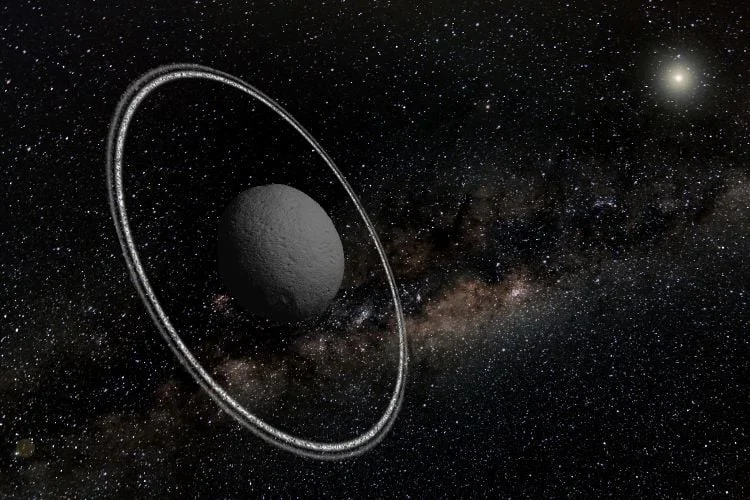
The exploration of the outer solar system has long been dominated by the study of the four gas and ice giants—Jupiter, Saturn, Uranus, and Neptune. However, recent astronomical investigations are shifting the focus toward the smaller, more enigmatic residents of the deep solar system: the Centaurs. Among these, (10199) Chariklo has emerged as a primary subject of interest. An international consortium of over two dozen researchers has recently published findings in the journal Science Advances, detailing a significant and unexpected evolution in Chariklo’s unique ring system. By comparing data from ground-based observations in 2017 with high-precision measurements from NASA’s James Webb Space Telescope (JWST) in 2022, scientists have detected dramatic changes in the density and opacity of the rings, suggesting a dynamic environment far more active than previously theorized for such a small celestial body.
The Nature of Centaurs and the Discovery of Chariklo
To understand the significance of these findings, one must first consider the unique classification of Chariklo. Centaurs are a population of small solar system bodies that orbit the Sun between Jupiter and Neptune. They are often described as "hybrid" objects, possessing characteristics of both asteroids and comets. Their orbits are inherently unstable because they frequently cross the paths of the giant planets, whose massive gravitational influence eventually ejects the Centaurs from the solar system or pulls them into the inner solar system to become short-period comets.
Chariklo was first discovered in 1997 by the Spacewatch program at the Kitt Peak National Observatory. With a radius of approximately 125 kilometers (78 miles), it is the largest known Centaur. For over a decade, it was viewed as a relatively standard, albeit large, icy rock. This perception changed fundamentally in 2013 when an occultation event revealed that Chariklo was not alone. As the Centaur passed in front of a distant star, the starlight blinked out not once, but three times: once for the main body and twice more for a pair of narrow, dense rings. This discovery was revolutionary, as it proved that ring systems were not the exclusive domain of massive planets like Saturn.
The Mechanics of Stellar Occultation
The primary tool used to study Chariklo’s rings is stellar occultation. This technique involves observing a distant star as a solar system object passes directly in front of it. Because the star is essentially a point source of light, the way its light is blocked provides an extremely high-resolution "shadow" of the foreground object.
While the transit method—famously used by missions like Kepler and TESS—measures the dip in light as a small planet passes in front of a large star, stellar occultation measures a relatively large solar system body passing in front of a much smaller, distant star. This allows astronomers to detect features that are far too small to be imaged directly, such as the thin rings of a Centaur or the delicate atmosphere of a dwarf planet like Pluto. The recent study utilized this method to compare the state of Chariklo’s rings across a five-year interval, providing a rare "before and after" look at a minor-body ring system.
A Comparative Chronology: 2017 vs. 2022
The research team established a baseline for Chariklo’s rings using a massive observational campaign in 2017. During this event, ground-based telescopes across the globe captured the occultation, allowing scientists to map the dimensions and opacity of the two rings, designated C1R (the inner ring) and C2R (the outer ring).
The 2017 data revealed that:
- C1R (Inner Ring): Located approximately 265 kilometers (165 miles) from Chariklo’s center, this ring was found to be the denser and wider of the two.
- C2R (Outer Ring): Located approximately 280 kilometers (174 miles) from the center, this ring was thinner and more diffuse.
In October 2022, the James Webb Space Telescope was deployed to observe a new occultation event. This marked a significant milestone, as it was the first time the JWST’s Near-Infrared Spectrograph (NIRSpec) instrument was used to study a minor-body ring system through occultation. The sensitivity of the JWST allowed for a level of precision unattainable by ground-based observatories, which are often hampered by atmospheric distortion.
Quantitative Findings: Gaining and Losing Material
When the researchers compared the 2022 JWST data to the 2017 baseline, the results were startling. The rings had undergone a massive transformation in their physical properties.
The study found that the opaqueness of the inner ring (C1R) had increased by more than 50 percent. Opaqueness, or optical depth, refers to the ability of an object to block light. An increase of this magnitude suggests that the inner ring has become significantly more crowded with particles, or that the particles themselves have changed in size or distribution.
Conversely, the outer ring (C2R) exhibited a decrease in opaqueness of approximately 60 percent. This indicates that the outer ring has become much more transparent, losing a substantial portion of its light-blocking material over the five-year period.
These findings suggest a "see-saw" effect where material may be migrating between the rings or being lost to space and replenished from the surface of Chariklo. The researchers noted that while the rings are stable enough to persist, they are not static; they are part of a living, evolving system.
Theories on Ring Dynamics and Shepherd Moons
The discovery of such rapid changes in a ring system around a body as small as Chariklo poses a significant challenge to existing models of planetary science. In the case of Saturn, rings are maintained by "shepherd moons"—small satellites whose gravity herds ring particles into place, preventing them from drifting away or clumping together.
While no moons have been definitively imaged around Chariklo, the dynamic behavior observed in the C1R and C2R rings strongly implies their existence. Small, undetected "shepherdettes" only a few kilometers in diameter could be responsible for the material shifts. These moons would exert gravitational tugs that could cause material to migrate from the outer ring to the inner ring, or vice versa, depending on their orbital resonances.
Another possibility involves the influence of Chariklo’s own shape and rotation. Because Chariklo is not a perfect sphere, its uneven gravitational field could create "traps" or "voids" in the ring plane. Additionally, if Chariklo experiences outgassing—similar to a comet—the pressure from escaping gases could push dust and ice particles into the rings, replenishing them over time.
Supporting Data and Technical Analysis
The researchers’ analysis of the JWST data also provided insights into the composition of the rings. The NIRSpec data showed clear signatures of crystalline water ice. This is particularly interesting because, at Chariklo’s distance from the Sun (roughly 13 to 19 Astronomical Units), the environment is cold enough to preserve ice, but solar radiation and micrometeoroid impacts should gradually turn crystalline ice into amorphous ice over millions of years.
The presence of crystalline ice suggests that the rings are either relatively young or are being constantly "refreshed" by fresh material from within Chariklo or through high-velocity collisions between ring particles that "re-crystallize" the ice. The 50 percent increase in the inner ring’s density could be evidence of a recent "injection" of fresh material, perhaps from a small impact on Chariklo’s surface that ejected debris into orbit.
Broader Implications for Planetary Science
The implications of this study reach far beyond the study of Centaurs. For decades, the "standard model" of ring formation suggested that rings were either the remnants of a destroyed moon or leftover material from the formation of the planet. These rings were thought to be stable over millions of years.
The Chariklo observations suggest a much more "short-term" and volatile lifecycle for rings around small bodies. If a 250-kilometer rock can maintain and modify a complex ring system, it suggests that rings might be a common feature among other large Centaurs, Kuiper Belt Objects, and even some asteroids. This expands the list of potential targets for future missions and changes how we calculate the mass and evolution of small bodies in the outer solar system.
Furthermore, the successful use of the JWST for stellar occultation opens a new frontier in "high-resolution" astronomy. The telescope’s ability to track the shadow of a ring system across the vacuum of space demonstrates that we can study the fine structure of objects billions of miles away with a level of detail previously reserved for flyby missions like Voyager or New Horizons.
Official Responses and Future Outlook
In the study, the researchers emphasized that while the data is clear, the physical origin of the changes remains an "open question." The team noted that the unexpected changes point to "dynamical behavior that had remained entirely hidden until now." This sentiment reflects a broader excitement in the astronomical community regarding the capabilities of the JWST to tackle solar system mysteries.
The international team, which included experts from the Observatoire de Paris and various NASA-affiliated institutions, has called for continued monitoring of Chariklo. Future occultation events will be critical in determining whether the rings fluctuate in a periodic cycle or if the observed changes represent a one-way evolution toward the eventual dissipation or consolidation of the rings.
As the JWST continues its mission, Chariklo remains a high-priority target. Scientists hope to use the telescope to search for the hypothesized shepherd moons and to perform deeper spectroscopic analysis to identify non-ice components of the rings, such as organic compounds or silicates.
The study of Chariklo serves as a reminder that the solar system is rarely as static as it appears. Even in the cold, dark reaches beyond Saturn, tiny worlds are undergoing rapid transformations, governed by the complex interplay of gravity, collisions, and the remnants of the solar system’s birth. The "pocket rings" of Chariklo, once a mere curiosity, are now a window into the fundamental processes that shape every ringed world in our celestial neighborhood.