Sisilia Frederika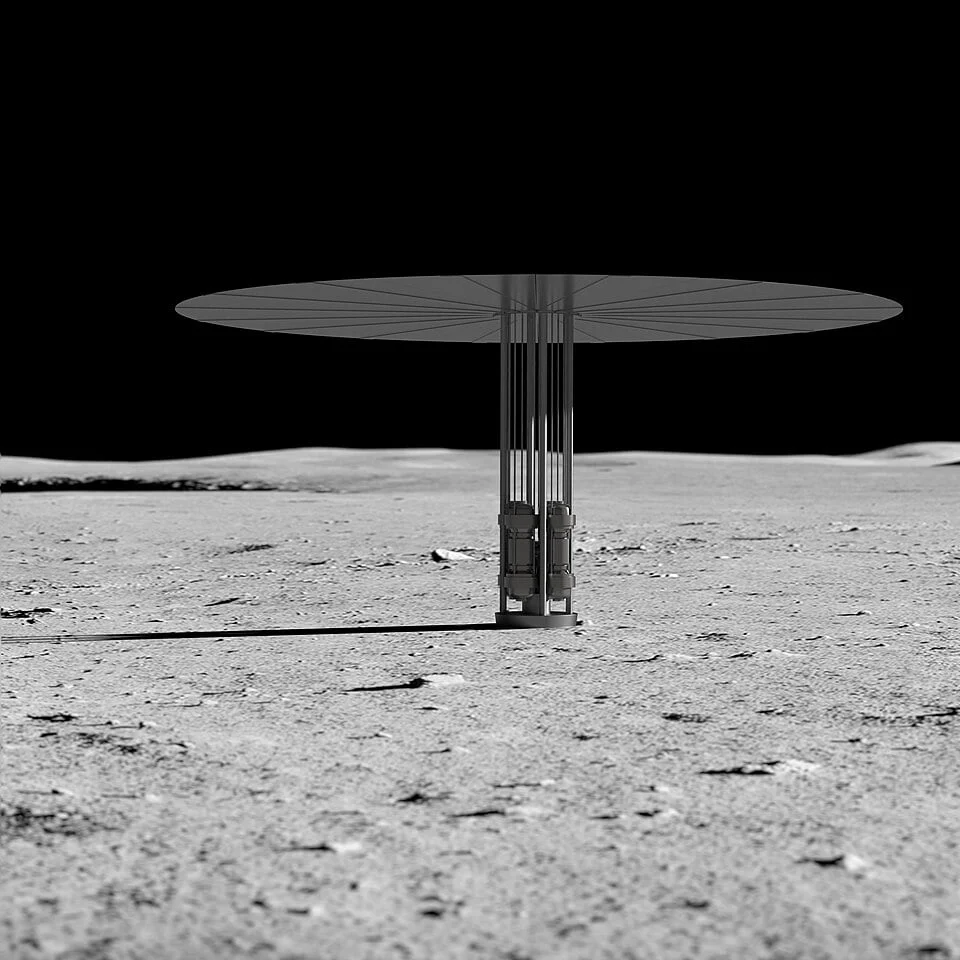
As the international community accelerates its efforts to establish a sustained human presence on the Moon, engineers and physicists are confronting the most formidable environmental obstacle to lunar habitation: the lunar night. Lasting approximately 354 hours—or roughly 14 Earth days—the lunar night subjects the lunar surface to temperatures as low as -223°C (-370°F). For any permanent settlement, the reliance on solar energy is insufficient to bridge this two-week gap of darkness, and the logistical costs of transporting traditional chemical fuels from Earth are economically ruinous. In response to this challenge, a research team led by Julius Mercz of the Technical University of Munich has proposed a sophisticated solution in a new paper available on the preprint server arXiv. Their design, the Microreactor Utilisation for Lunar Exploration (MULE), represents a strategic shift from traditional nuclear designs by integrating power generation with industrial resource extraction.
The Economic and Physical Necessity of ISRU
The cornerstone of modern lunar strategy is In-Situ Resource Utilization (ISRU), colloquially known as "living off the land." The current cost of delivering payloads to the lunar surface remains a primary bottleneck for space agencies; estimates suggest that shipping supplies can cost between $50,000 and $100,000 per kilogram depending on the launch vehicle and mission profile. To mitigate these costs, lunar bases must transition from being "supply-depots" to "self-sustaining industrial hubs."
The lunar surface is covered in regolith, a fine layer of fragmented rock and dust. While appearing inhospitable, regolith is rich in oxygen and metallic elements, including iron, aluminum, and titanium. However, these resources are chemically locked within mineral oxides. Extracting them requires immense amounts of energy, specifically thermal energy. The MULE reactor is designed not merely as a "battery" for life support, but as the thermal engine for a lunar industrial revolution.
The Technical Architecture of the MULE Reactor
The MULE design departs from conventional nuclear paradigms through its "thermal cascade" system. In traditional terrestrial and space-based nuclear reactors, a significant portion of the energy produced—often upwards of 60%—is lost as waste heat during the conversion to electricity. The MULE reactor seeks to capture this "waste" by utilizing it in a tiered sequence of applications based on temperature requirements.
At the apex of this cascade is the Molten Salt Electrolysis (MSE) process. To extract oxygen and metals from regolith, the material must be dissolved in a liquid salt bath and subjected to an electrical current. This process requires temperatures exceeding 900°C. The MULE reactor is engineered to provide a direct thermal output of approximately 1,000°C to the MSE plant. By providing direct heat rather than converting heat to electricity and back to heat via resistive elements, the system achieves unprecedented efficiency. To ensure stability, the design incorporates a thermal storage bank, acting as a buffer to maintain the high temperatures required for chemical processing even during reactor maintenance or fluctuations in demand.
Following the high-heat industrial stage, the remaining thermal energy is funneled into a closed-loop Brayton cycle. In this stage, the expanding gas—typically helium—powers a turbine at roughly 750°C to generate the electrical power necessary for the base’s avionics, communications, and internal systems. Once the gas has passed through the turbine, it retains a temperature of approximately 150°C. Rather than being discarded, this heat is utilized to maintain the internal climate of human habitats. Finally, the residual heat, now at 75°C, is expelled into the vacuum of space via infrared thermal radiators.
Advanced Safety and Material Engineering
A critical innovation of the MULE reactor lies in its fuel and core construction. The design utilizes TRistructural-ISOtropic (TRISO) fuel particles. Each particle, roughly the size of a poppy seed, consists of a uranium-carbide fuel kernel encased in three layers of carbon and ceramic (silicon carbide) shells. These layers act as individual pressure vessels that contain fission products and remain stable at temperatures that would melt conventional fuel rods.
The core itself is a ceramic structure made of silicon carbide, containing 37 hexagonal fuel assemblies. To achieve the necessary power density in such a compact frame, the fuel is enriched to 93% U-235. While this level of enrichment is high, the inherent safety of the TRISO particles and the ceramic core provides a "melt-proof" guarantee, essential for a reactor operating in an environment where emergency intervention from Earth is impossible.
Control of the nuclear reaction is achieved through six pivot-controlled drums located around the perimeter of the core. Unlike terrestrial control rods that slide in and out of the core, these drums rotate. One side is coated with boron-carbide, a neutron absorber that slows the reaction, while the other side features beryllium oxide, a neutron reflector that increases the reaction rate. This mechanical simplicity reduces the risk of failure in the abrasive, dust-heavy lunar environment.
Dimensions, Weight, and Launch Compatibility
For any lunar technology to be viable, it must fit within the payload fairings and mass limits of contemporary heavy-lift rockets. The MULE reactor is remarkably compact, measuring 2.3 meters in length and 0.78 meters in width. With a total mass of 2.1 metric tons, it is well within the lift capacity of the SpaceX Starship, which is expected to deliver over 100 tons to the lunar surface, or Blue Origin’s New Glenn.
This small footprint allows for a modular approach to lunar power. Multiple MULE units could be deployed to different sectors of a lunar colony, providing redundancy. If one unit requires maintenance, others can maintain the thermal and electrical load, preventing a catastrophic failure of the habitat’s life support during the lunar night.
Simulation Results and Unprecedented Longevity
To validate the theoretical design, Mercz and his colleagues utilized Serpent 2, a sophisticated Monte-Carlo neutron transport code. This software simulates the behavior of millions of individual neutrons within the reactor core to predict fuel depletion and reactivity over time.
While the researchers initially aimed for a 10-year operational lifespan—a standard benchmark for space-based nuclear systems—the results of the simulation were startling. After a simulated decade of operation, the control drums had only rotated 5.34 degrees to compensate for fuel burn-up, and 98% of the uranium remained unconsumed. Further analysis indicated that the MULE reactor, in its current configuration, could theoretically operate for up to 95 years without refueling.
This longevity is a game-changer for lunar economics. A power plant that can last nearly a century eliminates the need for frequent, dangerous, and expensive refueling missions, allowing the lunar colony to focus its resources on expansion and scientific research.
Challenges and Future Considerations
Despite the promising simulations, significant engineering hurdles remain. The use of high-temperature helium as a heat transfer fluid is notoriously difficult due to the gas’s tendency to leak through even microscopic apertures. Furthermore, while ceramics like silicon carbide are excellent for heat resistance, they are brittle and susceptible to cracking under extreme thermal shock.
Another unresolved issue is radiation shielding. The current 2.1-ton mass estimate does not include heavy lead or water shielding to protect human occupants from gamma rays and neutrons. The authors propose a "Starcraft-style" solution: burying the reactor under several meters of lunar regolith. Regolith is an excellent radiation shield, but this strategy assumes the existence of autonomous lunar excavation machinery. Currently, humanity lacks the heavy equipment on the Moon capable of digging the necessary trenches or boreholes to house such a reactor.
The Geopolitical and Strategic Context
The development of the MULE reactor concept arrives at a time of renewed geopolitical interest in the Moon. NASA’s Artemis program, the China National Space Administration’s (CNSA) International Lunar Research Station (ILRS), and private ventures like those from ESA and Roscosmos are all vying for a foothold at the lunar South Pole.
The South Pole is highly coveted due to the presence of water ice in Permanently Shadowed Regions (PSRs). However, the terrain is rugged and the lighting conditions are complex. Nuclear power is widely recognized as the only viable solution for high-power industrial operations in these regions. The MULE reactor represents a significant contribution to this "Power Race," offering a blueprint for how a lunar base can transition from a scientific outpost to a self-sustaining industrial colony.
Conclusion and Implications
The MULE reactor proposal by Mercz et al. provides a rigorous technical framework for solving the dual problems of lunar survival and resource independence. By viewing heat as a primary product rather than a byproduct, the design maximizes the utility of every gram of uranium.
The transition from theoretical pre-print to physical prototype will require years of material science testing and international cooperation on nuclear safety standards in space. However, the data provided by the Serpent 2 simulations suggests that the physics of the MULE reactor are not only sound but exceptionally efficient. As the 2030s approach—the decade many agencies have targeted for the first permanent lunar structures—the integration of microreactors like MULE will likely be the deciding factor in whether humanity becomes a multi-planetary species or remains tethered to the terrestrial cradle.