Clarissa Hana
Over the past two decades, the internet has fundamentally reshaped itself, driven by a business model that thrives on extensive knowledge of its users. Every application installed, every account created, every website visited, and every online form completed contributes to a vast data collection system designed to track, profile, and ultimately monetize individuals and their digital identities. This pervasive practice, often termed surveillance capitalism, transforms personal data and user attention into commodities, with individuals serving as the raw material.
The insidious nature of this data aggregation often goes unnoticed in daily online interactions. A single email address, for instance, can become a linchpin, connecting disparate aspects of a user’s life, including shopping habits, health-related searches, location history, and social connections. This intricate web of personal information is then further consolidated by data brokers, entities specifically established to aggregate, buy, sell, and cross-reference fragments of individuals’ lives. Their objective is to construct detailed profiles that often exceed a user’s own self-awareness.
Crucially, this extensive data collection and profiling often occur without explicit user knowledge or informed consent, operating as the default mode of the internet. Data brokers, in particular, represent a significant segment of personal information handlers who function largely outside the purview of consumer awareness, leading to a situation where privacy is no longer an inherent right but a construct that users must actively and painstakingly build. The repercussions of this model are often diffuse and delayed, unlike the immediate impact of a stolen credit card. Instead, the damage manifests as increased spam, discriminatory pricing, identity theft, and a general erosion of control over one’s digital self.
The growing sophistication of Artificial Intelligence (AI) has exacerbated this challenge. AI systems empower data brokers to link disparate online actions in ways previously considered impossible. AI’s core strength lies in its capacity for massive data analysis, enabling the correlation of vast amounts of information to forge highly detailed and valuable user profiles. This raises a critical question: in an era of pervasive surveillance capitalism, can the balance of online privacy be shifted back in favor of the individual, and is it truly possible to maintain privacy, security, and safety online?
The Mechanics of Surveillance Capitalism
The digital economy has, over the last twenty years, evolved into a complex ecosystem where personal data is the primary currency. This transformation, driven by the rise of the internet and mobile technology, has seen companies shift from selling products directly to selling access to user attention and data. The underlying principle is simple: the more a company knows about an individual, the more effectively it can target advertising, influence purchasing decisions, and personalize user experiences. This personalization, while often presented as a benefit, is the very mechanism that fuels the surveillance engine.
The ubiquity of online services and applications means that virtually every digital interaction leaves a trace. From browsing history and search queries to social media activity and online purchases, a constant stream of data is generated. This data is then collected, analyzed, and often enriched with information from third-party sources, creating a comprehensive digital footprint for each user. This footprint is then segmented and sold to various entities, including advertisers, marketers, and even political campaigns, for purposes that are not always transparent to the individual.
The Unseen Threat: Data Brokers and the Fragmented Self
Data brokers operate in a largely unregulated space, aggregating information from public records, online activities, and data purchased from other sources. These entities play a pivotal role in the surveillance capitalism ecosystem. They act as intermediaries, piecing together fragments of personal information to build detailed profiles that can include demographics, interests, purchasing habits, financial status, and even sensitive personal details like health concerns or political affiliations.
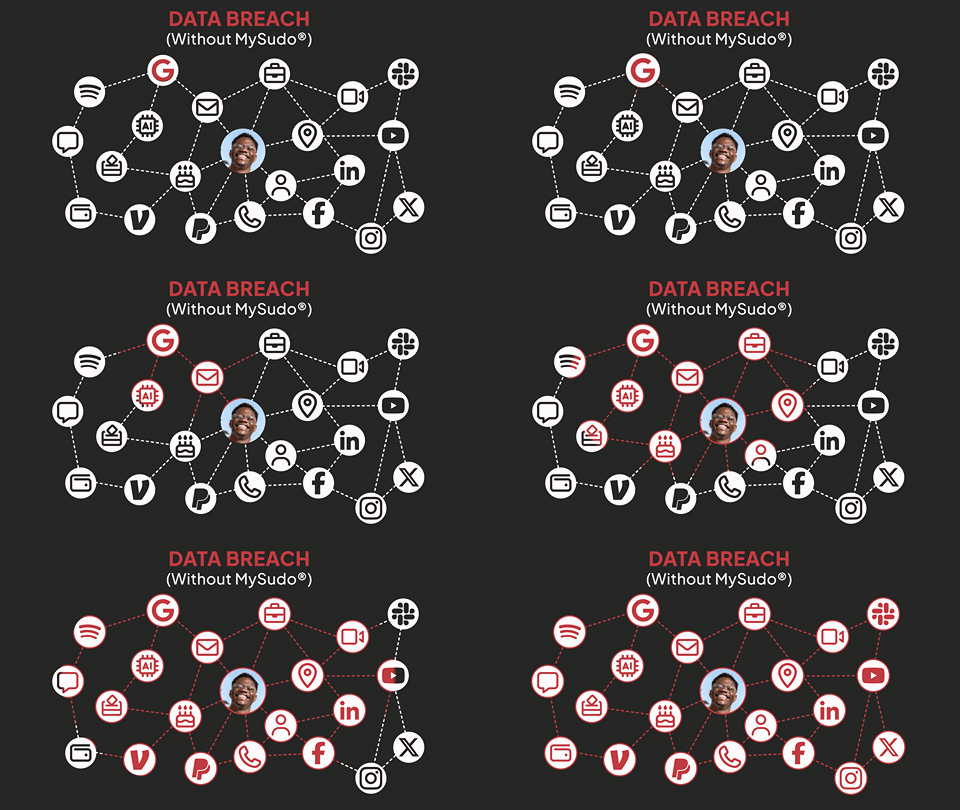
The danger lies in the sheer volume and interconnectedness of this data. A single data breach, which has become an alarmingly frequent occurrence, can expose an entire interconnected network of personal information. Without effective compartmentalization, such a breach can link a user’s activities across various platforms and services, leading to a complete compromise of their digital identity. The graphic below illustrates this vulnerability: a data breach without robust protective measures can expose a user’s entire online persona, making them susceptible to identity theft and targeted exploitation.
The AI Accelerator: Amplifying Data Linkage and Profiling
The advent of advanced AI technologies has significantly amplified the capabilities of data brokers and surveillance entities. AI algorithms are adept at identifying patterns and correlations within massive datasets that would be impossible for humans to discern. This allows for the linkage of seemingly unrelated data points, creating a more granular and accurate picture of an individual’s life. For example, AI can now correlate browsing history, social media interactions, and even app usage patterns to infer highly specific details about a person’s lifestyle, preferences, and vulnerabilities.
This enhanced data linkage capability means that the profiles constructed by data brokers are becoming increasingly sophisticated and potentially more damaging. They can be used for discriminatory practices, such as denying loans or insurance based on inferred risk factors, or for highly targeted political manipulation. The speed and scale at which AI can process and analyze data mean that the traditional methods of online privacy protection are struggling to keep pace.
Reclaiming Digital Autonomy: The Power of Compartmentalization
The fundamental premise of surveillance capitalism is the aggregation of data to create a unified, exploitable profile. Therefore, the most effective countermeasure lies in disrupting this aggregation by breaking the correlating identifiers that link different aspects of a user’s online life. This principle is at the heart of a strategy known as compartmentalization, which involves deliberately segmenting online activities into separate, purpose-built digital identities, or "personas."
Instead of using a single email address, phone number, payment method, and online handle for all digital interactions, compartmentalization advocates for creating distinct personas for different contexts. For example, one persona might be dedicated to online shopping, another to social media, a third to travel bookings, and yet another for engaging with online communities or forums. Each persona would operate with its own unique set of identifiers – a dedicated email address, a separate phone number, a distinct payment method, and a unique communication handle.
The critical element of this approach is ensuring that these personas are not interconnected, either with each other or with the user’s actual identity, in a way that a data broker or advertiser could easily trace. This creates a crucial layer of separation. The graphic below demonstrates the efficacy of this strategy: if one persona is compromised in a data breach, attracts spam, or is sold to a marketing list, the damage is contained within that specific persona. The user’s core identity and other digital lives remain protected and untied to the compromised segment.
This compartmentalization model represents a significant departure from conventional privacy tools. While many security solutions focus on fortifying a single identity with stronger passwords, enhanced encryption, and more stringent permission controls, compartmentalization operates on the assumption that any single identity is ultimately vulnerable to correlation. It anticipates inevitable breaches and data leaks by ensuring that no single identity holds significant interconnected value. The goal is not to build an impenetrable fortress around one identity but to avoid concentrating all one’s digital value behind a single, easily identifiable wall.
The elegance of this compartmentalization strategy lies in its independence from the broader internet ecosystem. It does not require every company and service provider to fundamentally alter their data collection and privacy practices. Instead, it introduces a user-centric layer that generates and manages these distinct personas, acting as a buffer between the individual and the data-hungry digital landscape. This approach empowers users to take proactive control of their digital footprint without waiting for systemic change.
MySudo: Implementing Compartmentalization for Everyday Users
While the concept of compartmentalization offers a robust solution to the challenges of surveillance capitalism, its practical implementation for the average user presents a significant hurdle. The complexity of managing multiple email addresses, phone numbers, and payment methods for each online activity can be daunting and unsustainable for most individuals. This is where solutions like MySudo emerge, aiming to bridge the gap between advanced privacy concepts and user-friendly accessibility.
MySudo, developed by Anonyome Labs, is designed to embody the principles of compartmentalization and persona creation, making them manageable for everyday users. The application allows individuals to create multiple distinct digital identities, referred to as "Sudos." Each Sudo functions as a self-contained unit, providing a unique email address, a dedicated phone number, and other essential identifiers that are entirely separate from the user’s primary identity and other Sudo profiles.
The core innovation of MySudo lies in its ability to automate and simplify the creation and management of these personas. Users can generate up to nine distinct Sudo profiles, each tailored for specific online activities. This means that when engaging in online shopping, for example, a user can activate their "shopping" Sudo, utilizing its unique email and phone number. Should that shopping platform experience a data breach, or begin bombarding the user with spam, the repercussions are confined to that specific Sudo, leaving their personal identity and other online activities unaffected.
MySudo is part of a broader suite of privacy and security tools offered by Anonyome Labs. This family of products includes a privacy-focused Virtual Private Network (VPN) and an upcoming password manager, further strengthening the user’s ability to create a secure and private digital environment. The objective is to provide users with a comprehensive toolkit to navigate the online world with greater control and confidence.
The Broader Implications and the Path Forward
The proliferation of surveillance capitalism and the increasing sophistication of data collection methods pose significant challenges to individual autonomy and privacy. The ability of entities to amass detailed profiles of individuals, often without their knowledge or consent, has profound implications for democratic societies, economic fairness, and personal liberty. The erosion of privacy can lead to a chilling effect on free expression, enable discriminatory practices, and create vulnerabilities for exploitation.
The strategy of compartmentalization, as exemplified by tools like MySudo, represents a critical shift in how individuals can approach online privacy. It moves away from a passive reliance on data protection policies and towards an active, proactive construction of digital identity. By de-linking personal data and segmenting online activities, users can significantly reduce their exposure to the pervasive data collection and profiling mechanisms that define the current internet landscape.
The ongoing development of privacy-enhancing technologies, coupled with increased awareness among users, signals a potential recalibration of the online privacy paradigm. While the challenges are substantial, the tools and strategies for reclaiming digital autonomy are becoming more accessible. The future of online privacy hinges on the ability of individuals to understand the risks and adopt robust methods for managing their digital identities. As the saying goes, "Your identity is already being pieced together. Stop handing over the pieces." The adoption of compartmentalization represents a powerful step in that direction, empowering individuals to regain control over their digital lives in an increasingly data-driven world.