Garick Elordi
The traditional game modding landscape, long defined by meticulous manual coding and asset creation, is currently facing a significant internal schism as a new wave of "vibe-coded" content begins to flood social media platforms. Veteran developers within the community are voicing growing frustration over what they describe as a "bullshit trend" of generative AI-driven mashups—projects that use large language models (LLMs) to bridge disparate game engines and assets with minimal human intervention. This phenomenon, often characterized by the jarring insertion of high-fidelity modern assets into classic titles or the crossing of intellectual property boundaries, has sparked a debate over the future of digital craftsmanship and the ethics of automated software manipulation.
At the heart of the controversy is the concept of "vibe-coding," a term used to describe the process where a user provides a high-level natural language description to an AI model, which then generates the underlying code or scripts necessary to implement a feature. While this lowers the barrier to entry for prospective creators, long-time modders argue that the results are frequently "slop"—unpolished, buggy, and devoid of the creative intentionality that has historically defined the modding scene.
The Technological Catalyst: Claude Opus 5.5 and Astra 6
The sudden surge in these AI-generated mashups can be traced back to recent advancements in the efficiency and affordability of generative models. Specifically, the release of updates to models like Claude Opus 5.5 has significantly lowered the cost of "tokens"—the units of data processed by the AI—while simultaneously improving the model’s ability to interpret and generate complex code. These models are now capable of analyzing decompiled game data and suggesting the necessary "glue code" to port assets from one engine to another.
In a direct comparison of the technology’s current capabilities, footage popularized by digital creators has showcased the limitations of these automated tools. When testing Claude Opus 5.5 against OpenAI’s Astra 6 model, observers noted that while the AI could successfully place assets into new environments, it struggled with the fundamental logic of game design. Common issues included non-player characters (NPCs) that remained entirely static or ignored the player’s presence, and complex vehicles, such as space fighters, that displayed broken physics—flying in one direction while their weapon systems fired in another.
Despite these technical shortcomings, the speed at which these mods can be produced has allowed a small group of users to dominate social media feeds, particularly on X (formerly Twitter). This "engagement farming," as some critics call it, focuses on the visual shock value of seeing a holographic sight from a modern tactical shooter inside a medieval village, rather than the functional quality of the gameplay experience.
A Week of Digital Collisions: The Mashup Phenomenon
The past seven days have seen an unprecedented volume of these "impossible" crossovers appearing online. Among the most shared examples are:
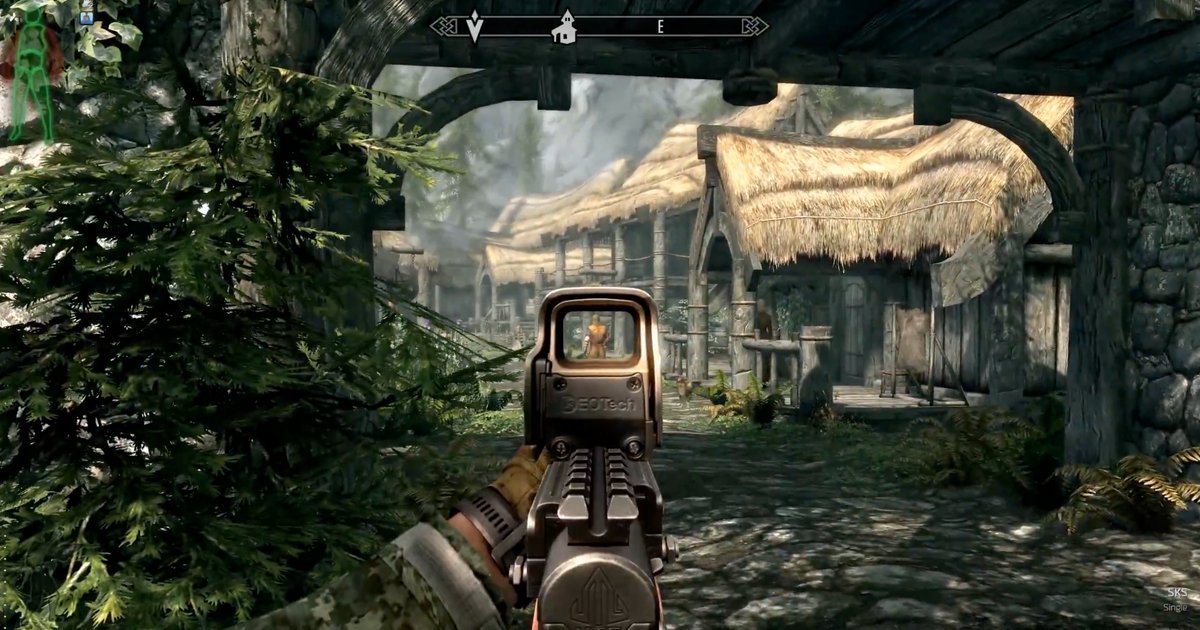
- Escape from Tarkov in Skyrim: This mod attempts to bring the high-stakes, tactical gunplay and hyper-realistic weapon attachments of Battlestate Games’ shooter into the fantasy world of Bethesda’s Elder Scrolls V. Screenshots often show players looking through advanced optics at thatched-roof cottages and dragons.
- World of Warcraft in Call of Duty: World at War: A mashup that places the stylized, high-fantasy assets of Azeroth into the gritty World War II setting of Treyarch’s 2008 shooter.
- Spider-Man in Gotham City: Using assets from Insomniac Games’ Spider-Man, users have demonstrated the web-slinging hero traversing the dark, gothic architecture of Batman: Arkham City.
While these clips garner millions of views, they are conspicuously absent from major community hubs like Nexus Mods. This absence is not due to a lack of technical interest from the community but rather the immense legal and ethical hurdles associated with their creation.
The Modder Backlash: Craftsmanship vs. Automation
The reaction from the established modding community has been overwhelmingly negative. For many, modding is an art form that requires years of learning specific engine quirks, such as Bethesda’s Creation Kit or Valve’s Source Engine. The introduction of AI-generated content is seen as a devaluation of that labor.
A prominent modder known as kran27 expressed the sentiment of many peers, stating, "I mod games and I’m not shy about the fact that I use AI to do it. I hate this bullshit ‘trend’. Pure slop, there’s nothing creative about this at all." The distinction kran27 makes is between using AI as a productivity tool for specific tasks and using it to generate an entire project without understanding the underlying mechanics.
Another developer, operating under the pseudonym discountmodder, suggested that the proliferation of AI content might lead to an exodus of talented creators. "If this becomes the permanent state of modding, this may be my last project," they remarked. "I don’t wanna be involved in an AI slop-factory."
The term "slop-factory" has become a rallying cry for those who believe that AI-generated mods are flooding the market with low-quality content that makes it harder for high-effort, manually crafted mods to find an audience.
Intellectual Property and the Nexus Mods Policy
Beyond the aesthetic and philosophical complaints lies a more concrete danger: copyright infringement. Almost all the current "vibe-coded" mashups rely on decompiled code and ripped assets from proprietary software. Porting a character model from a PlayStation-exclusive title like Spider-Man into a Warner Bros. Games title like Batman: Arkham City is a direct violation of multiple End User License Agreements (EULAs).
Nexus Mods, the world’s largest hosting platform for game modifications, took a proactive stance on this issue as early as 2023. Their policy explicitly warns creators against the use of generative AI tools that utilize unlicensed datasets. "In order to prevent any issues with your mods, we encourage you to avoid using these tools unless you have explicit permission to use all the assets," the policy states.

Because these AI models are often trained on copyrighted codebases and because the "mashup" trend inherently involves the theft of assets from one game to be used in another, these projects are effectively banned from reputable hosting sites. This has relegated the trend to social media, where creators can gain "clout" without having to provide a functional, downloadable file that would subject them to a DMCA (Digital Millennium Copyright Act) takedown.
Corporate Crackdowns and the Future of the Community
The rise of AI modding comes at a time when major game publishers are already tightening their grip on community-created content. Rockstar Games, the developer behind the upcoming and highly anticipated Grand Theft Auto 6, recently updated its modding guidelines to impose stricter restrictions. These new rules are designed to protect the company’s intellectual property and prevent the monetization of mods that could compete with their own live-service offerings.
Industry analysts suggest that the "vibe-coding" trend could provide publishers with the ammunition they need to shut down modding communities entirely. If AI makes it easy to create "derivative works" that infringe on copyrights across multiple franchises, companies may move toward more "closed" ecosystems where modding is either strictly controlled or banned to avoid legal liability.
The long-term implications for the PC gaming community are profound. For decades, modding has been a pipeline for talent into the professional industry; many lead designers at major studios began their careers making maps for Doom or skins for Quake. If the barrier to entry is replaced by a "generate" button, the community risks losing the skill-building pipeline that has sustained game development for thirty years.
Conclusion: A Community at a Crossroads
As the "vibe-coded" trend continues to evolve, the modding community finds itself at a crossroads. On one side are the proponents of AI who see these tools as a way to democratize game development and create cross-over experiences that were previously the stuff of fan-fiction. On the other side are the traditionalists who see the trend as a threat to the integrity of the craft and a legal ticking time bomb.
The immediate future of modding will likely be defined by how platforms like Nexus Mods and Steam Workshop navigate the influx of AI content. If they can successfully filter out the "slop" while allowing for the responsible use of AI as a tool, the community may survive. However, if the trend of asset-flipping and "vibe-coding" continues to dominate the public perception of modding, the era of the independent, creative modder may be drawing to a close, replaced by a landscape of automated, corporate-restricted content.