Sisilia Frederika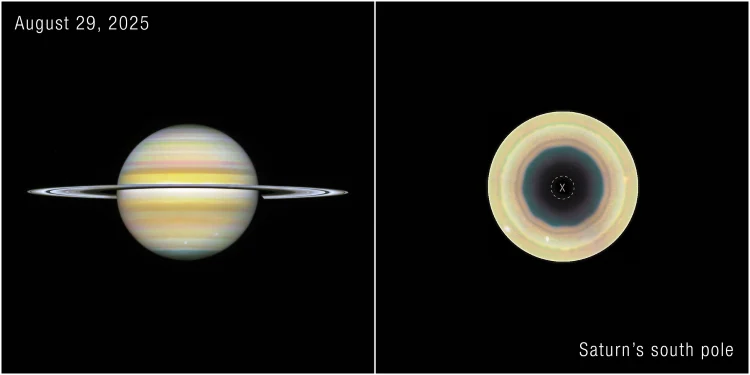
The planet Saturn, long celebrated for its majestic and complex ring system, has revealed a new atmospheric mystery that is reshaping the scientific understanding of gas giant dynamics. An international team of researchers, utilizing data from the Hubble Space Telescope (HST) and ground-based observatories, has identified a massive, ten-sided atmospheric structure—a decagon—encircling the planet’s southern pole. This discovery, detailed in a study recently published in the journal Science Advances, represents the first time such a geometric phenomenon has been observed in Saturn’s southern hemisphere, contrasting sharply with the famous hexagonal storm that has dominated the northern pole for decades.
The detection of the southern decagon was made possible through the Outer Planet Atmospheres Legacy (OPAL) program, a long-term NASA initiative designed to monitor the seasonal and atmospheric changes of the solar system’s outer planets. While the northern hexagon has remained a stable fixture of Saturnian geography since its discovery by the Voyager missions in the early 1980s, the southern pole has historically appeared much more chaotic and less structured. This new finding suggests that Saturn’s atmosphere is far more dynamic and responsive to seasonal shifts than previously theorized, providing a rare opportunity for scientists to witness the birth and evolution of a planetary-scale weather pattern.
The Discovery and Technical Observation Framework
The identification of the southern decagon resulted from a meticulous analysis of high-resolution imagery captured between 2023 and 2025. The primary data source was the Hubble Space Telescope’s Wide Field Camera 3, operating under the OPAL program. Since 2014, OPAL has provided annual global maps of Jupiter, Saturn, Uranus, and Neptune, allowing researchers to track subtle shifts in cloud color, wind speed, and storm frequency.
To corroborate the Hubble findings, the team utilized the Calar Alto Observatory in Almería, Spain. As the largest astronomical complex in continental Europe, Calar Alto provided the necessary ground-based infrared and optical support to confirm that the decagonal shape was not a transient optical artifact but a deeply rooted atmospheric feature. By combining space-based clarity with ground-based persistence, the researchers were able to map the boundaries of the decagon with unprecedented precision.
The structure is formed by a powerful jet stream that encircles the southern polar region. While the northern hexagon is defined by a jet stream traveling at approximately 320 to 354 kilometers per hour (200 to 220 miles per hour), the southern decagon is associated with significantly faster winds. The researchers clocked the southern jet stream at speeds ranging from 400 to 420 kilometers per hour (approximately 250 miles per hour). This discrepancy in velocity is one of several factors that distinguish the new southern feature from its northern counterpart.
Comparative Dynamics: Hexagon vs. Decagon
For over 40 years, the northern hexagon has been the gold standard for stable planetary polygons. It is a stationary wave pattern—a Rossby wave—that remains fixed relative to the planet’s rotation. In contrast, the newly discovered southern decagon exhibits a much more "fluid" behavior. According to the study, the decagon is not stationary; it is migrating in an eastward direction.
The researchers observed that the ten "corners" of the decagon undergo a periodic oscillation, swaying back and forth roughly every 32 days. This movement suggests that the southern decagon behaves less like a rigid structural boundary and more like a meandering atmospheric wave that penetrates multiple layers of the Saturnian atmosphere. Dr. Amy Simon, Senior Scientist for Planetary Atmospheres Research at NASA’s Goddard Space Flight Center and a co-author of the study, emphasized the uniqueness of this behavior.
"The northern hexagon has been there every time we’ve looked for more than 40 years," Dr. Simon noted. "This feature is different—it appears to be strengthening, giving us the rare opportunity to watch a giant atmospheric pattern develop."
The migration and oscillation of the decagon suggest a complex interaction between Saturn’s internal heat and the solar radiation reaching the southern hemisphere. Because Saturn takes approximately 29.5 Earth years to orbit the Sun, each season lasts more than seven years. The southern hemisphere is currently transitioning through a seasonal phase that may be providing the thermal energy necessary to organize chaotic polar winds into this geometric pattern.
Historical Context and the Cassini Gap
One of the most striking aspects of this discovery is its absence in previous data sets. NASA’s Cassini spacecraft orbited Saturn for 13 years, from 2004 to 2017, providing the most intimate look at the planet in human history. During its "Grand Finale" mission, Cassini performed close flybys of the poles, yet it never recorded a decagonal structure in the south. At that time, the southern pole was dominated by a massive, hurricane-like vortex with a well-defined eye, but no polygonal boundaries were detected.
The absence of the decagon during the Cassini era implies that the structure is a relatively recent development. This timeline suggests that Saturn’s polar atmospheres are subject to cyclical changes that occur on decadal scales. Scientists believe that as the southern hemisphere moved further into its summer and toward autumn, the changing angle of sunlight altered the temperature gradients in the upper atmosphere. These gradients are the primary drivers of the jet streams; a shift in temperature can cause a jet stream to become unstable, eventually settling into a polygonal shape as a way to maintain equilibrium.
The transition from a circular vortex to a ten-sided polygon represents a significant phase shift in fluid dynamics. In laboratory experiments involving rotating tanks of fluid, researchers have successfully recreated polygons by varying the speed of rotation and the viscosity of the liquid. The discovery of a decagon on Saturn provides a real-world laboratory to test these fluid dynamics theories at a planetary scale.
Broader Implications for Planetary Science
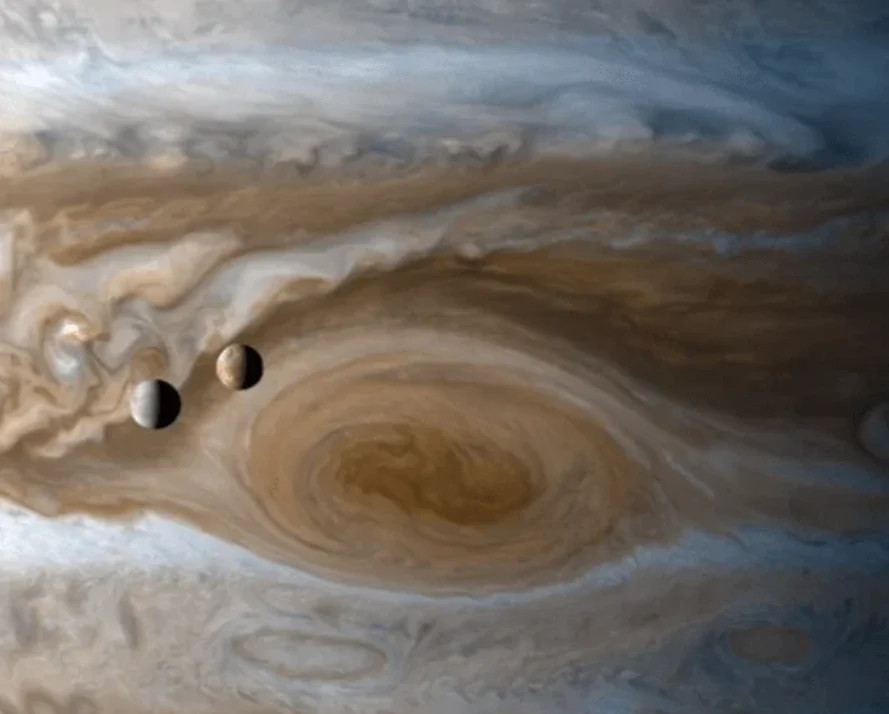
The discovery of the Saturnian decagon has immediate implications for the study of other gas giants, particularly Jupiter. NASA’s Juno mission has previously revealed that Jupiter’s poles are clustered with cyclones arranged in geometric patterns—octagons at the north pole and pentagons at the south pole. However, unlike Saturn’s polygons, which are formed by a single continuous jet stream, Jupiter’s shapes are formed by individual, discrete storms "locking" into place.
By studying the Saturnian decagon, researchers hope to build more robust computer models to explain how solar radiation and internal heat interact to create these shapes. A key question remains: why a hexagon in the north and a decagon in the south? The difference in the number of sides—six versus ten—is likely linked to the depth of the jet stream and the specific wind shear present at different latitudes.
"Specifically, the researchers note how the aid of computer models could help better understand how changing wind patterns and solar radiation influences the development of the polygonal structures on Jupiter," the study authors explained. Understanding the "physics of polygons" helps scientists determine the depth of a planet’s atmosphere. If these structures are rooted deep within the planet, they provide a window into the internal rotation and heat transfer mechanisms of the gas giant.
Future Research and Monitoring
The discovery has prompted a call for increased observation time for Saturn in the coming years. As the decagon appears to be "strengthening," astronomers are eager to see if it will eventually stabilize into a permanent feature like the northern hexagon or if it will dissipate as Saturn moves into its next seasonal cycle.
The OPAL program will continue to play a vital role in this monitoring. With the Cassini mission concluded, Hubble remains the primary tool for high-resolution longitudinal studies of the outer solar system. Furthermore, the James Webb Space Telescope (JWST) may be enlisted to provide mid-infrared data, which could reveal the temperature variations within the decagon’s corners and help determine how deep the structure reaches into the atmosphere.
The international scientific community views the southern decagon as a reminder of how much remains to be learned about the planets in our own cosmic backyard. The fact that a structure of this magnitude—thousands of miles across—could appear in less than a decade highlights the volatile and ever-changing nature of giant planet atmospheres.
As researchers refine their models, the focus will shift toward predicting the next phase of Saturn’s atmospheric evolution. If the decagon continues to migrate and oscillate, it may provide the data needed to finally solve the mystery of why gas giant atmospheres organize themselves into such rigid geometric shapes. For now, the ten-sided storm stands as a testament to the complexity of the universe and the necessity of long-term space observation. The study of Saturn’s south pole is no longer just about a single vortex; it is about a developing geometric marvel that challenges our understanding of planetary physics.